

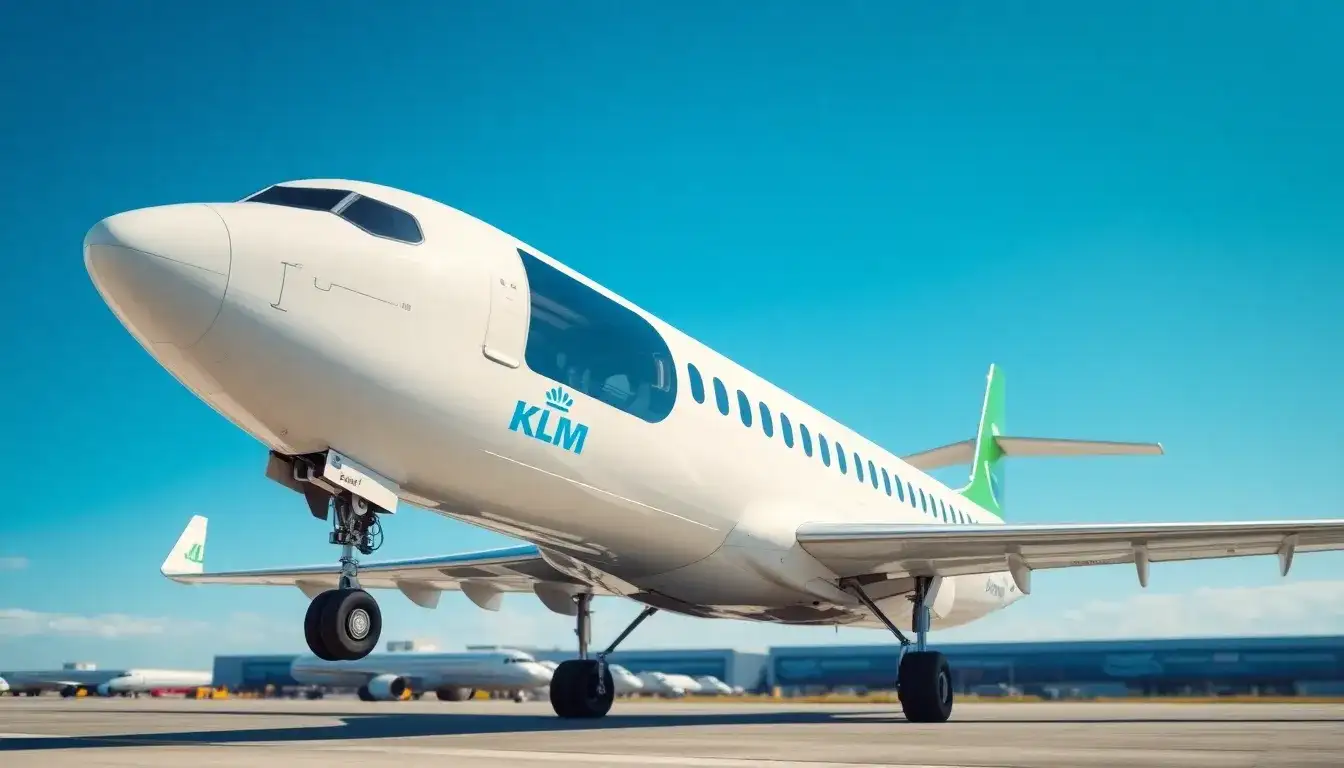
KLM and Transavia Partner with Elysian to Develop Battery-Electric Regional Aircraft and Ecosystems
—
On June 16, 2025, Elysian, a rising Dutch manufacturer of electric aircraft, announced a partnership with KLM and its low-cost affiliate, Transavia. The collaboration aims to advance the development and introduction of battery-powered planes designed for short-range flights.
Elysian is currently working on the E9X, a 90-seat aircraft capable of flying up to 800 kilometers on a single charge. In collaboration with KLM and Transavia, Elysian will investigate the technological, operational, and commercial requirements for this aircraft. Preliminary design and component testing are scheduled for 2026, followed by flight testing and certification in 2030, with full-scale production and entry into service anticipated by 2033.
“It’s impossible to create an aircraft that truly departs from industry norms without extensive collaboration with operators and airports,” stated Elysian’s Co-CEO and Chief Business Officer, Daniel Rosen Jacobson, during the 2025 Paris International Air Show. The event is expected to showcase significant advancements in zero-emission aircraft and powertrains.
The partnership is designed as a knowledge-sharing initiative, featuring joint workshops that will examine all aspects of electric aviation, both in the air and on the ground. This approach aims to ensure the successful introduction of next-generation regional fleets. “This collaboration will provide essential insights ranging from technical requirements to passenger experience and network integration, helping us identify operationally and economically viable destinations,” Jacobson explained. “It’s eye-opening to realize that we can operate more sustainably and cost-effectively than trains, making busy routes like Amsterdam to London entirely feasible with electric flight.”
For years, KLM has operated short-haul inter-city routes within Europe and the UK through its CityHopper subsidiary. The airline has been a significant customer of another Dutch manufacturer, Fokker, utilizing its F27 and F50 turboprops as well as F28, F70, and F100 regional jets. KLM is actively pursuing various initiatives, including the production and use of sustainable aviation fuel and the deployment of electric ground service equipment. The airline’s Climate Action Plan highlights the potential introduction of zero-emission aircraft from the mid-2030s to replace its smallest fossil fuel-powered planes.
“In collaboration with industry partners, we are exploring the potential for flights powered by electricity, hydrogen, and hybrid fuels,” said Jolanda Stevens, KLM’s Zero Emission Aviation Programme Manager. She has been a member of Elysian’s aircraft advisory board since April 2024. “By gaining a deeper understanding of the aircraft’s design and operations, we can contribute our expertise to help shape the final product. Furthermore, this collaboration allows us to envision how our sector can transform.”
Transavia’s Lead for Sustainability and Innovation, Oliver Newton, noted that the electrification of short-haul flights represents a promising direction in which they firmly believe. “Through this collaboration, we can take concrete steps toward sustainable air transport while ensuring commercial and operational feasibility. Connecting technical innovations with customer service, network, and costs presents a challenge, but we are fully committed to this effort.”
Elysian describes the E9X as “the world’s first large-scale battery electric aircraft,” a bold claim given the various delays and redesigns faced by other electric aircraft concepts. These challenges often stem from the immaturity and significant weight of current battery technology, as well as lengthy and costly certification processes. The initial design of the E9X features eight wing-mounted electric engines, each equipped with five-blade propellers, designed to accommodate up to 90 passengers for flights of up to 800 kilometers on a single charge. Elysian is also considering a longer-range version capable of flying up to 1,000 kilometers before requiring a recharge, allowing for one-stop journeys of up to 2,000 kilometers.
In the coming months, KLM, Transavia, and Elysian will conduct studies on use cases, route analyses, and passenger propositions for the E9X, expressing a shared ambition “not only to build a more sustainable aircraft but to create a comprehensive ecosystem around it.” Alongside KLM and Transavia, Elysian’s partners for the E9X include reputable organizations such as Fokker Services Group, the Royal Netherlands Aerospace Centre, the German aviation research group DLR, Delft University of Technology, and Dutch investment group Panta Holdings. The supervisory and advisory board of Elysian also features the CEOs of Fokker Services, Eindhoven Airport, and Air Traffic Control Netherlands, along with former executives from the Dutch National Rail Service and Tesla.
Elysian faces competition from another Dutch regional aircraft startup, Maeve, which recently unveiled preliminary plans for the Maeve Jet, a new hybrid-electric regional aircraft that can seat up to 95 passengers and claims a 40% reduction in fuel consumption compared to current regional jets. Maeve had previously proposed an 80-seat hybrid electric turboprop and a 44-seat version, with further details about the new jet expected soon.

*Tony Harrington*
*Correspondent*
*LinkedIn*
Original article by NenPower, If reposted, please credit the source: https://nenpower.com/blog/klm-and-transavia-collaborate-with-elysian-to-develop-battery-electric-regional-aircraft/

