

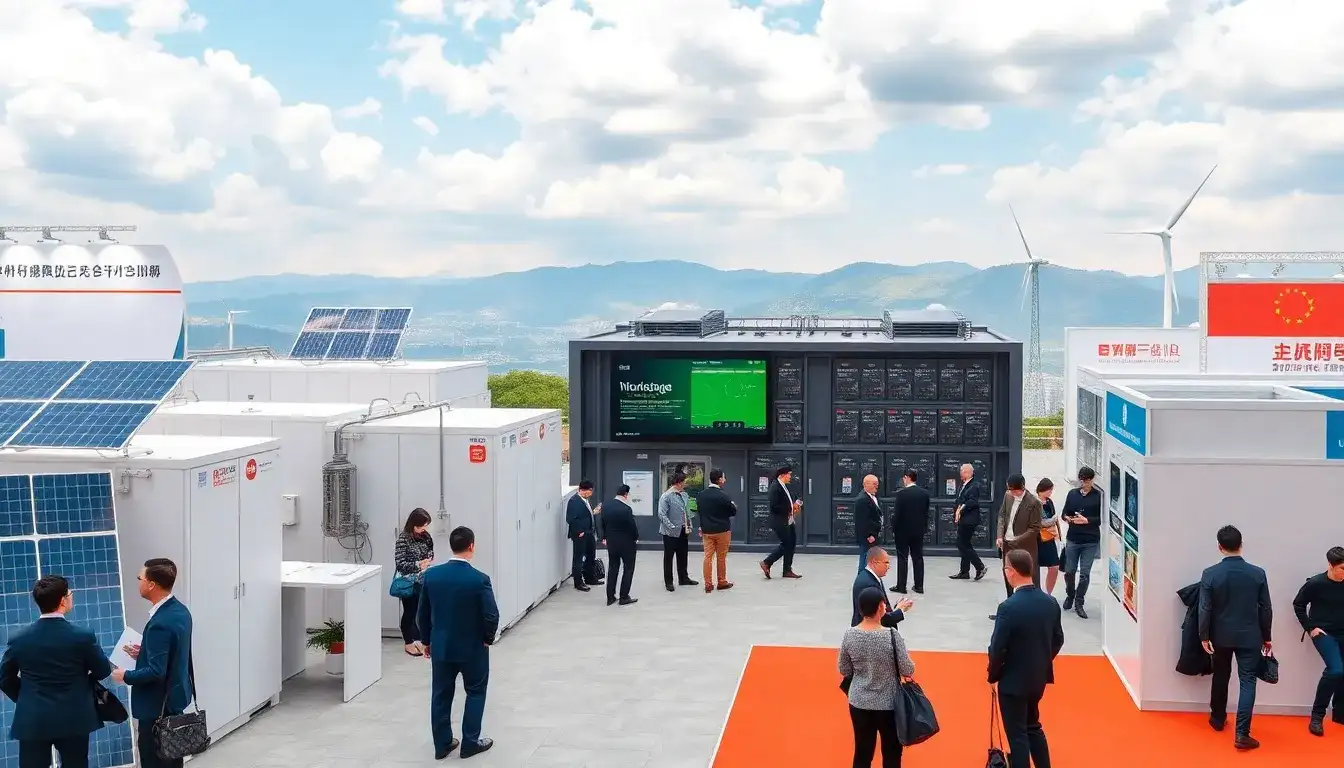
The largest energy storage exhibition in the country recently concluded in Beijing, showcasing significant industry signals. The event, known as the 13th International Energy Storage Summit and Exhibition (ESIE2025), was themed “Digital Intelligence Empowering Industrial Transformation, Energy Storage Reshaping Energy Landscape.” According to the organizer, the Zhongguancun Energy Storage Industry Technology Alliance, nearly 800 exhibitors from both domestic and international energy storage sectors participated, attracting around 100,000 professional attendees. The official online livestream gathered over 2.3 million viewers.
Compared to last year, the number of exhibitors increased by more than 300, while attendance remained steady. The venue shifted from Shijingshan District to Shunyi, but many other changes were also observed at this year’s exhibition.
Despite the high numbers, the overall enthusiasm appeared to be lower than in previous years. The most popular booths were primarily those of major players like Ningde Times (300750.SZ), Sungrow Power Supply (300274.SZ), BYD (002594.SZ), Envision Energy, and Trina Storage, whose brand influence has become more pronounced in the current downcycle of the industry.
Several industry professionals noted a reduced interest in this year’s exhibition, potentially due to the severe market saturation and oversupply affecting the sector. Additionally, this year’s event lacked innovative product launches compared to previous years.
A representative from a storage company remarked, “The excitement around energy storage should temper; the industry has been overheating.” In past exhibitions, companies often emphasized larger capacity cells and storage systems, but this year, there was a noticeable shift towards prioritizing safety, reliability, and longevity.
Data from the exhibition indicated a rise in the proportion of new products related to commercial and industrial energy storage. Companies were increasingly focused on tailored solutions and specific scenarios, particularly highlighting the concept of smart technology among leading enterprises.
On the other hand, sensitivity to energy storage product pricing appeared to decline. Many top-tier storage companies expressed similar sentiments during discussions, despite the ongoing price wars within the industry. The Zhongguancun Energy Storage Industry Technology Alliance previously reported that the average bidding price for a 2-hour energy storage system in 2024 was 628.25 RMB/KWh, a 43% decrease year-on-year. A 4-hour energy storage system recorded a lowest bid of 0.398 RMB/Wh, marking a historic low.
The introduction of new pricing policies for renewable energy at the beginning of the year is gradually shifting the competitive landscape away from solely price-driven strategies. On February 9, the National Development and Reform Commission and the National Energy Administration jointly issued a notice aimed at promoting high-quality development in the renewable energy sector, which has been referred to as Document 136. This document clarified that renewable energy generation would participate fully in market competition, halting mandatory storage requirements.
The removal of mandatory storage means that starting in June, renewable energy projects for wind and solar will no longer need to be paired with energy storage, significantly reducing the policy-driven demand for storage solutions.
From a demand perspective, future energy storage sales must prioritize actual operational efficiency and conditions, ensuring that storage facilities can connect to the grid and participate in market transactions. This will greatly reduce the occurrence of “built but unused” installations.
The launch of Document 136 signifies a transition in the storage industry from being policy-driven to being market-led. Consequently, it was evident at the exhibition that companies, especially the leading ones, are now focusing on how energy storage can generate real financial returns and create substantial value for owners.
According to Wang Kai, the product director at Midea Group’s Kelu Energy Storage, “The past two years saw an overheated market, leading to numerous makeshift manufacturers and continually dropping prices. After Document 136, the industry is shifting from a mentality of ‘I have to build’ to ‘I want to build’ and ‘I will build.’” He emphasized that the essence of energy storage is to earn dynamic revenue, with core competitiveness relying on understanding the power grid and providing integrated solutions.
InfoLink Consulting noted that during the previous phase of mandatory storage, some projects were constructed “blindly” to comply with regulations, revealing significant structural issues such as severe technological homogenization and rapid system efficiency degradation. Moving forward, economic viability and the ability to generate returns over the product lifecycle will become critical indicators of a company’s core competitiveness.
As a result of this trend, domestic energy storage manufacturers are increasingly recognizing the importance of software, such as AI, in enhancing hardware products rather than merely competing at a superficial level. Almost all leading companies featured intelligent platforms or references to “AI-enabled energy storage” in their promotional materials. While some critics allege that certain firms are merely riding the hype, it is undeniable that this is a future trend in the industry.
For instance, Envision Energy unveiled the world’s first intelligent energy storage product, the EN 8 Pro, which incorporates AI capabilities, including a Trade Agent for market transactions and a Grid Agent for network connection. The company claims its multiple dedicated AI models can automatically integrate weather data, market information, electricity price trends, and load forecasts to provide precise predictions of peak and valley pricing.
Tian Qingjun, Senior Vice President of Envision Energy, emphasized that “the precursor to intelligence is automation, followed by artificial intelligence and AI, representing ongoing evolution. Not every company has the capability to develop such solutions, and the market will serve as a testing ground for what companies offer.” He added that as energy storage returns to market value, its business model will heavily rely on trading capabilities.
Furthermore, Envision plans to focus on two main areas for its energy storage products: networking and trading. According to Tian, networking is crucial for the stability of a new power system and involves simulating the inertial characteristics of traditional synchronous generators to address stability issues arising from high proportions of renewable energy integration. With the removal of mandatory storage, establishing a commercial logic through trading will become essential, leveraging intelligence through big data and models to connect software and hardware, with human involvement becoming increasingly supportive.
At the Ningde Times booth, a smart energy management platform named “Tianheng·Smart Storage” was showcased. The company stated that the storage sector is transitioning from “scale expansion” to “value cultivation.” This platform can provide a comprehensive set of standardized capabilities for energy storage stations, encompassing intelligent alerts, operational analysis, performance evaluation, and smart maintenance.
Haibo Technology, which has been emphasizing “AI + Energy Storage” for nearly three years, showcased concepts related to intelligence at this exhibition. Co-founder Shu Peng believes that the relationship between AI and energy storage is a “mutual pursuit,” and as the domestic energy storage sector shifts from strong policy support to independent storage and market-based trading, efficiency, safety, and stability will be the key factors for product success.
Cao Wei, General Manager of Sungrow Power Supply’s commercial energy storage product line, pointed out that the integration of AI and energy storage is driving the industry from an “experience-driven” to an “intelligence-driven” paradigm shift. Sungrow believes that AI technology will reshape the value of energy storage products in three dimensions: precision in energy management, real-time decision-making in dispatching, and optimization of power trading strategies, thereby creating a trillion-level market growth potential.
The timing of the exhibition coincided with the United States’ proposal of what is termed “reciprocal tariffs.” Many industry insiders expressed a cautious outlook, noting that domestic energy storage companies are entering international markets later and with varying levels of readiness compared to solar and other renewable sectors. In the long term, companies may opt for diversified strategies in the international market and proceed cautiously with overseas capacity expansion.
According to Yu Zhenhua, Executive Vice Chairman of the Zhongguancun Energy Storage Industry Technology Alliance, the energy storage industry will face significant challenges by 2025 due to geopolitical tensions, green barriers, and the solidification of competitive technical paths. However, the emergence of new technologies and the acceleration of standardization in China present opportunities for growth.
Regarding emerging markets, Yu highlighted that by 2025, investments in renewable energy in Gulf countries will accelerate, increasing local collaboration opportunities and enhancing competition. Resource-rich countries like Indonesia and Chile may shift from export restrictions to requiring foreign companies to engage with local processing industries, prompting adjustments in overseas investment strategies for Chinese firms.
The Zhongguancun Energy Storage Industry Technology Alliance projects that during the 14th Five-Year Plan period, the annual compound growth rate for new energy storage from 2021 to 2024 will be 121%. By 2025, it is expected that installed capacity will exceed 30 GW. Overall, the annual compound growth rate for new energy storage throughout the 14th Five-Year Plan is expected to surpass 100%.
In conservative scenarios, it is estimated that by 2030, the cumulative capacity of new energy storage will reach 236.1 GW, with a compound annual growth rate of 20.2% from 2025 to 2030. In an ideal scenario, this figure could rise to 291.2 GW, with a compound annual growth rate of 24.5% during the same period.
During the opening ceremony of the exhibition, Bian Guangqi, Deputy Director of the Energy Conservation and Technology Equipment Department of the National Energy Administration, stated that the agency will continue to promote the development of new energy storage technologies and industries, focusing on four main areas: enhancing planning foresight, supporting technological innovation, guiding reasonable resource allocation, and fostering healthy industry development.
Bian also mentioned that the National Energy Administration will accelerate the construction of a power spot market, improve auxiliary service market trading varieties, and collaborate with relevant departments to research and refine pricing mechanisms for new energy storage to foster high-quality development in the sector.
Original article by NenPower, If reposted, please credit the source: https://nenpower.com/blog/key-insights-from-chinas-largest-energy-storage-expo/

