

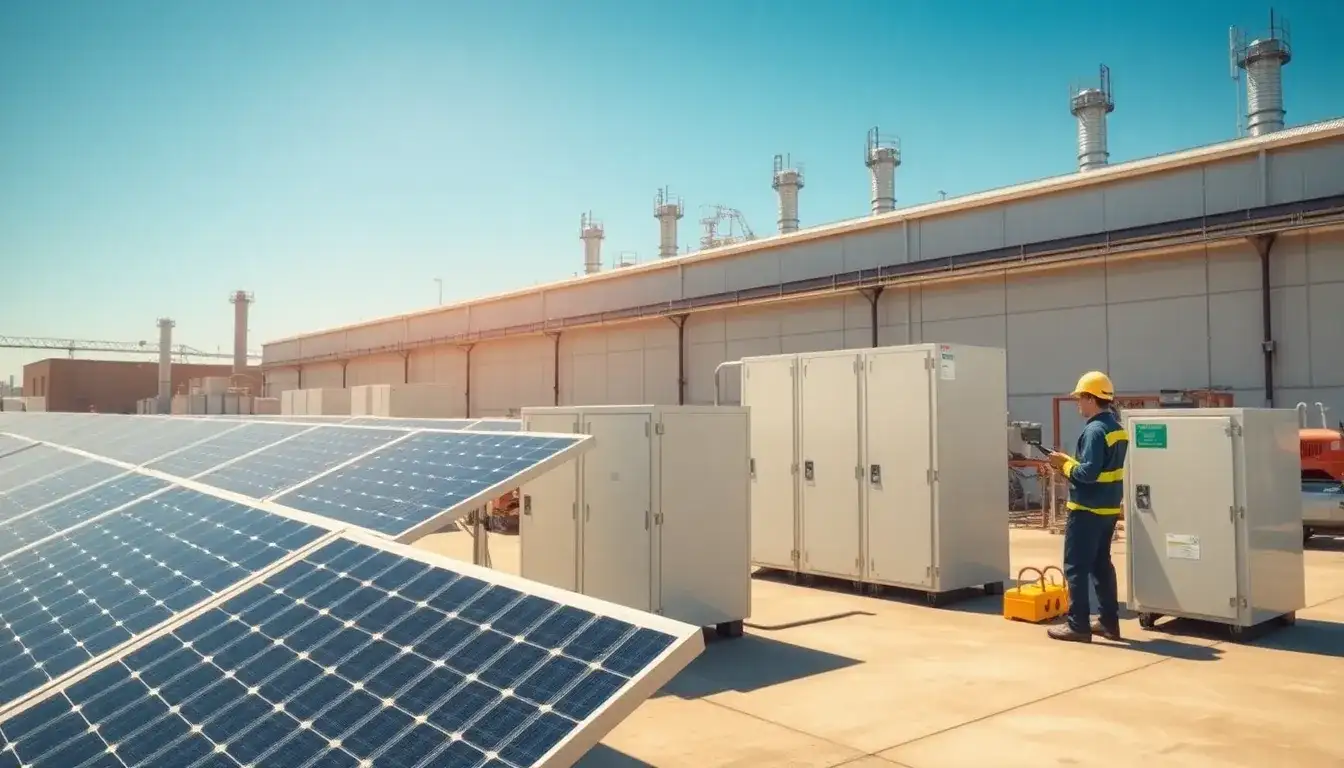
Analysis of Key Points for the Integration of Photovoltaic, Energy Storage, and Charging Solutions in Commercial and Industrial Sectors
This article provides a detailed interpretation of the key design points for the integration of photovoltaic, energy storage, and charging solutions, serving as a reference for the industry.
1. General Principles
- Adhere to the principles of “supply based on demand, balancing supply and demand, maximizing the absorption of renewable energy, and optimizing the utilization of renewable resources.” The installed capacity and output of new photovoltaic systems should meet electricity load demand to the greatest extent possible, with generated power being consumed on the user side.
- Use the “self-consumption of generated power with excess fed into the grid” approach for power access, following the “minimal excess fed into the grid” principle, ensuring that generated power is consumed as much as possible on the user side.
- Prioritize “green power over economic considerations” by configuring power sources with lower cost per kilowatt-hour whenever possible.
- Ensure that new power sources do not disrupt the operation of existing power sources. The output from new power sources should closely match the energy gap and additional load consumption, while any power discrepancies should be adjusted using energy storage, flexible loads, or virtual power plants to maintain the operational level of existing sources.
2. Intelligent Platform
2.1 Solution Description
Under the dual-carbon policy, traditional single renewable energy sources cannot meet the demand for large quantities of low-cost green electricity and carbon credits, especially for energy-intensive enterprises. The implementation of industrial green low-carbon microgrids (integrating renewable energy on the user side) can address multiple pressures and promote commercial models such as peak-valley arbitrage and supercharging services. The proliferation and large-scale application of advanced AI robots, smart photovoltaics, intelligent energy storage, liquid-cooled supercharging, and smart grids are pushing users toward comprehensive renewable energy integration.
2.2 Quantitative Standards
- Define the cost budget range for the platform.
- Specify the functional requirements of the platform.
2.3 Compilation Method
The intelligent operation platform for the photovoltaic energy storage and charging system consists of an integrated solution combining AI robots with hardware and software, featuring highly compatible communication control capabilities. The information exchange capability can extend to the basic components of the power station, enabling energy usage monitoring and intelligent control. The platform uses TCP/IP or serial communication to connect various system components, forming a local communication network structured into three layers: management, scheduling, and execution.
- Management Layer: Responsible for energy management system optimization and control, power forecasting, operational strategy optimization, and system performance visualization.
- Scheduling Layer: Comprising AI robots that provide high-performance computing resources and communication services for photovoltaic, energy storage, charging, and other loads.
- Execution Layer: Includes the fundamental components of the power station, like the photovoltaic generation system, energy storage system, and charging system, monitored and controlled by the platform.
2.4 Deliverables
Technical solutions for the intelligent platform system.
3. Photovoltaic Solutions
3.1 Solution Description
- Position of Photovoltaics: The photovoltaic industry, with its clean and renewable characteristics, has become a crucial player in the 21st-century energy revolution and a key force in the global energy transition. China’s photovoltaic industry has experienced ups and downs, evolving from a follower to a global leader, with total output value skyrocketing from 160 billion yuan in 2008 to over 1.75 trillion yuan in 2023. The country has established a complete global industry chain, significantly aiding the transformation of the global energy structure. Currently, China leads the global photovoltaic market, benefiting from reduced construction costs, increased generation efficiency, policy support, and technological advancements.
- Applications of Distributed Photovoltaics: Rooftops of buildings serve as the primary platform for distributed photovoltaic systems, playing a vital role in layout, safety, and profitability. Assessing rooftop load-bearing capacity is crucial during the initial risk assessment of distributed photovoltaic investments, as it directly impacts project safety and stability. Issues like structural reinforcement for load-bearing and project disassembly due to roof replacement can increase total investment costs and affect economic evaluations. The arrangement of air conditioning, ventilation equipment, parapets, and existing wiring can also impact module layout and overall installed capacity. Furthermore, the legal status of building ownership and necessary licenses directly affect the legality and compliance of the project, making comprehensive and professional rooftop evaluations essential for accurate investment analysis.
- Challenges in Distributed Photovoltaics: For user-side distributed photovoltaic projects, common challenges include:
- Increasing instances of grid overload and difficulty in grid connection, leading to poor compatibility with the grid.
- Mismatch between electricity demand and available rooftops, resulting in lower efficiency.
- Policy demands for further market entry of distributed renewables, alongside decreasing or eliminating subsidies, lead to diminished price expectations and protracted investment recovery periods with various uncertainties.
3.2 Quantitative Standards
- All rooftops and sites must be equipped with photovoltaic panels in accordance with the policies and requirements of local government and grid companies.
- Sites that do not meet fire safety and other principle requirements cannot install photovoltaics.
- All necessary architectural drawings, including building plans, structural diagrams, general layout plans, and electrical diagrams must be provided.
- Clarify whether the rooftop load meets the installation requirements for photovoltaic panels and whether reinforcement is needed.
- Define the arrangement plan, installed capacity, connection scheme, and any potential construction obstacles or special handling needs.
- Ensure that all licenses, including property certificates, are complete.
- Specify the frequency of rooftop maintenance and replacement.
3.3 Compilation Method
- Utilize tools like CAD to create preliminary photovoltaic module layout diagrams based on satellite images, aerial photos, and building plans, in conjunction with standardized atlases to determine installed capacity.
- Use software like Meteonorm and Solargis to obtain solar resource data and determine theoretical annual utilization hours.
- Employ Pvsyst software to establish system efficiency and component degradation based on the latest technological standards.
- Calculate self-consumption ratios using the “Electricity Absorption Analysis Model.”
- Use economic evaluation models for photovoltaic projects to analyze economic benefits, considering practical scenarios to optimize and finalize the photovoltaic configuration plan and economic viability.
3.4 Deliverables
- Economic benefits of photovoltaic systems under varying EPC pricing, determining discount ranges and pricing tiers.
- Identifying owner’s revenue, including cooperation models, discount pricing, partnership duration, annual generation, self-consumption, and average returns.
4. Energy Storage Solutions
4.1 Solution Description
- Role of Energy Storage in Renewable Power Stations: Implementing energy storage systems in renewable power stations can help mitigate issues of curtailed energy and peak shaving. It enhances the accuracy of photovoltaic output forecasting and compliance with regulations, smooths power curves to improve energy quality, and provides auxiliary functions for voltage and frequency support. Energy storage systems enhance operational stability and energy quality in photovoltaic generation while also allowing grid control and energy optimization, facilitating the development of smart grids.
- Applications of Energy Storage: Energy storage can be configured on the generation side to improve energy quality, while on the grid side, it can provide peak shaving services for profitability. On the load side, energy storage in industrial parks, factories, and typical scenarios can capitalize on peak and off-peak price differences to generate profit. Integrated energy storage projects focus on matching supply and demand with various power sources to ensure reliable energy delivery.
- Challenges with User-Side Energy Storage: For commercial and industrial storage, the primary profit model is based on peak-valley arbitrage. Current issues include:
- Low average peak-valley price differences in many regions leading to poor returns on traditional arbitrage models.
- Lower acceptance of energy storage by users and investors compared to photovoltaics.
- Variable peak-valley pricing and purchasing methods from grid companies increase revenue uncertainty, compounded by fierce competition that can lead to project failures.
4.2 Quantitative Standards
- Mandatory energy storage requirements from local government or grid companies must be met.
- Economically reasonable energy storage installation must comply with local policies and grid company requirements.
- Sites that do not meet fire safety and other essential standards cannot install energy storage systems.
- Specify purchasing methods: if not through grid agency purchases, examine the impact of small peak-valley price differences on arbitrage viability.
- All necessary documents, including general layout plans and electrical diagrams, must be provided.
- Verify that all licenses, including property certificates, are complete.
4.3 Compilation Method
- Inquire with the local development and reform commission or power supply bureau to check for mandatory energy storage requirements.
- Review electricity bills to determine if purchasing methods involve grid agency purchases and if the peak-valley price differences are significant (generally, a price difference of no less than 0.7 yuan/kWh is desirable).
- For customers with significant peak-valley price differences, survey to determine if the owner plans to change purchasing methods in the next 1-3 years.
- Survey production patterns through holidays, weekends, and maintenance to determine annual working days.
- Conduct site assessments to identify suitable locations for energy storage installations that meet safety standards.
- Utilize CAD tools and various mapping resources to draft initial energy storage layout diagrams and determine installation positions and electrical access routes.
- Consult the latest time-of-use pricing policies from local governments and grid companies to define operational strategies for 12 months.
- Based on electricity consumption data, calculate the required storage power and capacity, determining operational hours.
- Using project-specific principles, select the maximum effective storage capacity based on usage data.
- Evaluate the overall economic benefits using energy storage project models, analyzing and optimizing configurations accordingly.
4.4 Deliverables
- Economic benefits of energy storage under different EPC prices, determining discount ranges and pricing tiers.
- Identifying owner’s revenue, including cooperation models, discounts, partnership duration, average annual returns, and energy discharge amounts.
5. Charging Solutions
5.1 Solution Description
- Background: China is vigorously promoting electric vehicles and enhancing supporting infrastructure for charging and new energy storage. According to the National Development and Reform Commission and the National Energy Administration, by 2025, the distribution network’s capacity will significantly improve, accommodating approximately 500 million kilowatts of distributed renewable energy and around 12 million charging piles.
- Charging Station Applications: Common scenarios for charging stations include:
- Public Parking Lots: Ideal locations for charging stations due to their convenient access for electric vehicle users.
- Large Shopping Malls: Charging stations can provide services to electric vehicle users while encouraging shopping during charging times.
- Street Parking: Smaller charging stations can be installed in street parking spaces, addressing urban parking difficulties.
- Highway Service Areas: Quick charging stations at highway service areas support long-distance travel for electric vehicles.
- Residential Communities: While slow charging stations can meet daily needs, fast charging stations are crucial in emergencies.
- Enterprises and Office Buildings: Companies can install charging stations in their parking lots for employees and public use.
- Logistics Parks: High-power charging devices can meet the rapid energy needs of logistics vehicles.
- Public Urban Areas: Deploying charging stations in densely populated areas can effectively reduce waiting times.
5.2 Quantitative Standards
- Charging infrastructure must meet local government policy requirements.
- Economically reasonable installation of charging infrastructure must comply with local policies and grid company requirements.
- Sites that do not meet fire safety and other essential standards cannot install charging piles.
- All necessary architectural and electrical diagrams must be provided.
- Ensure that all required licenses, including property certificates, are complete.
5.3 Compilation Method
- Determine requirements for charging infrastructure based on local government policies, including the proportion of parking spaces occupied by charging piles and the ratio of fast chargers.
- Based on site layout, the number and size of parking spaces, and owner requirements, calculate the number of suitable parking spaces for charging pile installation.
- Consult local grid companies to assess existing transformer capacities and determine the total capacity for charging station installations.
- Engage with local traffic management to gather data on electric vehicle ownership and charging infrastructure status.
- Identify existing or planned charging stations through various mapping resources and site surveys to determine charging service fees and utilization rates.
- Assess site suitability for installations based on safety standards.
- Consider factors such as government policies, site space, transformer capacity, owner requirements, and market forecasts to establish preliminary configuration plans for charging piles.
- Utilize CAD tools to create initial charging pile layout diagrams and determine installation logistics.
- Assess charging service prices based on local government and grid company pricing policies.
- Determine preliminary cooperation models with owners based on market conditions and requirements, including leasing terms and profit-sharing ratios.
- Analyze project economic benefits utilizing charging project economic evaluation models, iterating to optimize configurations as necessary.
- For charging stations with external market operations, calculate economic benefits of integrated photovoltaic and storage solutions in accordance with local pricing and usage data.
5.4 Deliverables
- Economic benefits of charging solutions under varying EPC prices, determining profit-sharing ratios.
- Identify owner’s revenue, including cooperation models, profit-sharing ratios, partnership duration, average returns, and charging volumes.
6. Advantages of the Solution
Through the AI-driven integrated solution for photovoltaics, energy storage, and charging, large-scale photovoltaic deployment can take place, maximizing the consumption of low-cost and green electricity, leading to the production of green products. The share of green electricity can reach up to 100%, supporting the orderly construction of zero-carbon parks and actively responding to national production capacity requirements, aiding users in leading the industry towards achieving carbon peak and carbon neutrality sooner.
6.1 Higher Intelligence Upgrade
AI empowers intelligent control over resources, integrating generation, storage, consumption, and sales to achieve a balance of green electricity priority, economic efficiency, and safety.
6.2 Lower Electricity Costs
By reducing user energy consumption on the demand side and generating significant amounts of green electricity on the supply side—almost entirely for self-consumption—more savings on electricity costs can be achieved compared to standalone photovoltaic or storage systems.
6.3 Reduced Carbon Emissions
Maximizing onsite consumption of green electricity enhances energy-saving and emission-reduction benefits.
6.4 More Orderly Interaction
By coordinating energy storage and flexible loads, intelligent control technologies can facilitate friendly interactions with the larger power grid, effectively mitigating risks of power limitations and production cuts.
Original article by NenPower, If reposted, please credit the source: https://nenpower.com/blog/key-considerations-for-integrated-solar-energy-storage-solutions-in-commercial-and-industrial-applications/

