

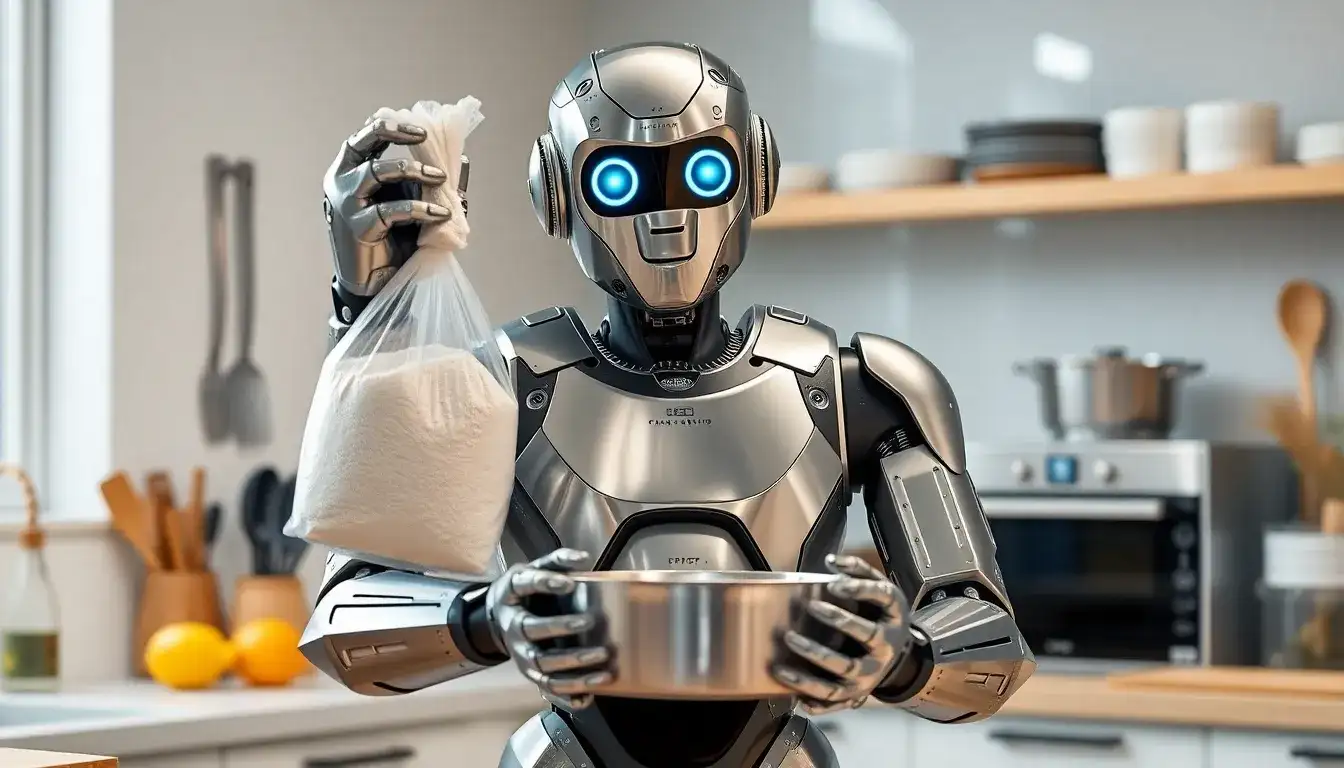
Introducing the versatile humanoid robot, CASBOT 01, capable of lifting weights up to 30 kg, screwing in light bulbs, and even flipping spatulas! Launched on November 13 by Lingbao, which has been operational for just over 300 days, CASBOT 01 marks a significant advancement in humanoid robotics.
In a landscape crowded with robotic products, few have successfully transitioned from research breakthroughs to practical applications. Unlike existing humanoid robots in the market, CASBOT 01 has introduced numerous innovations in both functionality and design. This robot is not only adept at cooking but also assists with household chores, organizes wardrobes, and in its leisure time, plays the piano. Such fluid operations are a testament to the strong foundation laid by its core team, which includes experts from prestigious institutions like the Chinese Academy of Sciences, Tsinghua University, and Beijing Institute of Technology.
In a competitive environment that includes well-known robots like Tesla’s Optimus and Boston Dynamics’ Atlas, Lingbao’s co-founder and COO, Zhang Miao, addressed concerns about the timing of their entry into the humanoid robot market. He emphasized that creating a commercially viable humanoid robot is no easy feat. “We believe that a product must be based on real demand to have the potential for large-scale commercial use,” he stated. The Lingbao team aims for their robot to excel in repetitive, low-cost, and meaningless tasks, thereby helping humans produce more efficiently and create greater value. Their vision is to develop an intelligent new species that fosters a world of smart cohabitation.
What makes CASBOT 01 suitable for these tasks? At the launch event, the Lingbao team provided an in-depth analysis of the robot’s mechanical design, embodied intelligence, and operational capabilities. Standing 179 cm tall and weighing 60 kg, CASBOT 01 resembles an average adult. Its head features two degrees of freedom and is equipped with advanced radar, cameras, and a display screen, enabling dual visual and auditory interaction. The upper body integrates a high-energy-density battery and a core control unit, ensuring a runtime of over 4 hours and efficient computing power. It comes standard with dual batteries, featuring a quick-release backpack structure, where a single battery can achieve effective fast charging in 30 minutes.
The robot’s legs have 6 degrees of freedom, allowing a movement range similar to that of humans. Some joints can achieve a 360-degree range of motion, enabling it to maintain balance while walking on different terrains. The joint design incorporates a proprietary blend of planetary, harmonic, and linear integrated joints, achieving a peak torque density of up to 207 Nm/kg and joint efficiency exceeding 80%. The team explained that CASBOT 01 employs a force control optimization strategy based on current or sensor readings, along with model tracking control and various technical enhancements to ensure high-precision torque control.
Moreover, CASBOT 01 is outfitted with an AI computing unit boasting 550T of processing power, coupled with RGBD cameras, laser radars, and IMUs, enabling real-time visual perception and computation. However, building a humanoid robot is far from straightforward. The Lingbao team faced numerous challenges in mechanical structure design, such as balancing the robot’s extensive range of motion with aesthetic appeal and meeting bandwidth requirements for structural stiffness, particularly given the high demands of bipedal robots.
Through multiple optimizations, the team achieved a balance between movement range and aesthetics. They visually decomposed and abstracted human muscle ratios in the robot’s ID design, enhancing its overall appearance. To ensure structural rigidity while significantly reducing weight, they utilized high-strength metal materials to craft complex curved surfaces, creating reinforced ultra-thin hollow cavities for stability and impact resistance.
A successful humanoid robot not only requires an attractive exterior but also an intelligent ‘brain.’ On this front, Ma Shikui, co-founder and CTO of Lingbao CASBOT, noted that there are various technological pathways in the field of embodied intelligence, each with its advantages and limitations. For instance, while large unified models like RT-2 excel in specific scenarios, they struggle with generalization and role frequency. In contrast, segmented decision models like VoxPoser perform well in general object grasping but falter in tool operation and skill learning. Similarly, models that utilize few-shot learning, like Mobile Aloha, can achieve efficient skill learning, but face challenges in generalization and data acquisition costs.
In response to these challenges, Lingbao CASBOT adopted a layered end-to-end model that separates high computational demand and low decision frequency tasks into the cloud, while keeping high-frequency skill motion planning and closed-loop control on the robot itself. The embodied intelligence system comprises three levels: the top level features a multimodal large model for human-robot interaction and task planning; the middle level employs a multimodal dexterous manipulation model based on a large language model, trained on diverse mixed data for comprehensive robot movement trajectory planning; the bottom level consists of a general motion prior control model that ensures dynamic balance and collision avoidance during skill execution.
For model training, the team first utilized deep learning to recreate a high-fidelity digital twin environment, followed by human expert demonstrations to generate large volumes of high-quality robotic operational data. This data was semantically organized with the help of large language models to train the multimodal dexterous manipulation model. Human experts also provided real-time digital twin demonstrations for unique scenarios, mixing human expert data, simulated synthetic data, and real operational data to enhance the model’s generalization ability. They further augmented the model’s performance using vast quantities of human operation videos from the internet through transfer learning and mixed training.
Equipped with both a ‘body’ and a ‘brain’, it’s time for CASBOT 01 to move. The robot employs a motion control framework that integrates adversarial motion priors with whole-body control, allowing it to execute complex tasks in challenging environments with stability. Specifically, the team generated a digital twin in a simulated environment that matched the robot’s physical properties. They captured extensive human motion data using motion capture technology, filtered and smoothed it to create an optimal dataset for reinforcement learning, enabling the robot to develop highly human-like control strategies.
Focusing on the hands, CASBOT 01 features a dexterous hand that is crucial for its functionality. This five-fingered bionic hand weighs 800 grams and can manage a load of up to 5 kg. Innovations were made in structure, perception, control, and algorithms: the hand employs a compact integrated design and a bionic structure, allowing it to adapt to various loads and sizes. Moreover, a modular drive design combining composite linkages with belt drives enables the decoupling of complex actions.
The perception system of the dexterous hand integrates touch, force, and visual sensors across the fingertips, palms, and other areas, enabling it to achieve a fusion of tactile and pressure perceptions. This multidimensional sensor integration ensures precise interactions with objects and the environment. Through the fusion of diverse information, the team developed an interaction state assessment model, enabling stable grasping of objects with varying shapes and materials while optimizing control algorithms and action planning to mimic human hand flexibility for various operations.
On the algorithmic front, the robot predicts grasp configurations based on object point clouds and constructs datasets for different object categories and grasping labels. The use of a visual language model facilitates general grasp learning algorithms, enhancing the robot’s adaptability to its surroundings, objects, and tasks. This synergy of hardware and software allows CASBOT 01 to achieve rapid learning and generalization in dexterous operations.
Currently, CASBOT is reportedly making significant inroads in fields like emergency rescue operations in aerospace and maritime, industrial manufacturing, and commercial services. Notably, at the end of the launch event, CASBOT 01 introduced a more relatable name—“Wednesday” (the date of release). It also hinted at an exciting development: the upcoming release of the next-generation humanoid robot “CASBOT NEXT GEN” in 2025, featuring advanced technologies like Embodied Brain 2.0 and Visual Foundation Model 2.0 to achieve enhanced efficiency.
Ultimately, Lingbao aims to become a leading global brand in humanoid robotics within the next 5 to 10 years, gradually expanding from the B2B to the B2C market, fulfilling the vision of making humanoid robots an integral part of everyday life. Are you looking forward to this future?
Original article by NenPower, If reposted, please credit the source: https://nenpower.com/blog/introducing-casbot-01-the-versatile-humanoid-robot-capable-of-lifting-30kg-cooking-and-more/

