

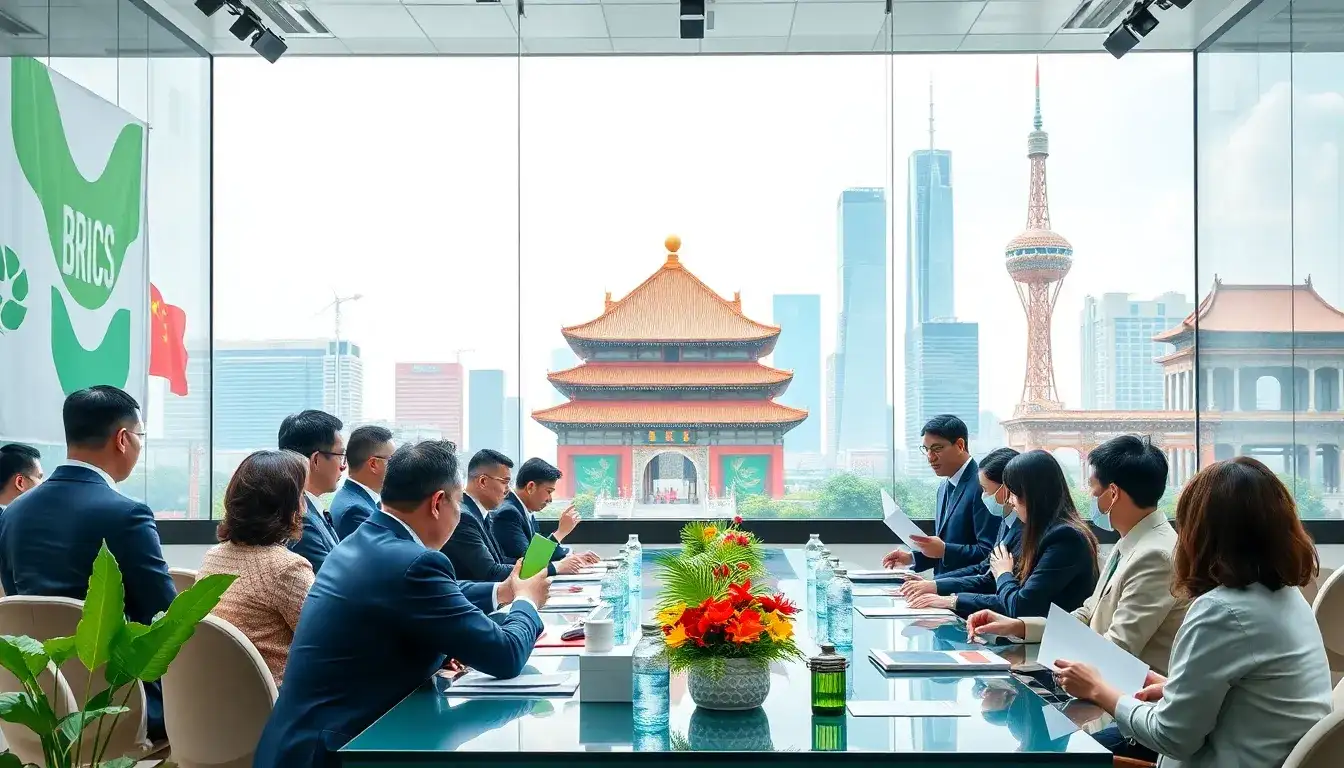
From May 25 to 26, the international seminar titled “Green BRICS, Golden Future” was held in Beijing, gathering scholars and guests from both domestic and international backgrounds to discuss global pathways for green development and collaboration prospects. Key figures at the event included Jin Xin, Assistant Minister of the International Department of the CPC Central Committee and Secretary-General of the Chinese Council for BRICS Think Tank Cooperation, Zhang Donggang, Secretary of the Party Committee of Renmin University of China, Xie Wei, Deputy Secretary of the Party Committee and President of Shanghai Pudong Development Bank, Zhao Han, Vice Chairman of the Haidian District CPPCC and Director of the District Development and Reform Commission, Eleanor Gina Reichel, former Austrian Ambassador to China and Chair of the Global Sustainable Energy Forum, and Gustavo Pedraza, former Minister of Sustainable Development and Planning of Bolivia. The seminar also featured participants from over 20 countries and regions, including BRICS member states and partner countries, including experts from universities and think tanks, business leaders, and media representatives.
In his opening remarks, Jin Xin emphasized that as a vital member of the BRICS cooperation mechanism and the “Global South,” China consistently upholds the concept of a community with a shared future for mankind. He pointed out that China actively promotes collaboration in green development among BRICS nations and advances global sustainable development. He highlighted that think tank exchanges and cooperation play a significant role in building a “Green BRICS.” Jin called for a strengthening of green consensus, the amplification of BRICS voices, and the unification of efforts among BRICS and Global South countries in the realm of green and low-carbon transformation. He also urged the need for enhanced policy research to provide intellectual support for green development in BRICS and Global South nations, as well as pragmatic cooperation to create opportunities for multi-level and multi-field collaboration.
During the keynote speeches, Sergio Queiroz, a researcher at the Brazilian Institute of Applied Economic Research, Amphai Kaewkoun, a senior researcher at the East Asian Institute of Thammasat University in Thailand, and Muritala Okiti, a senior researcher at Nigeria’s National Institute for Policy and Strategic Studies, each delivered impactful addresses. Queiroz highlighted that in the field of artificial intelligence governance, BRICS countries could collaborate on building digital infrastructure, establishing joint research centers, and enhancing technology talent development to achieve inclusive growth and avoid technological monopolies. He expressed hope that the seminar would further deepen practical cooperation among BRICS nations regarding digital transformation and sustainable development.
Kaewkoun discussed Thailand’s proposed “Bio-Circular-Green Economy” national sustainable development strategy, which focuses on four key sectors: agriculture and food, energy materials, health care, and creative tourism. He emphasized that technological innovation can drive industrial upgrades while reducing carbon emissions and enhancing economic value, providing a viable path for sustainable development in developing countries. He expressed hope that the seminar would facilitate international cooperation on green development strategies for inclusive growth.
Okiti noted that Nigeria faces challenges in advancing its national green development strategy, including funding and technology issues. He urged BRICS countries to take a leadership role in establishing green financial facilities, co-building cross-border tech parks, conducting joint research and training, and ensuring inclusive development to lead the global green transformation and turn commitments into action for a fair and sustainable future.
At the conference, the “Global South Green Cooperation Joint Research Project” and the Green Cooperation Workstation were officially launched. Zhao Han, Eleanor Gina Reichel, and other attendees unveiled the Green Cooperation Workstation. This project, led by the National Development and Strategic Research Institute at Renmin University of China, aims to provide recommendations on green transformation and international cooperation under the guidance of the United Nations 2030 Sustainable Development Goals and climate change targets, supporting BRICS and Global South countries in enhancing their green sustainable development capabilities. The Green Cooperation Workstation aims to leverage resources from businesses, talent, and ecological assets, especially in Haidian District, to actively respond to the “Green BRICS” initiative and facilitate collaboration in green industries, clean energy, and green minerals between BRICS and Global South nations, particularly supporting green technology enterprises in Beijing and Haidian District.
The seminar was co-hosted by the Chinese Council for BRICS Think Tank Cooperation and Renmin University of China, with the National Development and Strategic Research Institute of Renmin University organizing the event, and supported by the Haidian District CPPCC, Shanghai Pudong Development Bank, and the China Modernization Research Institute of Shanghai University of Finance and Economics.
Original article by NenPower, If reposted, please credit the source: https://nenpower.com/blog/international-seminar-on-green-brics-and-sustainable-future-held-in-beijing/

