

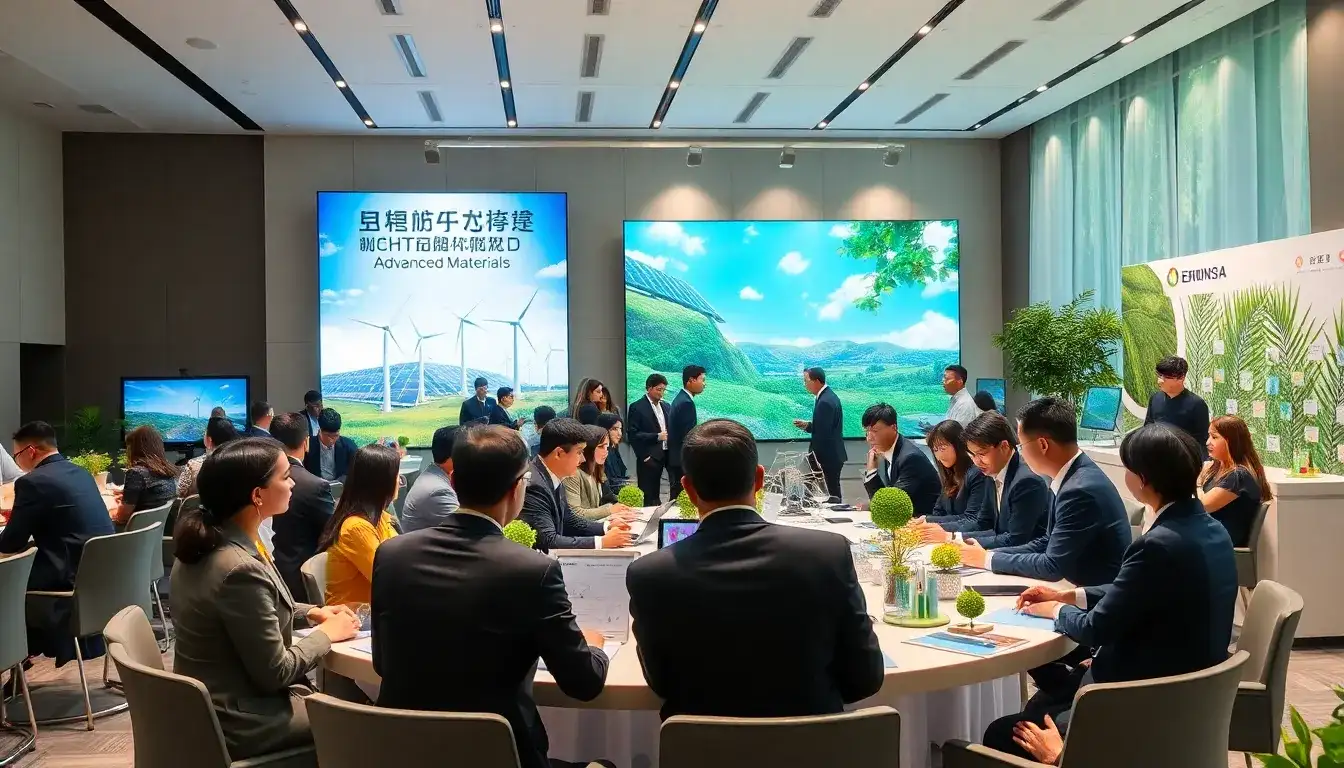
Green Innovation Under Discussion! The 2025 International Symposium on Energy Environment and Advanced Materials was held in Changsha.
From September 20 to 21, 2025, the International Symposium on Energy Environment and Advanced Materials (ISEEMS-2025) took place in Changsha. Over 400 experts, scholars, researchers, and representatives from various countries and regions, including China, Japan, Canada, France, Germany, Thailand, and Indonesia, gathered in this vibrant city to engage in in-depth discussions and collaborations focusing on cutting-edge science and technology in the fields of energy, environment, and advanced materials.
The event was jointly organized by Central South University of Forestry and Technology, Shanxi Chemical Society, Hirosaki University in Japan, and Taiyuan University of Technology, with the School of Materials and Energy of Central South University of Forestry and Technology serving as the host.
The conference was co-chaired by Professor Wu Yiqiang, an academician of the Chinese Academy of Engineering and the Party Secretary of Central South University of Forestry and Technology; Professor Kan Kunqi, an academician of the Engineering Academy of Japan and a professor at Hirosaki University; and Professor Xu Guangwen, an academician of the Royal Academy of Engineering and a professor at Shenyang University of Chemical Technology.
The symposium focused on the efficient utilization of new energies such as hydrogen and biomass, environmental protection, and the development of advanced materials. It covered multiple research areas, including biomass energy conversion, advanced functional materials, energy conversion materials chemistry, catalytic transformation, chemical sciences and environmental engineering, and nanomaterials related to carbon neutrality.
During the keynote session, several renowned experts from both domestic and international backgrounds shared their cutting-edge findings. Researcher Chu Fuxiang, former president of the Chinese Academy of Forestry Sciences, presented a report titled “Thoughts on Technological Innovation in the Wood and Bamboo Industry during the 14th Five-Year Plan”. He discussed strategic considerations for technological innovation in the wood and bamboo sector, emphasizing that replacing traditional fossil materials with renewable wood fiber resources to develop high-value-added bio-based materials and chemicals is crucial for achieving dual benefits in forestry carbon sinks and economic growth.
Professor Orlando Rojas from the University of British Columbia delivered a report on “The Role of Artificial Intelligence in the Transition to a Circular Bioeconomy”, exploring the critical role of AI in this transition and proposing optimization of biomass conversion processes through machine learning and multiscale simulations.
Professor Yongqiang, president of Nanjing Forestry University, presented on “Refining Technology for All Components of Lignocellulose”, highlighting the latest advancements in this area. He stressed that achieving high-value utilization of cellulose, hemicellulose, and lignin through the integration of green catalysis and biotechnology is a core strategy to overcome the industrialization bottleneck of biomass resources.
Academician Wu Yiqiang’s team presented a report focusing on “Scientific Frontiers of ‘Replacing Plastic with Bamboo’“. This report systematically explained the scientific frontiers of this concept and its industrialization pathways, pointing out that the efficient low-carbon processing and functional utilization of bamboo are vital directions for alleviating plastic pollution and achieving carbon reduction. They proposed new ideas for constructing a green manufacturing technology system for the bamboo-based materials industry.
The conference featured six parallel sessions, with over 200 scholars from home and abroad engaging in in-depth discussions on themes such as biomass energy conversion, functional materials, catalytic chemistry, environmental engineering, and nanomaterials, showcasing the latest research advancements and innovations.
Additionally, the symposium included a poster exchange session, providing a platform for young scholars and graduate students to present their research findings and expand collaborative opportunities, which sparked enthusiasm for innovation among young researchers.
The organizers announced that the next ISEEMS conference will be held in Thailand, aiming to continue enhancing its international brand influence and striving to establish it as a significant annual academic event with global impact in the fields of energy, environment, and materials. The initiative emphasizes promoting green technology innovation and sustainable development while contributing wisdom and strength to global sustainability efforts.
Original article by NenPower, If reposted, please credit the source: https://nenpower.com/blog/international-conference-on-energy-environment-and-advanced-materials-in-changsha-promotes-green-innovation/

