

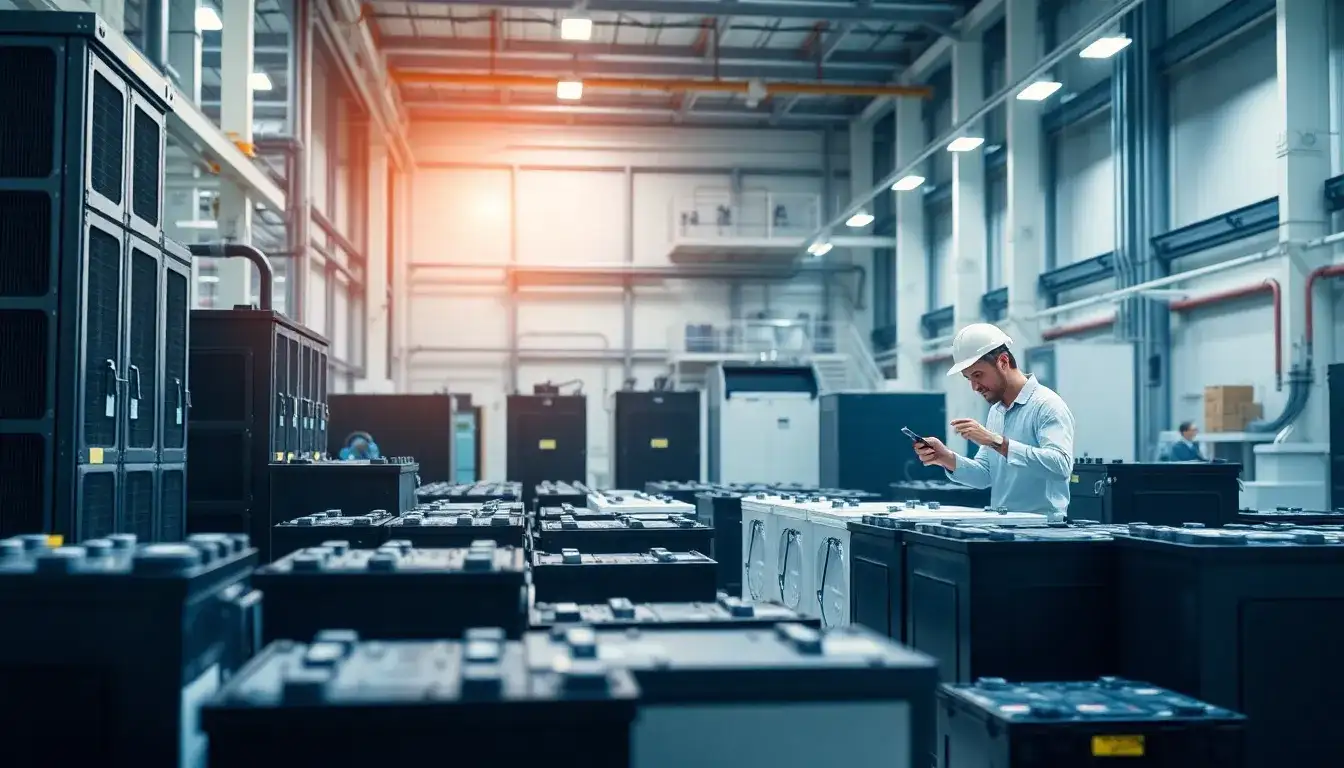
The energy storage industry is entering a highly competitive phase, with both the bidding volume and prices for battery systems declining sharply. Recent data from High Industry Research indicates that in March 2025, the scale of winning bids for energy storage systems fell by 55%, with bidding prices entering what some are calling the “0.3 yuan era“. The price range for successful bids on energy storage system procurements was between 0.368 yuan/Wh and 1.050 yuan/Wh, with an average price of 0.463 yuan/Wh, representing a 21% decrease from the previous month. The lowest bid was recorded at 0.368 yuan/Wh for a direct current energy storage system project.
Over the past two years, the energy storage industry has experienced a significant downturn, attributed to the falling prices of lithium carbonate, structural oversupply of capacity, and companies adopting a strategy of “price for volume.” This has led to a halving of battery cell prices, with system prices dropping below cost and a noticeable compression of EPC costs. As price wars intensify, traditional integrators are feeling the pressure, prompting calls for a return to rational competition. Industry insiders have noted that some integrators are no longer participating in the largest industry trade shows.
The industry’s focus on large capacities is no longer as fervent as last year. Instead, technological upgrades, such as liquid cooling, and diversified application scenarios are now receiving more attention. Meanwhile, the trend of declining prices continues.
Large Capacity is No Longer the Highlight
At the recent ESIE 2025 Energy Storage Expo, several energy storage cell and integrator companies showcased liquid cooling and networked energy storage products. For instance, products included the Sunpower commercial storage family, Yiwei Lithium Energy’s 6.9 MWh energy storage system, BYD’s Cube system, Haibos’s liquid cooling battery pack, Rongjie Group’s 261 kWh commercial energy storage cabinet, Ganfeng Lithium’s 5.02 MWh liquid-cooled prefabricated cabin, and New Source’s fully immersed commercial energy storage unit.
Currently, large capacity and size have become prominent marketing terms and are frequently discussed by industry professionals. Since 2023, energy storage battery products have transitioned from 280 Ah to batteries exceeding 300 Ah. Numerous domestic battery manufacturers, including CATL and Yiwei Lithium Energy, are introducing cells with capacities over 300 Ah, while some companies are even preparing for cells exceeding 500 Ah, 600 Ah, and 1000 Ah. Mainstream integrators are also keeping pace, upgrading the standard 20-foot energy storage systems from under 4 MWh to 5 MWh.
However, the industry’s enthusiasm for larger dimensions is noticeably waning. A staff member at KeLun Electronics noted, “Currently, the mainstream remains at 5 MWh. Commercial energy storage must prioritize safety, with battery cells still primarily at 314 Ah, compared to 280 Ah last year.”
Wang Kai, Director of Energy Storage Products at Midea Group, stated, “In the future, the competitiveness of energy storage products will depend on companies’ deep understanding of the grid and their ability to provide one-stop solutions. While the trend towards larger cells is evident, the critical factor will be the comprehensive strength of companies in R&D, manufacturing, quality control, and after-sales service. Providing high-quality one-stop solutions is key to success in market competition for energy storage companies.” Similarly, He Hongyan, Energy Storage Solutions Manager at XWANDA, remarked, “Larger cells are not always better; we hope for more innovative products. The energy storage industry should not only focus on technological competition but also explore various application scenarios and business models.”
Technological Upgrades
The energy storage industry has dramatically shifted from a profitable landscape to one facing losses over the past two years. The year 2023 marked a rapid expansion for energy storage, with China adding 21.5 GW of new energy storage installations, three times the level of new grid-connected capacity in 2022. It was also a year of intensified competition among energy storage companies. Market data shows a continued decline in energy storage system prices. According to the Zhongguancun Energy Storage Industry Technology Alliance, by December 2023, the average winning bid for energy storage systems had fallen to 0.79 yuan/Wh, a 50% year-on-year decrease, and a 48% decline compared to early 2023, reaching a historic low. Data from Forward Industry Research Institute indicated that the average winning bid for energy storage projects showed a fluctuating upward trend in 2022, with EPC (Engineering Procurement Construction) average bids reaching 2.64 yuan/Wh in December.
The continuous drop in lithium carbonate prices has driven down the costs of energy storage products. However, the escalating price war among energy storage companies is also a significant factor in the declining winning bid prices for energy storage projects. In this fierce competition, it seems that only those with larger-sized products can remain in the game.
By 2025, energy storage technology is undergoing rapid updates, with liquid cooling technology quickly replacing traditional air cooling as the mainstream choice, especially in the commercial energy storage sector, where it is nearly universally adopted. It is reported that liquid cooling directly contacts battery packs through glycol solutions and other liquid media, rapidly transferring heat and reducing temperature differences among cells, allowing for more precise thermal management.
According to a staff member from Inovance (002837.SZ), “Most companies already have air-cooled products; exhibiting air-cooled products now offers no competitive advantage. Compared to air cooling, liquid cooling improves energy consumption and efficiency, with significantly better heat dissipation.” New products are expected to enter mass production, and by 2025, customers will likely prefer liquid cooling products.
Inovance, established in 2005, is a leading manufacturer of cooling solutions and equipment, focused on the temperature control sector, and holds the top position in energy storage temperature control. Over the past decade, Inovance’s revenue and net profit have shown consistent growth, with recent performance increases between 20% and 30%. The latest quarterly report indicates that Inovance achieved a revenue of 2.872 billion yuan in the first three quarters of 2024, up 38.61%, and a net profit attributable to shareholders of 353 million yuan, an increase of 67.79%.
A representative from Hemai Co. (688032.SH) shared, “While some air-cooled PCS still exist, air-cooled direct current battery containers are nearly obsolete due to poor thermal efficiency and high temperature requirements for battery charging and discharging. As a result, nearly all have transitioned to liquid cooling, which may cost about 20% more than air-cooled containers.”
Low Prices Remain a Choice
As technological upgrades continue, the trend of low prices persists. In 2024, the energy storage industry chain price continued the downward trend from 2023, with prices for battery cells, systems, and EPC reaching historical lows. The average price of energy storage cells fell from 0.9 yuan/Wh at the beginning of 2023 to 0.3-0.4 yuan/Wh by August 2024. The average winning bid for 2-hour energy storage systems dropped from 1 yuan/Wh in 2023 to below 0.6 yuan/Wh by August 2024, with some direct current systems priced as low as 0.58 yuan/Wh. Additionally, the average winning bid for lithium battery storage EPC fell to 0.8 yuan/Wh.
In March 2025, data from High Industry Research showed that the winning bid price range for energy storage EPC projects was between 0.566 yuan/Wh and 1.433 yuan/Wh, with an average of 1.027 yuan/Wh. The procurement of energy storage systems has entered the “0.3 yuan era“, with a winning bid price range between 0.368 yuan/Wh and 1.05 yuan/Wh, averaging 0.46 yuan/Wh, which is a 21% decrease from the previous month.
At KeLun Electronics, several signs reading “0.588” were displayed at their commercial energy storage cabinets. Staff informed that this price applies to orders of at least 20 units, covering equipment and installation costs, using Ruipu Lanjun (0666.HK) cells. If using CATL cells, the price would be about 0.65. Korin Electric (6603050.SH) presented a new 135 kW/261 kWh liquid-cooled energy storage cabinet, publicly quoting the lowest price of just 0.568 yuan/Wh. For some companies with costs around 0.6 yuan/Wh, this price has already dipped below their cost.
In conclusion, the energy storage industry is navigating a challenging landscape marked by price wars and technological upgrades, leading to a rapid restructuring of the market. Moving forward, companies that can effectively control costs, establish technological barriers, and implement global strategies will be better positioned for resilience.
Original article by NenPower, If reposted, please credit the source: https://nenpower.com/blog/intensifying-competition-in-the-energy-storage-industry-price-and-quantity-decline-in-battery-systems/

