

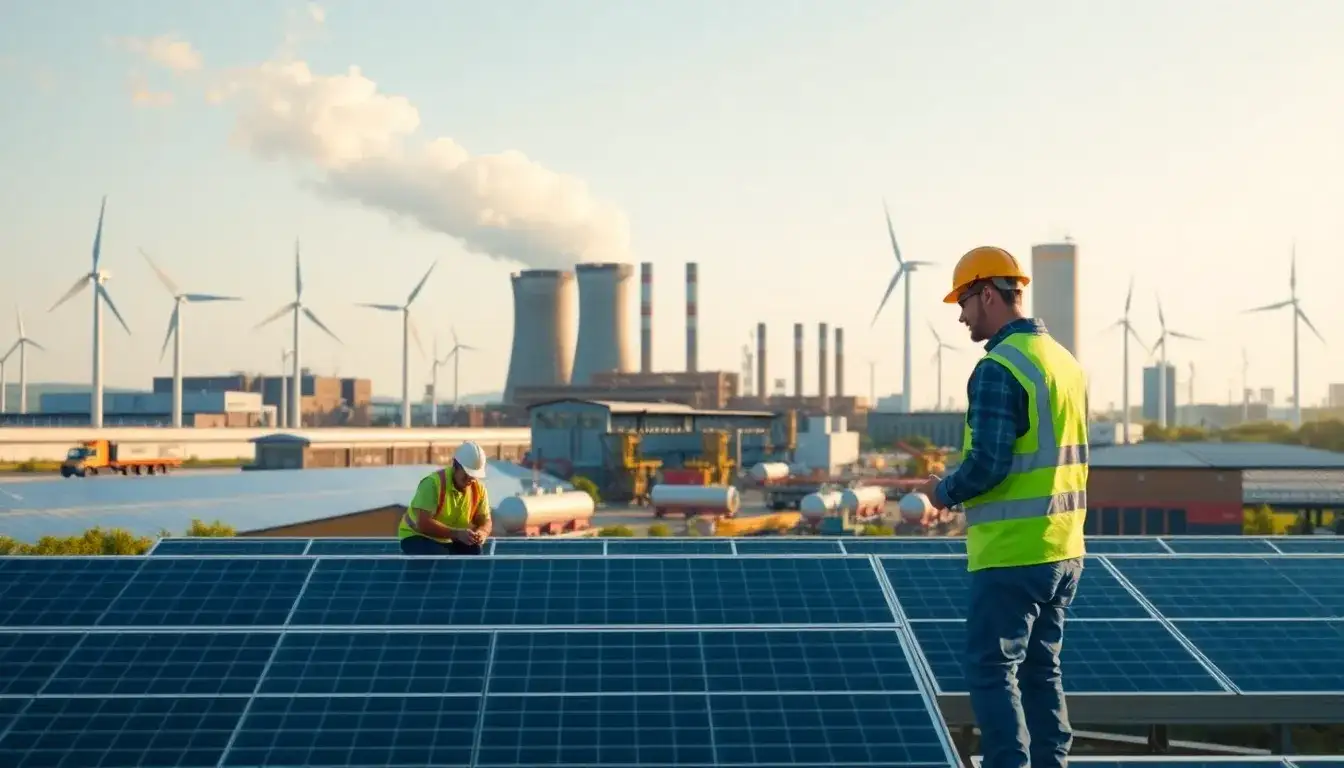
Integrated Source-Grid-Load-Storage (SGLS): Best Practices for Energy Challenges in Industrial Parks
With the recent adjustments in time-based electricity pricing and the advancement of electricity market reforms, the revenue-generating capacity of distributed photovoltaics and commercial energy storage has faced significant challenges. These policy changes highlight the true implications and urgent needs of the SGLS framework in the industrial and commercial sectors. Huawei has once again positioned itself at the forefront of the industry, providing a model solution in Jiangsu Province to realize the practical implementation of SGLS in commercial and industrial settings. As they face revenue challenges, SGLS has become a key choice for the industry.
In recent years, electricity consumption in China’s industrial and commercial sectors has been on a steady rise. According to the latest data from the China Electricity Council, the average daily electricity consumption across society for the first quarter of 2025 increased by 3.7% year-on-year, particularly within high-tech and equipment manufacturing industries. Notably, the electricity consumption in the manufacturing of new energy vehicles surged by 40.6%, while the power consumption in the wind energy equipment manufacturing sector rose by 46.4%. Amid the drive toward carbon neutrality, these high-energy-consuming enterprises are entering a phase of accelerated transformation. To expedite their transition to a green, low-carbon model, many opt to invest in distributed photovoltaics to enhance their use of green electricity. However, several challenges still persist in energy utilization within these parks, notably three key aspects.
Firstly, the changes in macro policies have increased revenue uncertainty, propelling the rapid implementation of SGLS integration. The newly released guidelines for the development and construction management of distributed photovoltaics have established requirements for both large-scale and general commercial photovoltaic grid connections. In some provinces, the introduction of new low-cost midday electricity pricing could potentially decrease photovoltaic revenue by more than 20%, while adjustments in peak and valley pricing have introduced further uncertainty in the profitability of commercial energy storage. Therefore, promoting distributed photovoltaics through SGLS integration to increase self-consumption rates and participating in electricity trading and grid scheduling through virtual power plants has become a primary development model in the industrial and commercial sectors.
Secondly, the safety of photovoltaic and storage equipment poses a risk to asset and energy utilization security in these parks. Currently, numerous companies produce solar and storage equipment with varying quality, leading to frequent safety incidents such as thermal runaway in storage, photovoltaic fires, or electric vehicle fires due to charging station malfunctions. The rapid expansion of photovoltaics has intensified grid fluctuations and increased system adjustment pressures, potentially causing grid overloads in certain areas due to capacity bottlenecks. Additionally, new energy plants urgently need to enhance their cybersecurity measures to prevent user privacy breaches or cyberattacks that could result in widespread power outages.
Thirdly, the low level of digitalization in energy management within these parks cannot meet the demands for efficient operation and future virtual power plant intelligent scheduling. Currently, most parks manage their energy equipment in a decentralized and inefficient manner, leading to high costs and inaccuracies in manual inspections during later operational phases. Furthermore, the low digitalization level results in isolated operations of solar, storage, and charging equipment, with single profit models for distributed photovoltaics or commercial energy storage leading to low utilization rates and poor overall benefits. With the push for electricity market reforms and the advancement of spot electricity markets, parks urgently need to achieve precise control over comprehensive energy management through a unified platform, allowing virtual power plants to aggregate distributed energy and load resources to participate in electricity markets. This can help enterprises optimize their electricity usage structure, reduce costs, and enhance operational efficiency in solar, storage, and charging, ultimately supporting carbon reduction goals.
Beyond the industrial electricity users in high-energy parks, the transportation sector is also undergoing a crucial low-carbon transition. The large-scale and uncoordinated charging of electric vehicles can significantly expand the peak-to-valley load difference in distribution networks and exacerbate power fluctuations, potentially leading to transformer overloads and other risks. This reality creates market opportunities for the “integrated solar-storage-charging” model and calls for enhanced collaborative capabilities in SGLS to steadily increase local energy consumption ratios.
Thanks to strengthened policies and deeper integration within the electricity industry chain, the SGLS integration model is rapidly advancing toward a scaled and market-oriented phase. To date, Henan Province has announced nine batches of integrated SGLS projects, totaling 415, with plans to establish over 1,000 demonstration projects by 2027. This year, Shandong Province also released pilot implementation guidelines and project lists for SGLS integration, promoting four models: local consumption, green electricity trading, virtual power plants, and distributed self-consumption.
As a major player in the new energy sector, Jiangsu is leading the way with the release of guidelines for zero-carbon park construction. These guidelines emphasize the need to accelerate the digital and intelligent development of microgrids in parks, enabling the reasonable integration of new energy, loads, and storage into microgrids. The coordinated operation and hierarchical control of main grids, distribution networks, and microgrids will facilitate the aggregation and regulation of new energy, loads, and storage in industrial parks. This requirement also promotes the practical realization of SGLS in the commercial sector.
As parks face energy challenges, entering the SGLS sector has become a new opportunity in this era. The integration of solar and storage, along with collaborative scheduling, presents an upgraded test for SGLS, linking all aspects of the electricity system from generation to consumption. Transitioning the electricity system from “supply-driven” to “source-grid-load-storage” requires enhancing the collaborative operational capabilities of various power sources integrated with solar and storage while ensuring the stable and safe operation of the system. This transformation represents a comprehensive shift in both technology and market dynamics.
Recently, at the 2025 Huawei China Digital Energy Innovation Summit held in Jiangsu, Huawei Digital Energy launched its integrated SGLS solution for commercial and industrial applications. According to Cai Xu, Head of Huawei’s Intelligent Photovoltaic Commercial Expansion Department, this solution aims to achieve utmost safety and long-term profitability, empowering parks toward low-carbon transformation. From the source perspective, the inherent volatility and consumption challenges of distributed photovoltaics require effective energy storage solutions to mitigate these issues. Huawei’s solar-storage integration solution maximizes self-consumption rates, particularly as reforms in photovoltaic electricity trading and the advancement of spot electricity markets progress, enhancing lifecycle operational profitability.
However, to achieve significant operational gains, the quality of photovoltaic and storage equipment must be robust. As a critical support for bidirectional energy transfer, energy storage must exhibit high reliability and greater operational efficiency. Huawei has previously launched the world’s first wind-liquid intelligent cooling commercial energy storage product, allowing the storage system to adaptively adjust based on environmental temperatures, switching among three operating modes: “active liquid cooling + natural air cooling + waste heat utilization.” This can reduce auxiliary power losses by 30%, significantly improving energy storage system efficiency. Additionally, it ensures higher reliability in power supply, better power quality, and stronger load capacity, supporting high-quality electricity usage across various scenarios.
Furthermore, the latest round of reforms in the electricity market has opened new revenue channels for new entities like virtual power plants, necessitating energy management platforms with intelligent scheduling and efficient response capabilities. This is to support the aggregation of distributed photovoltaic and storage resources into virtual power plants, enabling real-time responses to grid peak shaving and frequency regulation services to maximize revenue. In this regard, Huawei, leveraging its big data and AI algorithms, has partnered with collaborators to introduce an intelligent energy management platform that coordinates precise scheduling of various energy sources, optimizing electricity usage automatically and maximizing resource value for owners and parks alike.
As a pioneer in the new energy sector, Jiangsu has initiated multiple pilot projects across various energy fields. Huawei has partnered with China Huadian Corporation Jiangsu to establish a model case of SGLS integration in Wucheng, Changzhou. This park, representing the next generation of industrial zones, hosts a variety of technology enterprises, particularly in intelligent manufacturing and new materials, which face dual challenges of high electricity costs and low-carbon transformation. By implementing Huawei’s integrated SGLS solution, the park has successfully transformed into a “zero-carbon park.” The park has installed 1.28 MW of photovoltaic capacity, 1.08 MW/2.15 MWh of storage, and a full liquid-cooled ultra-fast charging system. The integration of these resources, facilitated by Huawei’s solutions, matches the energy demands of the park with precision. Furthermore, with AI technology, overall project profitability has increased by another 10%, setting a benchmark for digital and intelligent transformation in parks.
This project has received high praise from investors. According to Xia Wei, General Manager of Jiangsu Huadian Energy Sales Co., Ltd., the project is expected to generate 1.7 million kWh of green electricity annually, achieving nearly 100% self-consumption through solar-storage collaboration. Notably, in the Wucheng case, Huawei also utilized its liquid-cooled ultra-fast charging technology to promote green electricity consumption through the integration of solar and storage with charging stations. The addition of storage has reduced the need for electricity capacity expansion for charging facilities, establishing a well-practiced model for integrating solar, storage, and charging.
Simultaneously, Huawei is strategically aligning itself with the green electricity development trends in Jiangsu, expanding its focus beyond intelligent photovoltaics to also include intelligent charging networks and AI data centers. Earlier in 2023, Huawei participated in building Jiangsu’s first urban “solar-storage-charging” demonstration charging station. This station features five sets of Huawei’s full liquid-cooled ultra-fast charging equipment, with two 600 kW ultra-charging guns and 54 250 kW ultra-charging guns, accommodating charging needs for 56 parking spaces simultaneously. The technology employed supports a charging platform from 200 to 1000V, enabling a “one second per kilometer” charging experience. Moreover, Huawei’s smart photovoltaic technology allows the photovoltaic canopies to supply approximately 240,000 kWh of green electricity annually, with the accompanying storage system facilitating the consumption of green energy for new energy vehicles while flexibly utilizing peak and valley pricing to enhance operational profitability for charging stations.
Currently, Huawei Digital Energy is collaborating with a growing number of upstream and downstream enterprises and solution partners to promote the implementation of the “solar-storage-charging” model across the nation, fostering the green low-carbon development of the transportation sector. Now, with AI igniting the digital economy, computational power has become the core driver of social development and economic growth, while the energy consumption and carbon emissions of data centers have become increasingly prominent issues. Consequently, establishing green data centers has become a focal point for addressing these challenges. An example is the Changzhou campus of Hohai University in Jiangsu, where Huawei provided a comprehensive solution encompassing “architecture optimization, smart equipment, and platform construction.” This included two 600K modular UPS5000-E systems, six sets of FusionModule2000 intelligent micro-modules, 92 cabinets, and 18 precision air conditioning units, simplifying structures for easier operation and maintenance while meeting green environmental requirements and achieving efficient energy-saving low-carbon goals. The prefabricated and micro-module nature of the equipment also ensured rapid project delivery, helping to establish a stable, reliable, secure, fast, and flexible campus network.
In conclusion, 2025 is a critical milestone for the country to achieve its carbon peak and will serve as a benchmark for assessing the optimization of energy structures and innovation capabilities in green low-carbon technologies. At this significant juncture, Huawei is accelerating the practical application of zero-carbon parks through its mature technological systems and innovative approaches, advancing its comprehensive SGLS integration solutions to facilitate the green transition across various industries.
Original article by NenPower, If reposted, please credit the source: https://nenpower.com/blog/integrating-energy-sources-best-practices-for-addressing-power-challenges-in-industrial-parks/

