

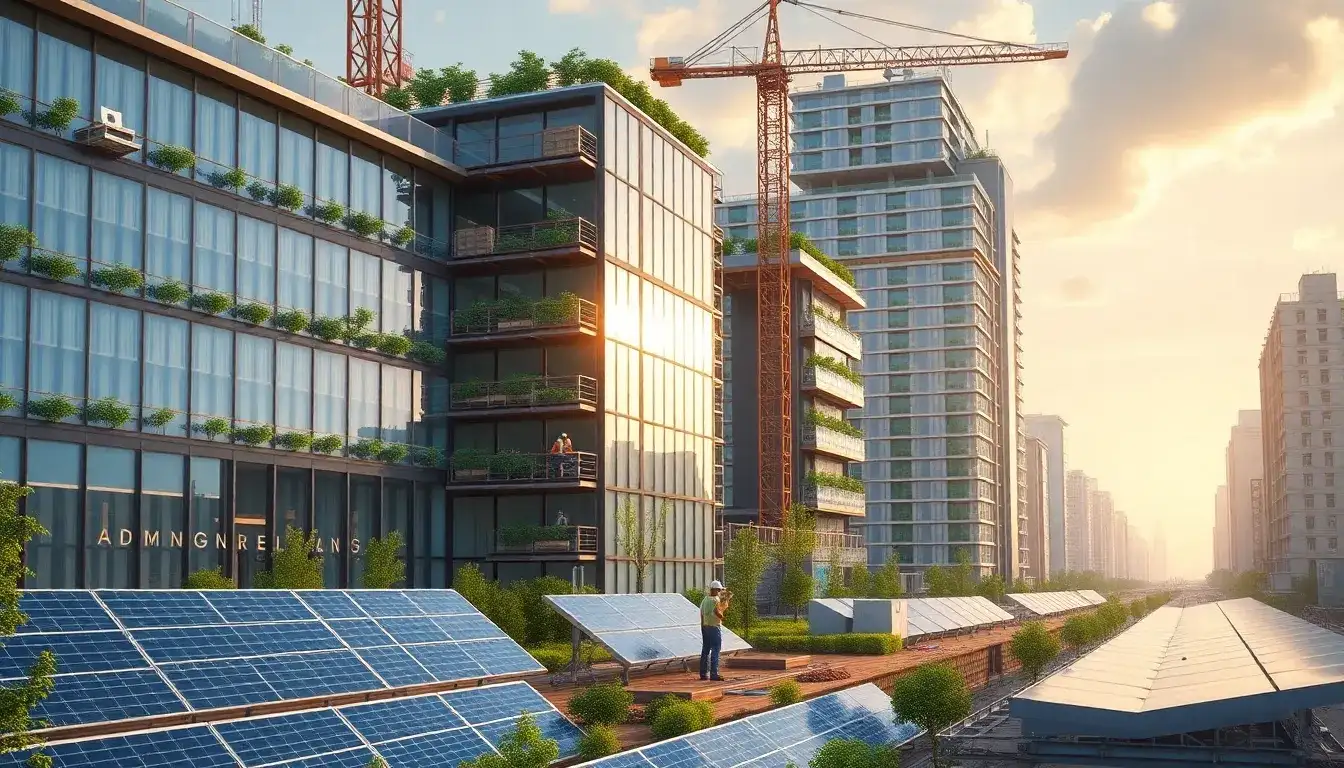
High-Growth Enterprises | China Railway Hualian: Merging Construction and Photovoltaics to Create Urban “Green Power Plants”
As a major manufacturing city, Dongguan is home to numerous industrial enterprises with factories densely packed. A key topic of interest has been how to “awaken” industrial rooftops to generate both social and economic value. In the current context of a slowing real estate market, many construction companies are seeking new paths for development. Distributed photovoltaic (PV) systems have emerged as a favored new sector in recent years, buoyed by strong policy support that has led to a broadly optimistic outlook for the distributed PV market.
Latest figures indicate that by the end of 2024, the cumulative installed capacity of distributed PV generation will reach 370 million kilowatts, a staggering 121 times the capacity at the end of 2013, accounting for 42% of the total installed PV capacity. This forecast undoubtedly sparks enthusiasm among market participants and investors.
For construction companies venturing into the distributed PV sector, standing out in a competitive market requires a mature industrial chain. As a specialized and innovative enterprise in Guangdong Province, China Railway Hualian Construction Engineering Co., Ltd. (hereafter referred to as “China Railway Hualian”) has accelerated its involvement in the green energy sector. Its subsidiary, Huajing New Energy, has established a complete industrial chain for the construction of distributed PV projects, offering an integrated solution that spans design, project approval, acceptance, and operation.
Currently, China Railway Hualian has deployed distributed PV power stations in various industrial parks nationwide, with this new business rapidly increasing its share of the company’s total revenue, making distributed PV power stations the company’s “second growth curve.”
Exploring Cross-Industry Collaboration between Construction and Photovoltaics
PV generation can be categorized into centralized and distributed systems, with both currently developing in tandem. Distributed PV generation has become a significant force in the energy transition. In recent years, distributed PV in China has grown rapidly, becoming increasingly cost-effective, with development scales reaching new heights and achieving large-scale leapfrog development. This has played a vital role in ensuring reliable electricity supply, promoting green energy transition, and providing increased income and employment for farmers.
Data shows that by the end of 2024, the cumulative installed capacity of distributed PV generation in China will reach 370 million kilowatts, a remarkable 121 times the figure from the end of 2013, and will account for 42% of all installed PV generation capacity, up from just 16% in 2013. In terms of generation volume, distributed PV is expected to produce 346.2 billion kilowatt-hours in 2024, representing 41% of total PV generation.
While construction and PV power stations may seem unrelated, they are closely linked. The installation of solar PV power stations requires high-quality construction teams, effectively bringing the two industries together. Since its establishment over a decade ago in Dongguan, China Railway Hualian has focused primarily on the construction sector, holding 18 secondary qualifications in areas such as general contracting for construction, municipal public works, and electromechanical engineering, earning a solid reputation in the local construction industry.
In terms of project achievements, China Railway Hualian has successfully completed a series of representative projects, including the new factory for Xu Fu Ji in Dongguan and the Citizens’ Home in Ningxiang, covering various fields such as building construction, municipal works, and installations. With its exceptional engineering quality, the company has gained high recognition and praise from clients, gradually establishing a strong brand image in the industry and evolving into a specialized and innovative enterprise in Guangdong Province.
“Although we were not initially familiar with PV technology, the necessary civil engineering and electromechanical skills for PV projects are our strengths. So why not try to undertake them ourselves?” says Fu Zheng’an, General Manager of China Railway Hualian. The company boasts a strong R&D team dedicated to the research and application of construction engineering technologies. To date, it has obtained 21 patents, which have effectively improved engineering quality and construction efficiency during projects, becoming one of the core driving forces behind the company’s growth.
Fu Zheng’an further explains that distributed PV has the advantage of local development and utilization, making investment in PV projects a new direction for China Railway Hualian. Instead of immediately launching projects, the company invested significant time in understanding the PV industry, from initial approvals to the brand and channels of PV components, as well as post-operation maintenance. They even conducted detailed research on designing and building PV rack systems.
“From a developmental perspective, the price of PV components has fallen from around 5 yuan per watt in 2013 to approximately 0.7 yuan per watt now. New energy, including distributed PV, has fully entered a market development stage with no subsidies and competitive pricing,” says Fu Zheng’an. He also acknowledges that distributed PV faces challenges such as limited grid connectivity, increased risks to the safe and stable operation of power systems, and an incomplete rule system for participating in power market transactions. Notably, with the explosive growth of distributed PV generation in recent years, grid connectivity has become a primary constraint to development, necessitating adjustments in management strategies and exploration of collaborative synergies among sources, networks, loads, and storage to promote the rapid and healthy development of distributed PV.
Launching the Company’s “Second Growth Curve”
Chairman Wu Lijun indicates that, against the backdrop of intensified industry competition and an almost saturated market, the company has turned its attention to the more promising new energy sector. The management team has keenly identified the tremendous potential and opportunities in the renewable energy industry, particularly within the realms of distributed PV generation and energy storage. Unlike most competitors, China Railway Hualian has narrowed its focus on the industrial park sector for distributed PV power stations, as this is the customer group it knows best.
Wu Lijun believes that gaining a competitive edge in the distributed PV field hinges on maximizing returns through scientific site selection, optimized designs, and efficient operations. Currently, China Railway Hualian has established its subsidiary Guangdong Huajing New Energy Co., Ltd. and is engaging in close collaboration with industrial parks in Dongguan and surrounding cities, actively seeking longer-term contracts. Based on calculations from China Railway Hualian, a 1 megawatt power project with an investment of 3 million yuan can have a lifespan of 25 years, with a payback period of just 3.5 years.
To date, China Railway Hualian has developed a specialized management team of over 30 people for PV generation projects. Wu Lijun states that following the listing of the company on the Guangdong Equity Exchange on January 8, 2025, the pace of development in the new energy sector has accelerated further. Leveraging its rich experience and advantages in construction, China Railway Hualian is vigorously advancing the construction of distributed PV projects, with expectations that Huajing’s business volume will exceed 30 million yuan by 2025.
The company’s business structure is also being optimized, with distributed PV power stations being deployed across various industrial park partners nationwide. The new business’s share of total revenue has rapidly increased, with distributed PV power stations now constituting 30% of total revenue. Once operational, intelligent operation and maintenance management are essential. On a smart display screen at China Railway Hualian, intuitive bar graphs and various real-time data continuously inform managers of the power station’s operational status.
In terms of capacity planning, China Railway Hualian has set clear goals, aiming for an installed capacity of 50 megawatts by 2025, 100 megawatts by 2026, and striving for 200 megawatts by 2027. Throughout the implementation of new energy projects, the company has established long-term stable partnerships with upstream and downstream enterprises, exploring a collaborative model that emphasizes complementary advantages and resource sharing, thereby creating a comprehensive new energy industrial chain.
Through ongoing exploration, China Railway Hualian has established a complete industrial chain for PV project construction, from design and approval to acceptance and operation. The company is now focusing on diversifying its new energy business, actively expanding into sectors such as PV energy storage stations, smart charging stations, and regional centralized energy stations, striving to develop into a comprehensive service provider for PV new energy system solutions.
“In the future, China Railway Hualian will leverage its core construction business while expanding into emerging industries like new energy and new materials to accelerate its transformation and upgrade,” says Wu Lijun.
Original article by NenPower, If reposted, please credit the source: https://nenpower.com/blog/integrating-construction-and-solar-energy-china-railway-hualians-vision-for-urban-green-power-plants/

