

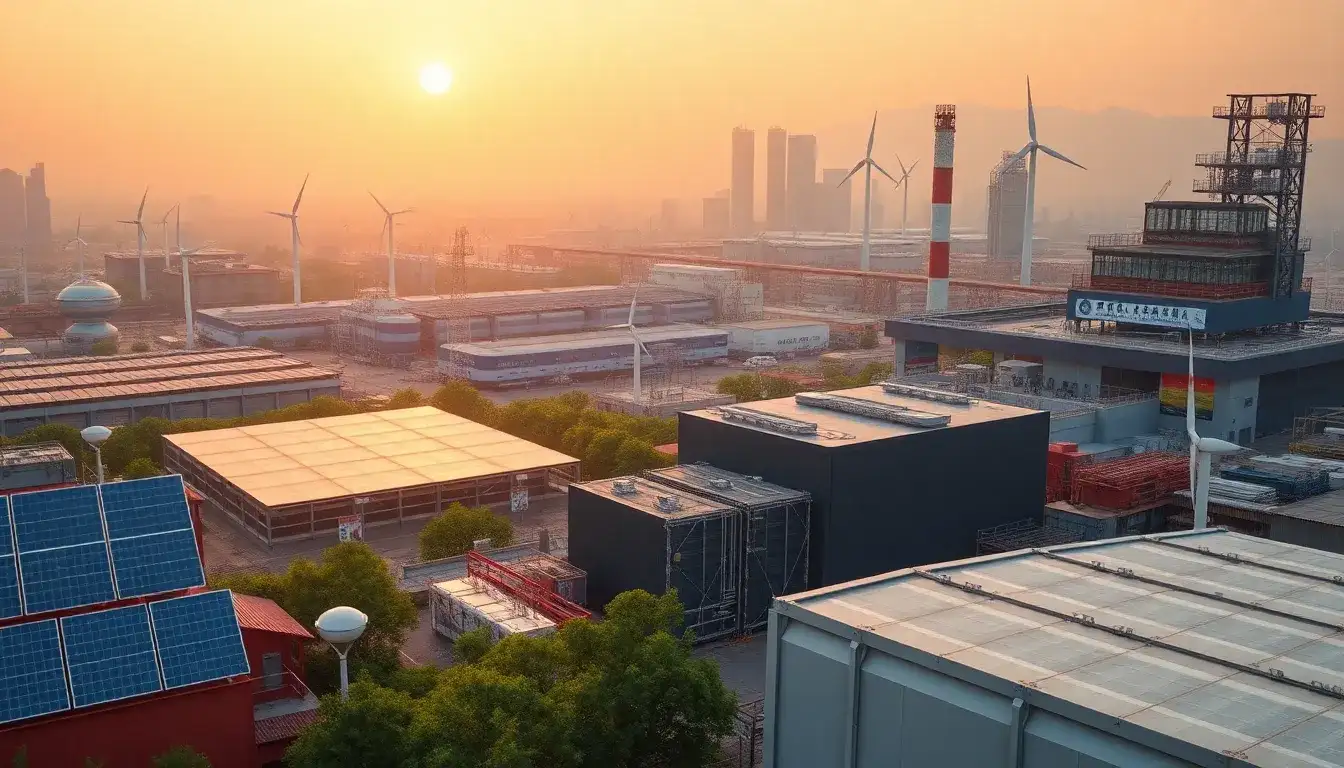
Industrial and Commercial Energy Storage: Insights into Competitive Dynamics and Industry Transformation
As 2025 begins, China’s industrial and commercial energy storage market is already witnessing a fierce competitive landscape, described as a “red sea” of competition. Although the market size is projected to reach trillions, challenges such as product homogeneity, price wars, and immature business models are becoming significant pain points for the industry. The battle for market breakthrough has commenced, with leading companies like Trina Storage and Singularity Energy employing differentiated strategies to capture market share. The question remains: who will uncover the underlying logic of industrial and commercial energy storage to seize the market advantage?
In recent years, advancements in energy storage technology and a continuous decline in costs have significantly improved both the performance and economic viability of industrial and commercial energy storage systems. The design and development of these products are becoming increasingly refined and specialized, leading to the introduction of new products and concepts such as large-capacity storage cabinets, modular storage products, direct current coupling for commercial solar storage, and integrated mobile storage solutions.
According to statistics from Polaris Energy Network, in regions like Guangdong and Zhejiang, the equivalent price difference for industrial and commercial energy storage projects charging and discharging twice daily has exceeded 1.2 RMB/kWh, with a theoretical internal rate of return (IRR) surpassing 15%. The expected new scale of the industrial and commercial energy storage market in China is projected to reach 4GW/10GWh by 2025. With supportive policies and an increasingly mature market, the potential for growth in China’s industrial and commercial energy storage sector is substantial.
01 A Competitive Race in the Red Sea
As the new year begins, the industrial and commercial energy storage sector has ignited the first price war. At the brand launch event of Boshi Energy, a massive price of 0.499 RMB/Wh was displayed, a stark contrast to the average price of around 1 RMB just a year prior. This dramatic price reduction is indicative of the chaotic expansion within the energy storage industry. Amid uncertainties regarding project returns, long-term operation, and plant safety, the primary challenge for players in the industrial and commercial energy storage sector is turning unpredictability into certainty.
Approximately 90% of industrial and commercial energy storage scenarios revolve around peak-valley arbitrage, where charging occurs during low electricity prices and discharging takes place during high prices. However, the China Electricity Council reported that in 2023, over 57% of energy storage stations experienced unplanned outages, with more than 80% of these incidents attributed to equipment defects, system anomalies, and lack of integration. At the World Energy Storage Conference held in late 2023, CATL stated that while some power-type energy storage systems are marketed with a lifespan of 10 years, in reality, many are decommissioned after less than 3 years.
With the threat of “zombie power stations,” equipment quality has become a significant obstacle for industrial and commercial energy storage. Currently, Trina Solar utilizes a fully self-developed vehicle-grade A+ 314Ah cell, combined with the Pack Pro battery module’s fire safety design, enhancing safety from cell to cabinet. Additionally, a liquid cooling temperature control system reduces system losses and extends the cycle life.
Software operational capabilities in energy storage are equally critical. As AI penetration continues to rise, Trina is enhancing project returns by leveraging intelligent management through an AI energy cloud platform that predicts electricity prices and loads in real time, dynamically optimizing charging and discharging strategies.
Industrial and commercial energy storage projects face numerous segmented scenarios, requiring a higher level of operational efficiency and adaptability to increasingly diverse and complex electricity demands. Trina Storage provides flexible energy storage system configurations tailored to the diverse needs of commercial users, including integrated solar-storage solutions, virtual power plants, and zero-carbon parks. The new generation of Trina’s integrated energy storage cabinet focuses on balancing efficiency with performance, achieving a 38.1% reduction in footprint while increasing energy density by over 55.9%, which significantly shortens the time to return on investment.
Sunlight Smart Energy’s cloud platform offers panoramic monitoring, while Sunlight Power’s self-developed Energy Management System (EMS) employs its proprietary En-grow algorithm and a vast database of deep learning to generate optimal scheduling strategies. The EMS supports coordination across photovoltaic, storage, and charging station scenarios, utilizing demand control and peak-valley arbitrage strategies, alongside optimal economic models and power load forecasts.
Envision’s EnPower smart energy storage system integrates AI big data analytics, supporting various trading types and optimizing power trading strategies and efficiency. Behind the low-price competition and negative spirals lies a struggle for market share with low-quality, low-cost products, while gaining a foothold in the growing market will depend on specific strategies.
02 The Battle of Technological Paths
According to the China Chemical and Physical Power Industry Association, by 2025, the global cumulative installed capacity of industrial and commercial energy storage is expected to reach 11.5GW, with a market size between 19 billion and 24 billion RMB. Within China, there is approximately 2.2GW/5.5GWh of growth potential, leading to a cumulative market size of around 6.5 billion to 8 billion RMB.
While the market size for industrial and commercial energy storage is not as large compared to large-scale storage, the number of entrants is on the rise, intensifying competition. Owners often face difficulties in project decision-making and contracting due to various considerations related to cost, policy, safety, and operation and maintenance. This situation compels energy storage companies to accelerate technological iterations and develop products that better meet owners’ needs. Currently, the energy storage industry is highly competitive, focusing on quality, price, and technology.
Trina Storage is capturing the industrial and commercial energy storage market through a multifaceted strategy that combines scenario-based customization, technological innovation, deep customer value cultivation, and global service. The company continues to build a unique advantage through a dual-driven approach of “full-stack self-development + global delivery.” By optimizing cell structure and manufacturing processes, Trina has developed high-safety, high-performance, long-life, and first-year zero decay 314Ah dedicated energy storage cells with a cycle life exceeding 12,000 cycles. For different regional needs, Trina offers flexible combination solutions, employing a grid-based storage system in areas with scarce land resources and device upgrades to ensure equipment stability in extreme climates.
Singularity Energy’s differentiation strategy focuses on “modularity.” Their user-side energy storage product, eBlock-230, achieves a 100% depth of discharge for charging and discharging, with an AC conversion efficiency of ≥ 90%. It significantly boosts energy density, reduces associated costs by 12%, lowers auxiliary power losses by 8%, and increases internal rate of return by 3%. While the technological advantages of modular solutions are clear, implementing modular systems for large-scale energy storage poses greater challenges compared to centralized solutions. To rapidly promote modular solutions or products, it is essential to explore new application fields beyond the traditional large-scale and industrial commercial storage markets, showcasing the technical advantages and economic viability over the entire lifecycle.
Other manufacturers are also mapping out their technological innovations. Kstar’s dual-line liquid cooling and air cooling systems include a 125kW/233kWh liquid cooling system equipped with CATL cells and a fully self-developed 3S system, optimized for revenue models through time-of-use pricing strategies, covering multiple European markets. Haibos’ outdoor cabinets feature an “extreme safety” design, integrating an intelligent fire prevention and diagnostic system, suitable for the rapid deployment needs of distributed storage. As the power spot trading policies improve and virtual power plants develop, industrial and commercial energy storage will gradually engage in electricity markets and auxiliary service provision, potentially prompting further technological innovations.
03 Moving from Disorder to Order
“In the second half of energy storage, including industrial and commercial sectors, the focus is on sustainability,” states Sunlight Power. The key to sustainable development in industrial and commercial energy storage lies in safety, efficiency, and long-term commitment. The company’s industrial and commercial energy storage solutions encompass a diverse range of green energy combinations, utilizing three-electric technology and AI to enhance returns, safety, and user experience. A singular product performance advantage is no longer sufficient for victory. Companies must build comprehensive capabilities encompassing “scenario insight – solution design – operational optimization,” with the ultimate evolution of business models moving from product sales to ecological co-construction.
Trina has established a global service system based on “technology export + localized operation,” with three major system integration centers in China, Europe, and North America, providing one-stop services from solution design to operation and maintenance. Innovation in business models will determine the profitability ceiling. The Zhejiang Provincial Energy Bureau predicts that in 2024, the expected marketized electricity transaction volume in Zhejiang will reach around 330 billion kWh, marking an increase of approximately 6.45% year-on-year, with the number of market participants continuing to rise. Under the electricity spot market model, pricing not only involves multiple points in time but also has wider fluctuations, making it challenging to predict.
Currently, some domestic energy storage system integration companies have proactively recognized this substantial market and have developed energy storage products with predictive and trading capabilities. In terms of profitability models, Trina is exploring a combination of frequency modulation revenue and auxiliary services in the electricity market with unit-price trading, breaking the limitations of single peak-valley arbitrage. Singularity Energy has also introduced an “Energy Storage as a Service” (ESaaS) model, allowing users to select financing leases or revenue sharing, thereby lowering the initial investment threshold.
Industry-wide innovations continue to emerge. Companies like Trina and Kubo Energy are promoting a “source-grid-load-storage” bidirectional sharing model through cloud platforms that aggregate decentralized energy storage resources, facilitating cross-entity electricity trading. Kstar, in collaboration with NARI Group, is developing a storage cloud platform that connects industrial and commercial energy storage systems to regional virtual power plants, participating in spot market arbitrage and auxiliary service bidding. In the context of carbon neutrality, achieving low-carbon transformation is an essential challenge faced by both nations and enterprises. Whether addressing the instability of power grids due to high proportions of renewable energy or deeply engaging in electricity market trading, industrial and commercial energy storage will play a pivotal role in the new power system. There are numerous application scenarios yet to be uncovered, awaiting development. The key inflection point for this market to transition from disorder to order remains to be seen, and it will depend on whether one or several companies can break through, championing long-term value orientation, and leading industrial and commercial energy storage toward a healthier, more positive ecosystem.
04 Conclusion
The reshuffling of the industrial and commercial energy storage industry is inevitable. Trina Storage, with its technical depth and global layout, occupies a leading position, while Singularity Energy opens up small and medium markets through modular innovation, and players like Kstar and NARI Group build competitive advantages in niche areas. The companies that emerge victorious in the future will be those that integrate technological iteration, scenario understanding, and business model innovation into a cohesive strategy. For industry participants, breaking free from homogeneous competition and reconstructing value in differentiated markets is essential to gain a competitive edge in this energy revolution.
Original article by NenPower, If reposted, please credit the source: https://nenpower.com/blog/insights-into-the-competitive-landscape-of-commercial-and-industrial-energy-storage-in-china-strategies-for-industry-transformation/

