

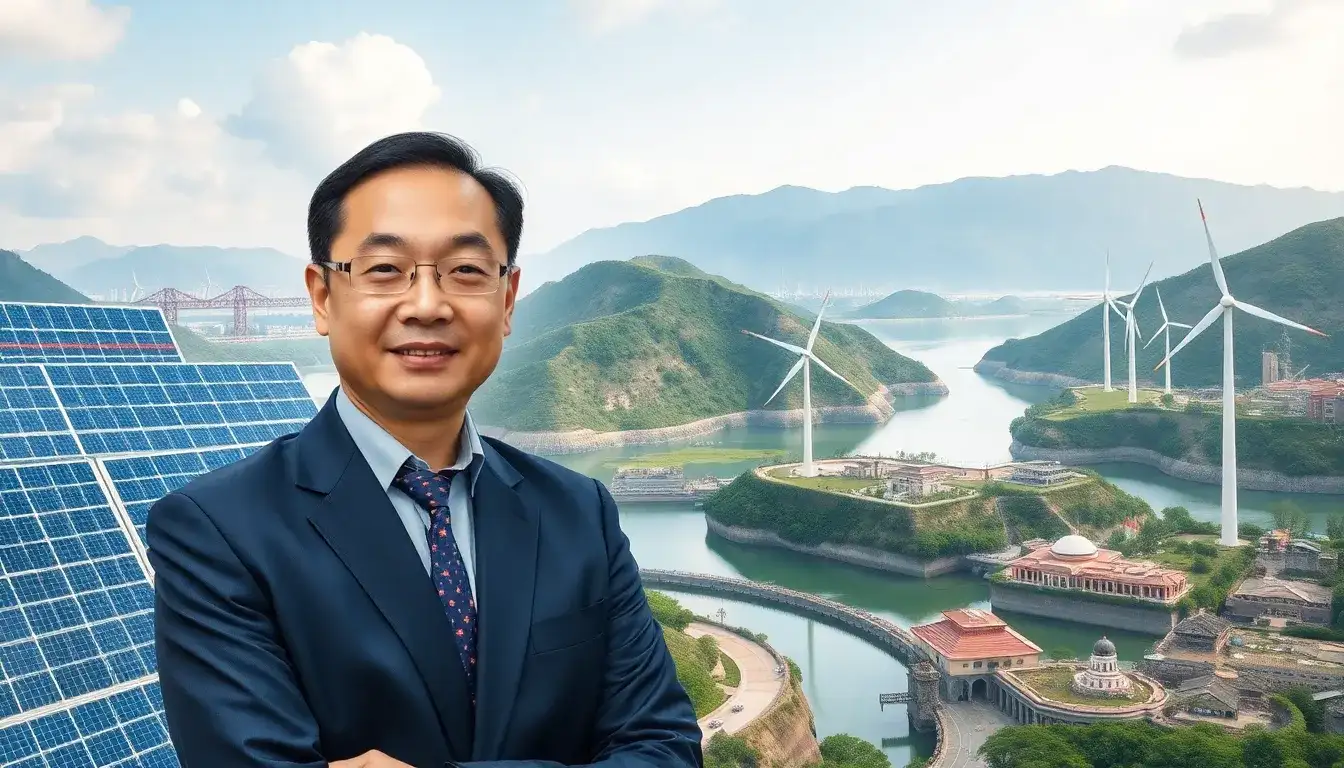
Dialogue with Yang Lei: What Has China Done Right in the New Energy Industry and What More Should Be Done?
Date: June 2, 2025
The market-oriented reform of China’s energy industry is accelerating, and there is still greater potential for the development of new energy. On May 22, the National Energy Administration released the latest statistics for China’s electricity industry. As of the end of April 2025, the cumulative installed capacity of solar power in the country reached 990 million kilowatts, accounting for over 40% of the world’s total installed capacity; the installed capacity of wind power reached 540 million kilowatts, surpassing 45% of the global total.
By the end of 2024, China’s production of photovoltaic modules exceeded 80% of the global output, lithium battery production accounted for over 75%, and sales of new energy vehicles represented more than 70% of global sales. In 2015, China’s cumulative installed capacity of solar power was 19% of the global total, while wind power accounted for 33%, photovoltaic module production for 60%, lithium battery production for 10%, and new energy vehicle sales for 40% of the global market.
Over the past decade, China’s new energy industry has experienced remarkable growth, showcasing astonishing global dominance. However, some sectors have fallen into the traps of overcapacity and price wars. According to statistics from Caijing, the combined losses of eight leading publicly listed photovoltaic companies in 2024 reached 37 billion yuan.
What has China done right in the new energy sector, and what further actions need to be taken? Dr. Yang Lei, Deputy Director of the Energy Research Institute at Peking University, recently discussed this topic in depth with Caijing‘s Executive Editor, Mark. Yang has a long history of service in the National Energy Administration, witnessing the development and growth of China’s new energy industry and the market-oriented transformation of the energy sector. Before joining the Energy Research Institute, he worked for three years as a senior advisor to the Director-General at the International Energy Agency.
Yang believes that China’s manufacturing capacity in the new energy sector is already strong, and the urgent issue now is how to absorb this manufacturing capacity. In 2012-2013, the anti-dumping and countervailing duties imposed by Europe and the United States nearly devastated China’s photovoltaic industry, but domestic demand helped it recover. Today, the photovoltaic industry needs to stimulate domestic demand further, which requires accelerating the market-oriented process in China’s energy sector and making significant strides in establishing price and market mechanisms.
Yang points out that although the Trump administration has withdrawn from the Paris Agreement again, its core energy policy focuses on deregulation and accelerating market-oriented development, which has objectively benefited the growth of renewable energy. Conversely, China and Europe share more consensus on climate issues, and given the pressure from the United States, now is an opportune time for China and Europe to strengthen cooperation in energy and climate change response.
Key Factors in the Rise of China’s New Energy Industry
Caijing: Looking at production capacity and installed capacity, China is leading the world in the new energy sector. Reflecting on the past decade, what do you think we have done right?
Yang: First, we believed in the market. Most leading companies in wind power, solar energy, and electric vehicles are private enterprises, and the primary innovators in the industry are also private companies. Secondly, we had supportive policies. From the No. 5 Document in 2002 to the No. 9 Document in 2015, as well as recent reforms in incremental distribution networks and the establishment of spot electricity markets, the Chinese government has consistently promoted market-oriented reforms in the energy sector. Some may still feel that the pace of market-oriented progress is slow and not aligned with their expectations, but we must recognize that the direction of marketization has remained unchanged for over 20 years. The establishment of the national oil and gas pipeline company is another important step toward the marketization of natural gas, which has progressed faster than electricity reform. There is now a basic consensus in the industry that resource allocation should be optimized through market mechanisms, especially with the call from the Third Plenary Session of the 18th CPC Central Committee to let the market play a decisive role—this policy direction has not changed.
Thirdly, we have faith in technology. The driving force behind this round of industrial or energy revolution is technology. We have always said that science and technology are the primary productive forces. Productivity has led to changes in production relations and business models, pushing us into a new era. If the external pressures of climate change and unsustainable resources are one aspect, technology provides us with the internal motivation to address them. Now, both the state and enterprises emphasize innovation and technological research and development, which have indeed achieved remarkable results.
Caijing: There are voices abroad claiming that China’s rapid development of the new energy sector relies heavily on government industrial policies. How valid is this assertion?
Yang: Globally, there are many incentive policies for new energy, and such policy guidance is not problematic. China has also established such industrial policies. However, I want to emphasize that the true sustainable and foundational roles are played by technology and the market. For example, we have also supported ethanol, but it has not achieved the same scale as photovoltaic energy. When policies provide support, there are many choices and trial-and-error processes, and ultimately, the market’s choice prevails. Support from industrial policies is crucial; the backing for photovoltaics and electric vehicles has accelerated industrial development. While the international reaction may be significant and understandable, the view that China’s success solely stems from industrial policy support is rather one-sided.
Caijing: China is now the world’s largest new energy market, but for a long time, Europe held that title, supported by subsidies from various EU countries. Why has Europe not developed a robust new energy industry while we have surged ahead?
Yang: The EU’s new energy sector remains strong. For example, Germany’s share of photovoltaic and wind turbine installations and electricity generation exceeds ours. In terms of manufacturing, the EU has not developed as robustly; they adhere more to the principles of comparative advantage, often purchasing ready-made products from China. Why are Chinese photovoltaic products cheaper? It is because there is a large industrial chain supporting the entire process from the refining of polysilicon to processing, slicing, and assembly. This is an advantage of China’s industrial foundation and an outcome of international division of labor. Europeans might think that since they excel in automotive manufacturing, they should focus on that and buy photovoltaic components from China. However, after the pandemic and the impact of the Russia-Ukraine conflict, countries are paying more attention to supply chain risks and are seeking to bring manufacturing back. Yet many countries face higher production costs; for example, in the United States, producing the same photovoltaic component could cost significantly more than in China. If some countries insist on bringing back manufacturing, it may have benefits, as a thriving industry relies on the collective effort of many. China has substantial advantages in investment and direct technology transfer. Many technologies improve through mutual learning, and cooperation is undoubtedly more beneficial. Regarding concerns about the security of the industrial chain, it is essential to sit down and have discussions; a hasty “decoupling” from China is irrational.
Caijing: Besides market, policy, and technology, I believe another crucial factor is entrepreneurial spirit. There is also a debate about whether entrepreneurial spirit or the engineer bonus is more important; I think the entrepreneurial spirit is more significant. Without entrepreneurial spirit, the engineer bonus cannot be fully realized.
Yang: Entrepreneurs rely on the market. The market encourages you to seek fortune and risk, to be a pioneer, to do what others do not, and to turn the impossible into possible. Ultimately, a well-functioning market is needed to reward such behavior, which in turn drives industry development.
Caijing: The relationship between the market and entrepreneurs is like fish and water; fish can only thrive in water.
Yang: If the water is well managed, the fish will naturally thrive.
Caijing: In 2015, we initiated the “Energy Chronicle” column to introduce international experiences as references for domestic energy transformation. Now that China has risen to the world’s top position, is there still international experience worth learning from?
Yang: We must not become complacent. One of the excellent traditions of Chinese culture is humility, which is always a virtue. There is still much we can learn, such as in market mechanisms and business models, which we have yet to perfect. We also lack many original technologies. The idea that “our new energy industry is now world-class, so we no longer need to learn from international experiences” is a mindset we must avoid. The world changes rapidly; to achieve sustainable development, we must continue learning. We should reflect with gratitude on history. No successful entrepreneur would claim they can shut the door and become a world leader, nor can any country close itself off and become a strong nation.
Caijing: In the current environment, is it worth discussing the pursuit of a fully autonomous and controllable industrial chain?
Yang: From a risk management perspective, some countries argue that relying solely on Chinese products is problematic; we also recognize that technological bottlenecks are an issue. This consideration includes cost; we must first assess whether we can achieve self-sufficiency. If so, at what cost would it be appropriate? This line of thought is not exclusive to China; the Trump administration has considered similar issues.
Caijing: It is about finding a balance between safety and cost, or safety and efficiency.
Yang: Our generation has lived in a peaceful era, and we lack awareness of the intensified or deteriorating international situation. Russia provides a reference: a country that is self-sufficient in food and energy will not face survival issues. Some speculate that after so long in conflict with Ukraine, Russia must be close to collapse. However, it appears they are still operating normally, with the quality of the economy declining and the living standards of the people dropping, but basic sustenance remains secure, which stabilizes society.
Caijing: The core issue is that Russia can be self-sufficient in energy and food.
Yang: Human survival needs are not as extensive as some might think. For instance, people often say that if the Malacca Strait were to be in conflict, we wouldn’t have oil to drive our cars. But if such extreme situations occur, would you still be driving back and forth? Who would you sell what you produce to? In critical areas, we must have a bottom-line mindset, but we should not exaggerate the risks we face. I am concerned that if this mindset spreads, various extreme measures requiring significant investment will be implemented, potentially bringing economic risks. Resource allocation cannot be misaligned for extended periods; we must not exhaust ourselves before an extreme situation even arises.
Caijing: As you just mentioned, it is essential to find a balance between safety and efficiency or safety and cost. The blockade of the Malacca Strait is an extremely low-probability event; if your daily operations are based on such unlikely events, the operational costs of the entire system will become infinitely high.
Yang: Yes, we have historical lessons regarding this. What important things have we not accomplished yet?
Caijing: We just discussed what we have done right. Conversely, what should we have done but have not adequately addressed or even started?
Yang: This is worth serious exploration. We say we believe in the market, but does the energy market truly play a decisive role in resource allocation? For example, the international market does not accept Chinese prices for natural gas because we lack a sufficiently mature market to establish prices; many prices are still based on previous government-set rates. We are the largest natural gas importer, yet we do not have long-term contracts based on our price index, which also reveals issues with our soft power. Therefore, we need to expedite the marketization of pricing, including business models. The energy market reforms in developed countries have progressed earlier, and there is much we can learn from their innovations in business models. Many of their policy tools are relatively neutral, designed to create markets that optimize resource allocation. I have conducted extensive research on natural gas market reform and know that the international community has made many mistakes in trial and error; I hope we can learn from their experiences without incurring similar social costs. We also have much to learn in the realm of foundational innovation. Currently, our research system’s greatest challenge is how to encourage true creativity and original innovation, rather than merely focusing on papers and projects, which often leads to numerous KPIs that distance us from genuine research.
Caijing: Twenty years ago, we were already discussing why there is no Chinese pricing, and this issue remains unresolved today.
Yang: From the perspective of economic common sense, the market is the best tool for optimizing resource allocation, but why is it so challenging in the energy sector? When we restore the commodity attributes of energy, does it possess any specific characteristics? Energy indeed has some unique features, the most significant being the constraints of infrastructure. For instance, once a wind or solar power plant is built, I can sell electricity only if there are power lines and a grid to deliver it. If I want to develop a natural gas field, the gas must be piped out to be sold. When preparing for the West-East Gas Pipeline, I was involved in the entire process. At that time, there was a lot of pessimism and conservatism because there was no prior experience with natural gas. You had to persuade people to use it while assuring them that the pipelines would be built; they would hesitate, saying they didn’t need that much gas and would contemplate the price. Would you still want to develop the gas field and invest in constructing expensive pipelines? This hesitation is common. The natural gas industry generally signs contracts that require payment regardless of whether you need the gas, while electricity is a much more immediate commodity; once generated, it must be consumed instantly, which raises the infrastructure requirements even higher. Thus, the energy industry needs a comprehensive set of facilities and regulations to support it. Both electricity and natural gas initially operated within monopolistic structures involving integrated upstream and downstream operations.
Caijing: This method is the most efficient.
Yang: Correct, but as the scale increases, it can only rely on government-regulated prices. In fact, China began energy market-oriented reforms over 20 years ago. For example, after separating power generation from the grid, power plants were built quickly. Now, we are considering how to leverage the market to better promote the development of new energy. There is a consensus on this, but policy alignment is necessary for implementation. One issue is universal service; the problem of cross-subsidization has troubled us for a long time. Residential electricity prices are relatively low; can we raise them a bit? It is possible to maintain low prices, but we need to clarify the source of the subsidy funds. Only then can we effectively engage the market; otherwise, it becomes indistinguishable which actions are market-driven and which are universal services.
Caijing: Companies fulfill market functions, while universal services should actually be the role of the government; mixing these responsibilities makes many matters unclear.
Yang: This situation has historical roots; it involves fair responsibility distribution and execution, and it can indeed affect vested interests. We have been reforming this for a while, and I am confident in our progress. Our Energy Research Institute at Peking University is also conducting bottom-up reform research, including studies on large parks, small towns, and rural areas. If we can build effective markets at the grassroots level, we can promote systemic changes, which is a beneficial practice. The past monopolistic and centralized model arose because fossil energy is inherently concentrated; oil fields, coal mines, and power plants become more efficient as they grow larger, necessitating such a structure. However, the natural attributes of energy have changed; for example, a power plant that once had a capacity of 1 million kilowatts can now be a few kilowatts, and households can install small-scale solar power systems. When millions of small power plants are combined, the scale becomes significant. Australian media reports say that China can build facilities equivalent to five 1-million-kilowatt power stations in a week through concerted efforts. Indeed, in the energy sector, the era of widespread participation from the populace is approaching. This creates an urgent demand for systemic reforms. The current electricity grid struggles to absorb the increasing amounts of wind and solar energy, reflecting that the transformation of productivity is forcing a rapid evolution of production relations.
Caijing: To summarize, in the past couple of decades, we have resolved the manufacturing side of the issue. Now we must address problems related to market structure, transaction mechanisms, and pricing mechanisms.
Yang: We have successfully addressed the quality of production; however, the question of how to utilize it effectively is now urgent. The photovoltaic market is currently sluggish. Why can’t the domestic market expand its usage? It is akin to the anti-dumping measures that Europe and the U.S. imposed on us, which caused orders to plummet, even more dramatically than today. We relied on activating our domestic market to recover then, and we must do so again, as there is still a vast domestic market to tap into.
Caijing: We need to stimulate industrial vitality through domestic demand once more, but there are many obstacles.
Yang: Our market environment has improved significantly since that time. Recent years of building incremental distribution networks and power spot markets have increased the number of market participants. If you visit rural areas, you’ll find many farmers acting as entrepreneurs in new energy, with technological barriers dropping rapidly, fostering grassroots ingenuity. These developments can rely on the collective efforts of the populace. We need to research what systems, mechanisms, and business models can support the larger-scale development of new energy. In the past, when wind and solar accounted for 5% of grid electricity, the grid claimed it couldn’t handle it; now that figure is 20%. In Germany, renewable energy on the grid averages 72%, with wind and solar often reaching 100% during optimal conditions.
To achieve the “dual carbon” goals, non-fossil energy must account for over 80%, with non-fossil energy production in electricity exceeding 90%. This requires us to tackle challenging issues, namely building a new power system centered on new energy.
Yang: Just as roads were not originally built for cars, now that we have vehicles, roads need to be modified, including adding traffic lights and expanding width. We need to upgrade our energy infrastructure, including grids, natural gas pipelines, and heating networks. Additionally, there are opportunities for multifunctional upgrades of pipelines; for instance, can pipelines originally designed for transporting natural gas also transport hydrogen? The enhancement of the grid and the construction and improvement of distribution networks are of utmost importance. Many renewable energy sources require localized consumption; if the distribution network does not keep pace, they cannot be effectively utilized. Thus, we must build distributed smart grids.
Caijing: Previously, the grid was designed for centralized generation and long-distance transmission, resulting in a well-developed backbone grid but a relatively weak distribution network. Now, with the rise of distributed energy, the previously weak distribution grid appears even more fragile.
Yang: The construction of the distribution network also involves investment mechanisms. Should only state-owned enterprises build it, or can there be more diverse investment options? How should we improve investment mechanisms in the future? These are practical issues we are currently addressing. If only a few state-owned enterprises invest, resolving distribution network issues becomes challenging due to the enormous investment scale. However, reflecting on the planned economy era, many previously intractable problems were resolved by leveraging market forces. I sense that this wave of reform carries a strong bottom-up character. Various virtual power plants and aggregators are finding space to grow in the market. Storage companies also need to understand when to store energy and when to release it. As electric vehicle adoption grows, the scale will surpass that of current storage systems. Each electric vehicle serves as a mobile battery. If we reach a scale of over 100 million electric vehicles, they could store tens of billions of kilowatt-hours and feed electricity back to the grid. Considering a slow charging power of 10 kilowatts, 100 million vehicles could provide 100 billion kilowatts of peak capacity and backup. Our total installed power generation capacity is currently over 3 billion kilowatts. How can we tap into this potential? We are still exploring this. Of course, what I describe are ideal conditions; the numbers may not fully translate into reality, but the trend is promising.
Caijing: The European Union has been conducting electricity market reforms since the 1980s, and they have been working on it for over 40 years. If we count from the release of Document No. 5 in 2002, we have only been on this path for over 20 years, yet we have achieved remarkable accomplishments.
Yang: Therefore, we should have confidence. If everyone can reach a consensus and work together, the pace of marketization can accelerate, and new energy will develop more favorably. In the process of the great rejuvenation of the Chinese nation, new energy will play a crucial supporting role.
Has Trump’s Withdrawal from the Paris Agreement Actually Promoted New Energy Development?
Caijing: Following the signing of the Paris Agreement in 2015, the world made progress in energy transformation and addressing climate change. However, the outbreak of the Russia-Ukraine conflict in 2022 and Trump’s return to power introduced new variables into energy transformation and climate change responses. What are the short-term and long-term impacts of the Russia-Ukraine conflict on Europe’s energy transformation?
Yang: The Russia-Ukraine conflict has accelerated Europe’s energy transition. Prior to the conflict, about half of Europe’s fossil energy came from Russia. After the conflict erupted, Europe introduced the REPowerEU plan, a comprehensive set of policies and actions. This plan sets an ambitious goal of completely eliminating reliance on Russian fossil energy imports by 2030 through accelerated energy transition and diversification. Initially, many believed that without Russian natural gas, Europe would struggle to cope; however, three years later, Europe has not collapsed. Progress in reducing reliance on Russian fossil energy has been even better and faster than planned.
Caijing: In the short term, it appears that Europe’s energy transition has stalled or even regressed, as fossil energy usage has increased, leading to rising electricity and energy prices and social discontent. However, from a long-term perspective, these short-term difficulties have accelerated the push toward renewable energy.
Yang: Indeed, signs of this acceleration are already evident. Investment in energy transition is increasing, such as in hydrogen strategies, which are progressing faster than before.
Caijing: Much of the natural gas previously supplied to the EU by Russia has been replaced by U.S. natural gas. If this is merely a substitution, what significance does it hold for energy transition?
Yang: This is a short-term phenomenon. For example, the development of large hydrogen projects and the EU’s hydrogen strategy largely aims to replace natural gas. Due to both policy and economic factors, the current usage of natural gas in Europe is declining, beyond simply filling the gap left by Russia. Of course, high gas prices are a contributing factor, but this trend is already underway. Some new regulations, such as those in the Netherlands prohibiting new buildings from having natural gas pipelines, send a clear signal of accelerating transition. The decline in natural gas use in Europe is affecting the global natural gas industry, causing some panic among major natural gas suppliers, as Europe is the world’s largest natural gas consumer. In the past, we labeled natural gas as a clean energy source with a bright future, but what is happening in Europe may suggest that the era of resource-driven development is waning, and we are entering a market-centric era.
Caijing: Let’s discuss Trump. He has withdrawn from the Paris Agreement for the second time. What similarities and differences do you see between this withdrawal and the last one?
Yang: The Republican Party has consistently held a skeptical view of climate change. When George W. Bush took office in 2001, he withdrew from the Kyoto Protocol. Trump, upon taking office, claimed that climate change was a fabrication of the Chinese.
Caijing: There were assertions here that climate change was also a fabrication by Americans.
Yang: This is indeed laughable. The Republican Party has a historical tradition of skepticism regarding climate change, with Trump taking a more extreme stance. Climate change is a real issue that we can feel firsthand. If Trump insists on waving the flag against climate change, it is ironically significant because during his previous term, the U.S. achieved greater emissions reductions than in Obama’s entire tenure. Obama published a paper in Science, boldly declaring that the momentum for clean energy development was irreversible.
But where does Trump’s pragmatism lie? His current approach is deregulation, which aligns with our often-stated goal of allowing the market to play a decisive role. The Biden administration advocates vigorously for the development of new energy, with Elon Musk as a leading figure, as Tesla encompasses photovoltaics, storage, and electric vehicles. Yet Musk has expressed frustration with Biden’s policies, citing overly complex approvals that have led to many new energy projects languishing for two years in bureaucratic queues. Therefore, I believe that if we can streamline the market, the development of new energy will benefit, as rapid technological advancements have already made the overall cost of new energy lower than that of fossil fuels. Trump possesses a commercial savvy and a pragmatic side; his rallying cry of “drill baby drill” echoes a campaign slogan from the Bush era (2001-2008), as the oil and gas industry is the largest energy sector in the U.S., a tradition of the Republican Party.
Our three state-owned oil companies reported that diesel consumption peaked two years ago, and gasoline consumption peaked last year. Oil consumption is on the decline, and business at gas stations is worsening year by year. This trend in China is also pushing global oil consumption to peak. As such, oil and gas no longer hold the same value as before. I personally speculate that this might be one of Trump’s motivations for accelerating oil and gas development: to capture the remaining profits from fossil energy while it is still profitable, thus positioning himself advantageously for future transitions. Many international oil and gas companies have similar intentions—profit now, transition later.
Caijing: This is the first time I have heard this perspective—that Trump understands that the transition to renewable energy is unstoppable but wants to seize the remaining profits from fossil fuels.
Yang: Whether he understands that the transition to renewable energy is unstoppable, I cannot say. However, I believe Trump embodies the philosophy behind our book, which is to trust the market and advocate for deregulation. When market forces are unleashed, they can produce significant results.
Caijing: Trump’s clear focus on fossil energy development, coupled with his deregulation policy, applies to all energy forms. Does that mean deregulation can also benefit renewable energy?
Yang: Yes, with the exception of offshore wind energy, which he explicitly opposes, his policies are generally applicable. Excessive regulation is most detrimental to small and medium enterprises; large companies have public relations departments and resources to navigate various approvals more quickly, while smaller companies often lack such resources. However, the shale gas revolution in the U.S. was largely initiated by small and medium enterprises, and many current renewable energy companies are also small and medium-sized. If regulations can be simplified, it will undoubtedly favor these smaller players. We have conducted follow-up research and found that some renewable energy projects in the U.S. fail due to long approval wait times, often lasting two years. This may stem from grid connection issues, land use, or environmental concerns. In China, decisions are made and projects are launched within the same year, but in the U.S., a two-year wait can prevent a project from even starting. Therefore, in this regard, I believe that renewable energy stands to benefit even more.
Caijing: This is a very interesting perspective. Could it be that Trump’s push for fossil energy development paradoxically promotes renewable energy? Your logic is quite convincing. This narrative is also applicable to climate change—economic correctness is more valuable than political correctness.
Yang: Climate negotiations have become increasingly large-scale yet progress remains limited. My strong sense in recent years is that climate conferences, traditionally places for emotional discussions, are now also becoming venues for business.
In 2023, the climate conference in Dubai attracted around 100,000 high-net-worth individuals, while the 2024 conference in Baku is expected to accommodate at least 70,000 participants. Last year, Professor Liu Qiao from the Guanghua School of Management at Peking University attended the Baku conference. We organized activities at the China Corner, where Guanghua alumni recognized him and approached him. I asked why they were there; they said they were promoting renewable energy and saw many ministers and CEOs as potential partners. Some entrepreneurs had even booked flights home but redirected their travels to further discuss projects during the conference.
Caijing: Harnessing business logic can more powerfully drive efforts to address climate change.
Yang: This is about sustainability. We must find viable business scenarios that yield sustainable returns.
Caijing: With Trump’s withdrawal, many suggest that “China and Europe should join forces to advance the climate change agenda.” What are your thoughts on this?
Yang: This represents a new trend. China and Europe have a growing need to draw closer due to U.S. pressure. We should actively pursue this, but it requires mutual willingness and patience. After all, China has only recently opened up its doors for development, and building trust takes time. This principle applies to both individuals and nations. As long as we adhere to the concept of building a community with a shared future for humanity—not just in words, but also in actions—now is indeed a good time for China and Europe to strengthen cooperation. If we contribute to the world and take on our responsibilities consistently, we will undoubtedly become more influential. During my time at the International Energy Agency, I often felt this way. Encountering different opinions is inevitable, and from the perspective of a shared future for humanity, seeking common ground through cooperation is far more beneficial to our collective well-being than engaging in conflict.
Caijing: Indeed, openness is better than closure, cooperation is better than conflict, peace is better than war, and markets are better than plans.
Original article by NenPower, If reposted, please credit the source: https://nenpower.com/blog/insights-from-yang-lei-on-chinas-successes-and-future-directions-in-the-new-energy-industry/

