

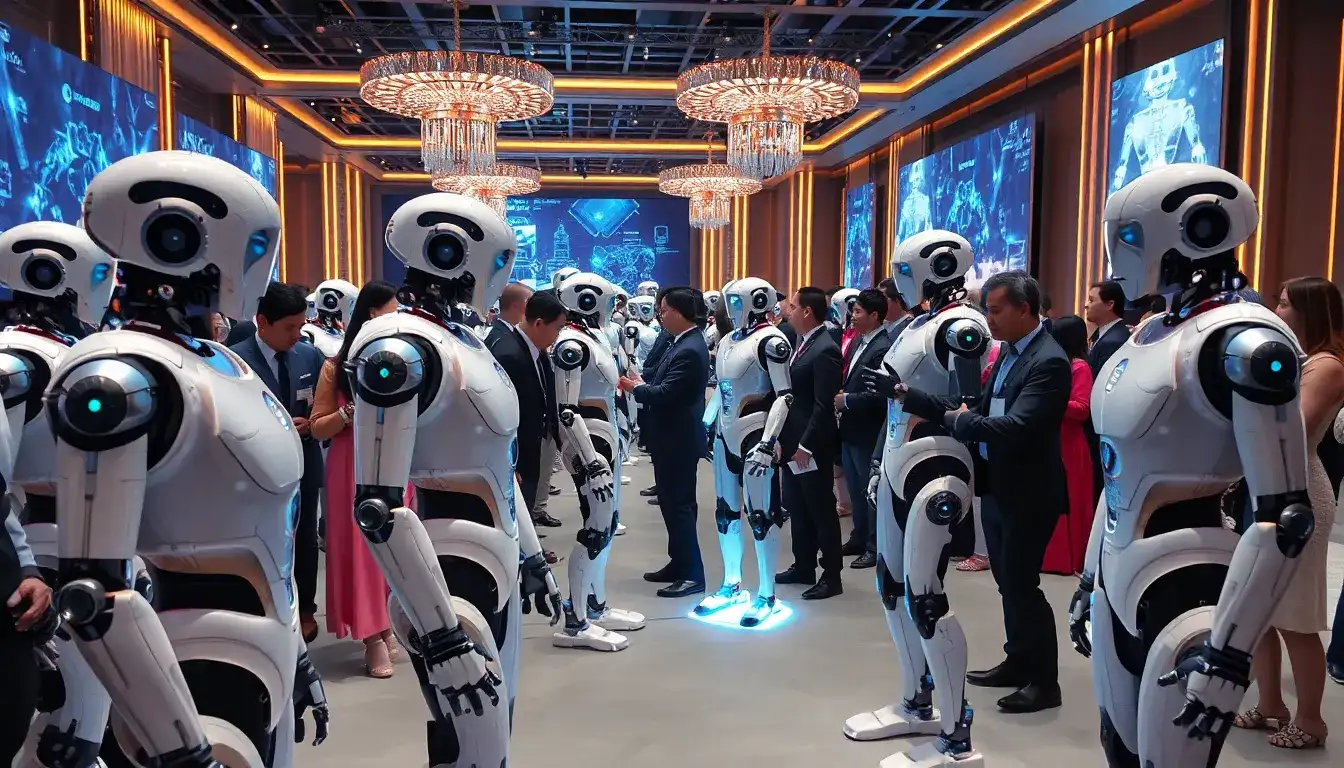
ZhiYuan Makes a Big Move! They are hosting a large-scale robot gala. What does this signal?
On the evening of February 8, at 8 PM, ZhiYuan AGIBOT held the world’s first large-scale robot gala titled “A Wonderful Night of Robots.” The event featured a vibrant blend of dance, skits, magic, martial arts, songs, and fashion shows, showcasing a significant transition in the Chinese robotics industry from “functional execution” to “cultural expression.”
Prior to the event, insiders revealed that ZhiYuan would not participate in the 2026 Spring Festival Gala and mentioned that they were rehearsing for the global premiere of “A Wonderful Night of Robots.” The primary goal of hosting this large gala is to create a true celebration where robots take center stage.
The event’s coordinator emphasized that this is not merely a “performance show,” but also an “ability showcase” and “ecological showcase” aimed at breaking the stereotype that robots are limited to specific fields such as industry and services. It explores their integrated applications in the cultural and entertainment industries.
From individual “show-off” to a collective display of capabilities, the coordinator stated, “We want to prove not just what a single robot can do, but what a group of robots can achieve together in a complex environment.” Over 200 robots were mobilized for the entire performance, covering ZhiYuan’s full product line and collaborating with partner products. This allowed for complex cooperation across multiple brands, shapes, and models, achieving a comprehensive synergy from program arrangement, action execution, to real-time interaction.
The gala included twelve performances, each testing the systemic capabilities of the robots. For instance, 24 robots performed a synchronized opening dance requiring precise group control technology for flawless execution. In one segment, the robots recreated traditional martial arts moves, balancing fluidity and accuracy. Several performances involved robots collaborating with human actors and on-site equipment, necessitating millisecond-level responses and error-free coordination.
During the opening dance “Dance Power Unleashed,” 24 LingXi X2 robots achieved flawless synchronized movements using advanced group control technology, with one robot showcasing aerial poses using a wire harness. All movements were executed in perfect unison thanks to this technology. In the world’s first robotic language show “Stand-In Date,” well-known actor Huang Xiaoming made a special appearance, collaborating with robots like LingXi X2 and YuanZheng A2. Multiple robots acted alongside Happy Mahua performers, executing human-like responses such as “shyness” and “confusion” based on the scene.
Additionally, the gala did not invite real human audiences; the entire seating was filled with “robot spectators.” ZhiYuan stated that coordinating over 200 robots to perform as actors and participate in audience interactions required stable, more human-like performances, driven by complex cluster control technology and situational programming capabilities.
The coordinator noted, “Our biggest challenge is to establish the uncertain nature of artistic creation on a highly certain technological foundation. Human actors can improvise based on understanding and emotions, but robots rely on precise programming and stable hardware. Any small deviation in a single element—such as an abnormal sensor reading, a slight movement trajectory shift, or even wireless signal interference between robots—could lead to a performance interruption or failure.”
ZhiYuan indicated that the smooth execution of this gala was primarily due to the maturity of their underlying technology system, which includes servo control, group scheduling algorithms, and artistic arrangement software that have achieved high coupling and reliable operation. “This systemic maturity is the fundamental premise for robotics technology to evolve from ‘toys’ and ‘demonstrations’ to ‘productive tools’ and ‘cultural carriers,'” the coordinator emphasized.
Specifically, many of the performances served as early tests of robotic technology in various commercial contexts. For example, the robotic skit “Stand-In Date” demonstrated the maturity of human-robot interaction systems, which can be directly adapted to commercial performances and cultural tourism interactions, offering businesses a differentiated experience. The robot sign language translation service validated the adaptability of robotic systems in public service, applicable to venue tours and accessible services, aligning with the commercial needs of the public service sector. Programs featuring robot magic, singing, and waltzing showcased the potential of system integration in public performances.
“It’s like a ‘model room’ for a new product,” the gala coordinator remarked, stating that the technologies used in the gala can be quickly adapted to various commercial scenarios without extensive modifications. ZhiYuan revealed that they have already received collaboration intentions from large theaters, performance centers, and science museums, planning to acquire the copyright for the entire gala for regular performances. Some segments will be commercialized through global tours and the “QingTian Rental” platform, truly promoting the transition of technology from “stage display” to “industrial application.”
The humanoid robot industry in China is expected to see significant growth by 2026. Analysts from Morgan Stanley recently noted that, on one hand, more humanoid robots will enter commercial validation scenarios to test their performance in various applications. On the other hand, a noticeable differentiation among companies within the industry is anticipated, leading to a scenario where strong players thrive while weaker ones are eliminated. “The production of humanoid robots in 2026 is expected to significantly exceed shipping volumes, with projections estimating industry shipments to reach between 28,000 and 30,000 units. However, this growth rate is not particularly high, and the core driving force for future industry development lies in the feedback collected from commercial validation scenarios and the ability to identify viable business applications,” the Morgan Stanley analyst further elaborated.
Original article by NenPower, If reposted, please credit the source: https://nenpower.com/blog/innovative-robot-gala-marks-a-new-era-in-chinas-robotics-industry/

