

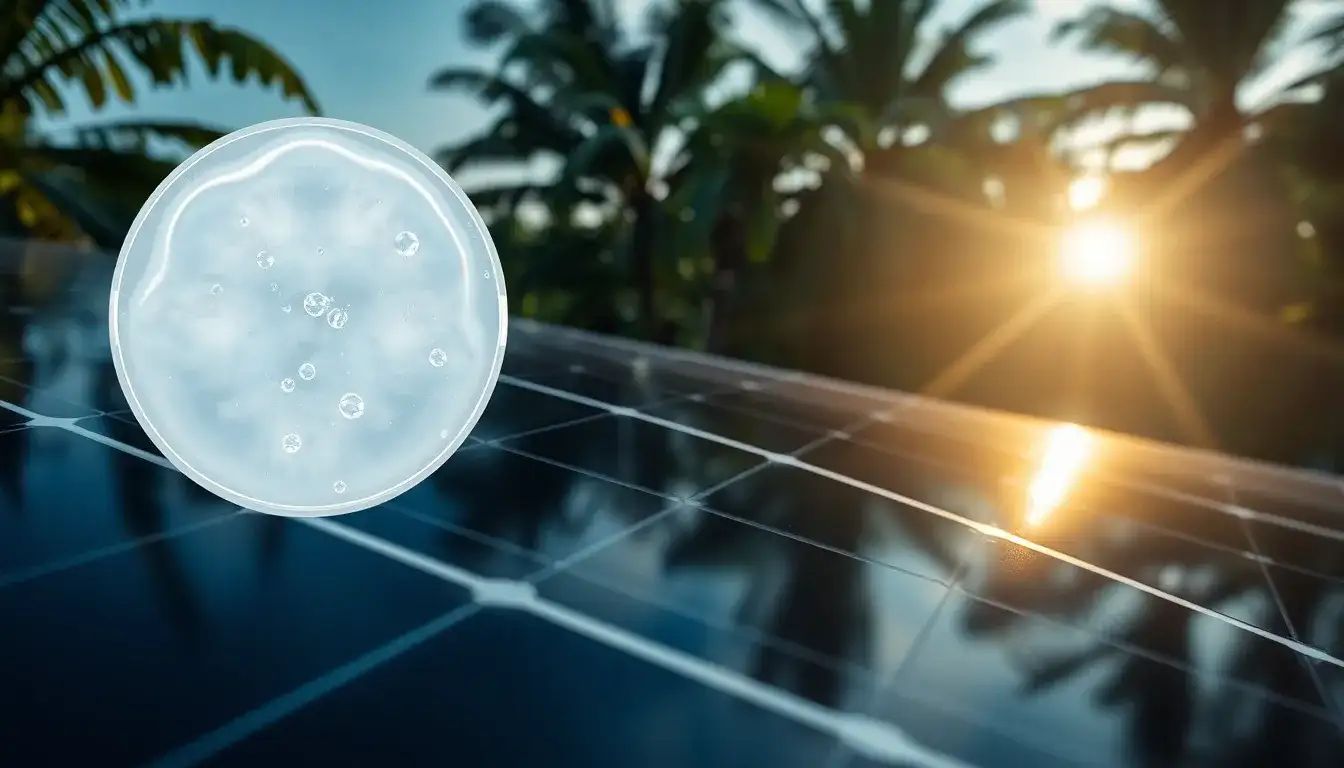
With the transition from fossil fuels to sustainable green energy, photovoltaic (PV) technology has emerged as a critical pathway for harnessing clean, renewable energy. PV systems have gained significant attention due to their high efficiency, low operating costs, and long lifespan. However, in tropical regions, the efficiency and durability of these systems are often compromised by high operating temperatures and intense solar radiation. Therefore, it is crucial to find efficient and convenient cooling technologies for solar panels.
This study introduces a sodium polyacrylate-lithium chloride (PAAS-LiCl) composite material and outlines its streamlined manufacturing process. This material serves as an inexpensive evaporative cooling layer attached to the back of photovoltaic panels. It utilizes the hygroscopic properties of a desiccant to absorb moisture at night and achieve cooling through evaporation during the day. Experimental results indicate that a 10 mm thick hydrogel layer can provide an evaporative cooling power of 373 W/m² under laboratory conditions. In an environment with a temperature of 38°C, this cooling layer can reduce the peak temperature by 14.1°C, enhancing the maximum output power of the photovoltaic panel by 12.9%. This cooling strategy has the potential to extend the lifespan of solar panels by over 200% and reduce electricity costs by 18%. The combination of this passive cooling strategy, durable hydrogel material, and scalable manufacturing process offers a feasible solution for the large-scale deployment of solar power plants.
The related work, titled Streamlined fabrication of an inexpensive hygroscopic composite for low maintenance evaporative cooling of solar panels, was published in Mater. Sci. Eng. R-Rep.. This study proposes a passive cooling strategy based on an adsorption-evaporation mechanism, effectively implementing day-night cyclic cooling by adhering the PAAS-LiCl composite hydrogel to the back of solar cells. A simplified, crosslinker-free, room-temperature forming process was established, with the composite material demonstrating excellent moisture absorption capacity, structural stability, and environmental adaptability under high humidity conditions.
Indoor simulation experiments confirmed its evaporative cooling efficacy, achieving a peak cooling power of 247 W/m² and a temperature drop of 11.8°C under 1 kW/m² solar irradiance. An outdoor empirical test over 21 days showed that the cooling layer achieved a maximum temperature reduction of 14.1°C and a 12.9% increase in photovoltaic conversion efficiency in an environment with 37°C and 53% relative humidity, demonstrating sustained moisture absorption-evaporation cycling capability.
Economic and stability analyses further indicate that this hydrogel material is low-cost and supports recyclability, maintaining over 90% performance after a year of aging and exposure to heavy rain, thus meeting the demands for long-term outdoor deployment.
In summary, this research presents an efficient method for manufacturing the PAAS-LiCl composite material, which passively cools photovoltaic cells during the day through evaporation while having low maintenance costs. This hydrogel composite employs a more economical synthesis method, enhancing its viability for widespread application. Its solid-state structure can be directly attached to the back of photovoltaic panels without the need for additional adhesive, effectively accommodating weight changes due to nighttime moisture absorption and rainfall, thus significantly reducing maintenance requirements. Thanks to the equilibrium effect of LiCl, the moisture stored in the hydrogel is gradually released during the day, avoiding the complex operations of frequently replacing hydrogel films for better cooling performance. The hydrogel integrated into the photovoltaic panels can significantly lower temperatures during the day, with a maximum drop of 14.1°C, while raising the power conversion efficiency from 13.1% to 14.7%. It can effectively reabsorb moisture overnight, demonstrating a resilient regenerative cycling ability adaptable to various climatic conditions. This cooling strategy is expected to extend the lifespan of solar panels by over 200% and reduce the levelized cost of electricity by 18%. Its flexibility allows for integration into various designs, making it suitable for solar power plants and heat-prone applications, ultimately increasing energy output and prolonging the lifespan of photovoltaic panels.
Paper Reference: Fang H., Dang S., Kumar P., et al. Streamlined fabrication of an inexpensive hygroscopic composite for low maintenance evaporative cooling of solar panels. Mater. Sci. Eng. R-Rep. 2025, 165: 101016. https://doi.org/10.1016/j.mser.2025.101016.
Original article by NenPower, If reposted, please credit the source: https://nenpower.com/blog/innovative-low-cost-hydrogel-for-efficient-cooling-of-solar-panels-in-hot-and-humid-climates-2/

