

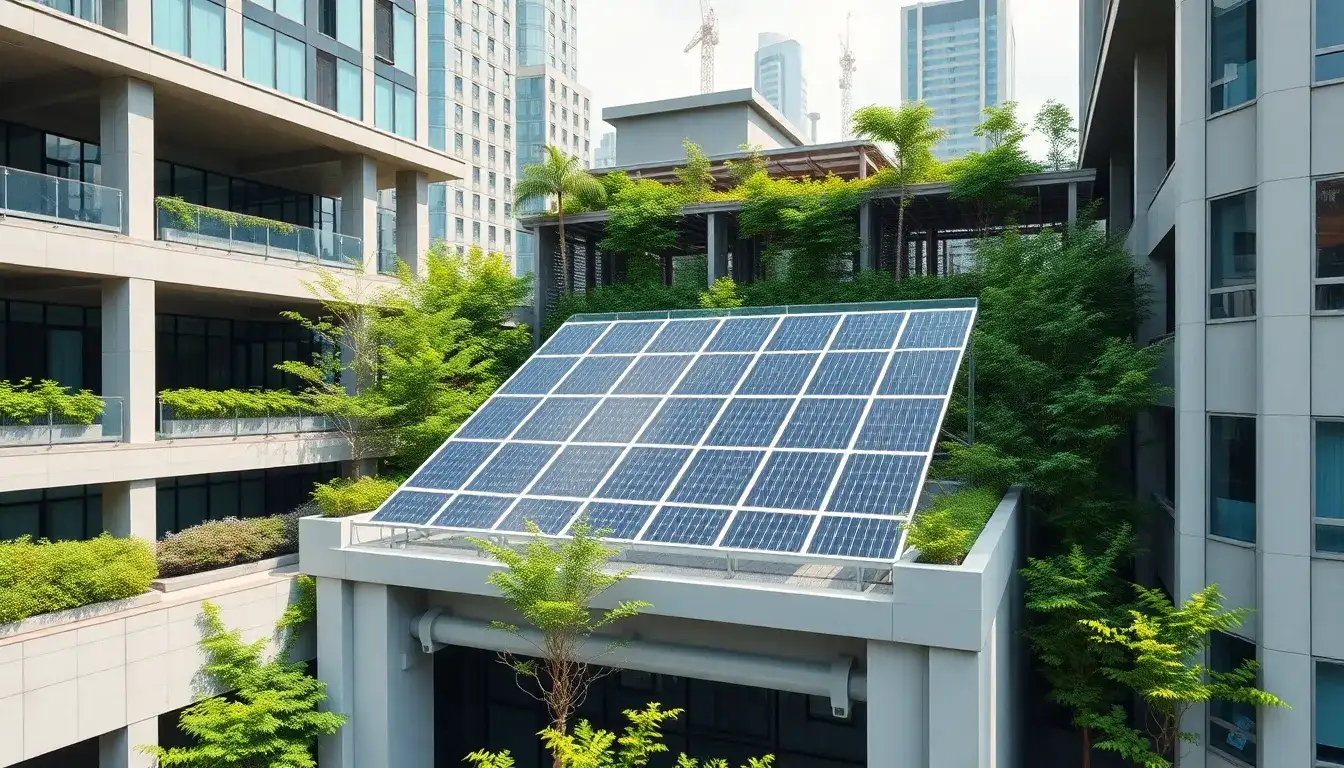
High-Growth Enterprises | China Railway Hualien: Integrating Construction and Photovoltaics to Create Urban “Green Power Plants”
As a major manufacturing city, Dongguan is home to numerous industrial enterprises and a dense array of industrial buildings. A key focus has been on how to "awaken" these industrial rooftops to generate social and economic value. In the context of a slowing real estate market, many construction companies are exploring new pathways for development. Recently, distributed photovoltaics have emerged as a favored sector. With strong policy support, the prospects for the distributed photovoltaic market appear quite promising.

Latest data indicates that by the end of 2024, the cumulative installed capacity of distributed photovoltaic power generation will reach <b>370 million kilowatts</b>, a staggering <b>121 times</b> the level at the end of 2013, accounting for <b>42%</b> of the total installed photovoltaic capacity. This forecast undoubtedly fuels enthusiasm among market players and investors.

For construction companies entering the distributed photovoltaic sector, excelling in a competitive market hinges on having a mature industrial chain. As a specialized enterprise in Guangdong province, <b>China Railway Hualien Construction Engineering Co., Ltd.</b> (hereinafter referred to as "China Railway Hualien") has accelerated its foray into the green energy sector in recent years. Its subsidiary, <b>Huajing New Energy</b>, has established a full industrial chain for the construction of distributed photovoltaic power generation projects, providing integrated solutions from design and project approval to acceptance and operation.

Currently, China Railway Hualien has deployed distributed photovoltaic power stations across various industrial parks nationwide. The contribution of this new business segment to the company's total revenue has rapidly increased, making distributed photovoltaic power stations a "second growth curve" for China Railway Hualien.

<b>Exploring Cross-Industry Collaboration in Construction and Photovoltaics</b>

Photovoltaic power generation can be categorized into centralized and distributed systems. Currently, there is a notable trend towards the simultaneous development of both. Distributed photovoltaic power generation has become a significant force in the energy transition. In recent years, the rapid development of distributed photovoltaics in China has enhanced its economic viability, achieving record-breaking scale and significant breakthroughs. This has played a crucial role in ensuring reliable electricity supply, promoting green energy transition, and increasing rural income and employment.

As of the end of 2024, China's cumulative installed capacity of distributed photovoltaic power generation reached <b>370 million kilowatts</b>, which is <b>121 times</b> that of 2013, and it accounted for <b>42%</b> of the total installed photovoltaic capacity, up from <b>16%</b> in 2013. In terms of electricity generation, distributed photovoltaic generation is expected to reach <b>346.2 billion kilowatt-hours</b> in 2024, representing <b>41%</b> of the total photovoltaic output.

While engineering construction and photovoltaic power stations may seem unrelated, they are closely connected. The installation of solar photovoltaic stations requires high-quality construction teams, bringing the two industries together. On January 8 of this year, China Railway Hualien was listed on the Guangdong Equity Exchange. Established over a decade ago, the company has primarily focused on engineering construction, boasting qualifications in various construction fields such as general contracting for construction projects, municipal public works, and electromechanical engineering.

China Railway Hualien has completed a series of representative projects, including the new factory of <b>Xufuji</b> in Dongguan and the <b>Civilian Home</b> in Ningxiang, earning recognition for its outstanding project quality and gradually establishing a strong brand image in the industry as a specialized enterprise in Guangdong province.

“Although we are not experts in photovoltaic technology, we have the necessary civil engineering and electromechanical expertise required for photovoltaic projects,” said <b>Fu Zhengan</b>, General Manager of China Railway Hualien. “Why not try to undertake these projects ourselves?” The company has a robust R&D team dedicated to developing and applying construction engineering technologies, having secured <b>21 patents</b> that effectively enhance construction quality and efficiency, becoming a core driver of the company’s growth.

Fu noted that distributed photovoltaic projects offer the advantages of local development and utilization, making it a new direction for the company's growth. Rather than launching projects immediately, China Railway Hualien invested significant time understanding the photovoltaic industry, conducting thorough research on project approval processes, component brands, channels, and operational maintenance, including designing and building photovoltaic panel supports.

“From a development perspective, the price of photovoltaic components has dropped from around <b>5 yuan</b> per watt in 2013 to about <b>0.7 yuan</b> per watt now. New energy, including distributed photovoltaic power generation, has fully entered a market-oriented development phase without subsidies,” Fu explained. He also acknowledged the challenges faced by the distributed photovoltaic sector, including limited grid access and the need for a more robust regulatory framework for power market transactions. Especially with the explosive growth of distributed photovoltaic power generation in recent years, grid access has become a major constraint, necessitating a shift in management strategies to foster coordinated efforts among generation, grid, load, and storage, promoting the healthy and rapid development of distributed photovoltaic energy.

<b>Launching the Company’s "Second Growth Curve"</b>

Chairman <b>Wu Lijun</b> explained that in an environment of intensified competition and market saturation, the company is focusing on the broader prospects of the new energy sector. The management team has recognized the significant potential and opportunities within the new energy industry, especially in distributed photovoltaic and energy storage fields. Unlike many competitors, China Railway Hualien has targeted the industrial park sector for its distributed photovoltaic business, as this is the customer group they are most familiar with. Wu believes that achieving a competitive advantage in distributed photovoltaics depends on maximizing returns through scientific site selection, optimized design, and efficient operations.

The company has established a subsidiary, <b>Guangdong Huajing New Energy Co., Ltd.</b>, and is collaborating closely with industrial parks in Dongguan and surrounding cities to secure longer-term contracts. According to China Railway Hualien's calculations, a <b>1-megawatt</b> power project with an investment of <b>3 million yuan</b> can have a lifespan of <b>25 years</b>, with a payback period of just <b>3.5 years</b>.

Currently, a specialized management team of over <b>30 people</b> has been cultivated for photovoltaic power projects. After being listed on the Guangdong Equity Exchange on January 8, 2025, China Railway Hualien further accelerated the development of its new energy sector. With its extensive experience and advantages in construction, the company is vigorously advancing the construction of distributed photovoltaic projects, expecting Huajing’s business volume to exceed <b>30 million yuan</b> by 2025.

China Railway Hualien's business structure is also being optimized, as it collaborates with various partners nationwide to deploy distributed photovoltaic power stations. The new business segment is rapidly increasing its share of total revenue, establishing distributed photovoltaic power stations as the company’s "second growth curve." Currently, the proportion of revenue from photovoltaic projects and signed orders has risen to <b>30%</b>.

Once operational, intelligent operation and maintenance management of the photovoltaic power stations become essential. On a smart display at China Railway Hualien, intuitive bar charts and real-time data inform management staff about the operational status of the power stations. Regarding capacity planning, the company has set clear goals, aiming to reach <b>50 megawatts</b> by 2025, <b>100 megawatts</b> by 2026, and striving for <b>200 megawatts</b> by 2027. Throughout the implementation of new energy projects, the company has established long-term stable partnerships with upstream and downstream enterprises, exploring a cooperative model that emphasizes complementary advantages and resource sharing, thereby building a complete new energy industry chain.

After continuous exploration, China Railway Hualien has successfully streamlined the entire industrial chain for photovoltaic power project construction, from design and project approval to acceptance and operation. The company is now focused on diversifying its new energy business, actively developing photovoltaic energy storage stations, smart charging stations, and regional centralized energy stations, with the goal of becoming a comprehensive service provider for photovoltaic energy system solutions.

“In the future, China Railway Hualien will base its operations on the construction industry while expanding into emerging fields such as new energy and new materials, accelerating the transformation and upgrading of the enterprise,” Wu stated.
Original article by NenPower, If reposted, please credit the source: https://nenpower.com/blog/innovative-integration-of-construction-and-solar-energy-china-railway-hualian-develops-urban-green-power-plants/

