

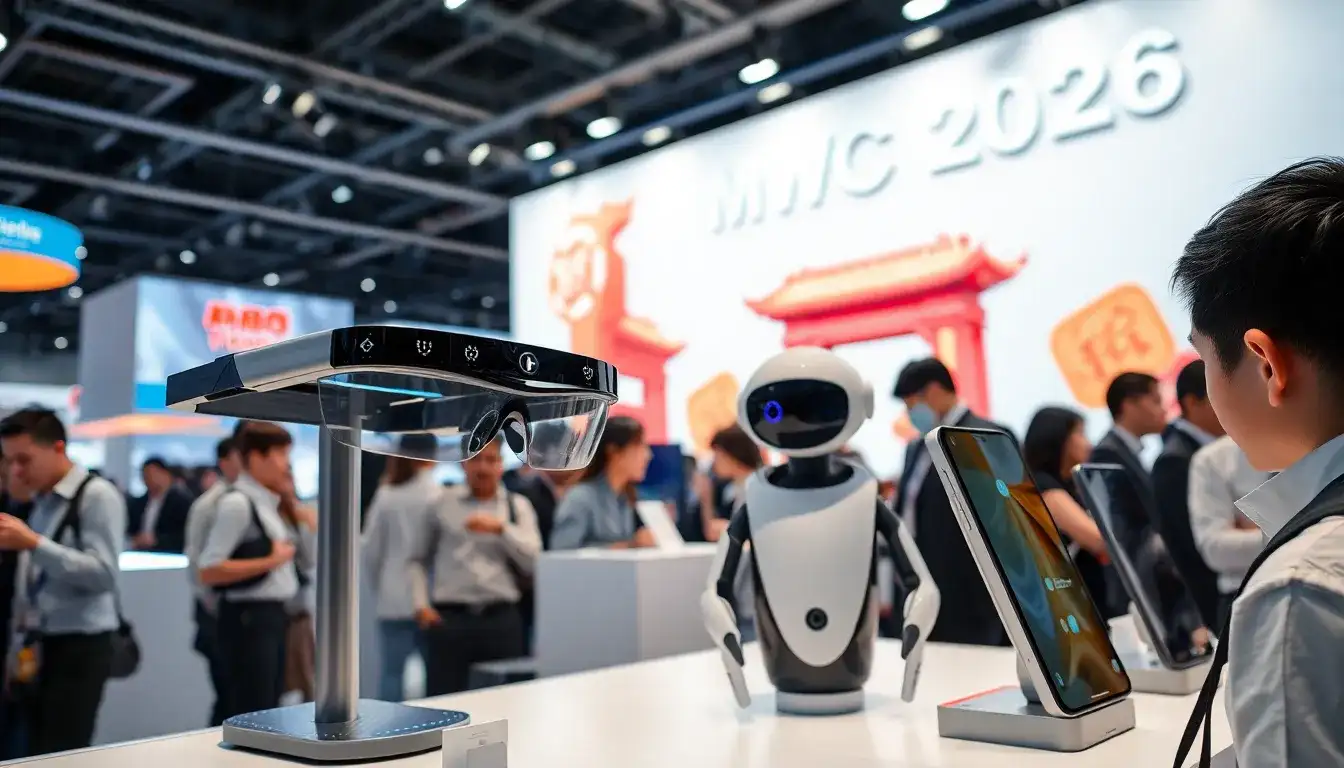
From March 2 to 5, the highly anticipated Mobile World Congress (MWC) 2026 took place in Barcelona, Spain. This year marks the 20th anniversary of MWC being hosted in Barcelona, with the theme “The IQEra (Intelligent New Era).” The event gathered top global players to outline an ambitious vision for the smart era. This year’s exhibition showcased major smartphone manufacturers, telecommunications companies, and various industries involved in embodied intelligence, all centered around the integration of AI and 6G technologies.
AI Fuels Innovation in Device Design and Functionality
As a premier platform for product launches, MWC 2026 saw numerous AI hardware making their debut. For consumers, the AI hardware segment is particularly captivating, while for the industry, the continuous innovation in AI hardware intensifies the competition in the battle for AI-driven endpoints.
Among the highlights, AI glasses emerged as a trending area. During the event, Alibaba’s first AI glasses, alongside Google’s Project Aura developed with Xreal, and Meta’s latest Ray-Ban Meta smart glasses, all targeted the consumer market. Domestic brands also made notable contributions, with the G1 series priced at 2899 yuan. With the inclusion of smart glasses in the government’s recycling subsidy program, the effective price could drop below 2000 yuan, making them appealing for early adopters.
Honor unveiled its innovative Robot Phone, breaking away from traditional smartphone designs with a “boring black box” aesthetic. This device combines embodied intelligent interaction with flagship imaging capabilities, marking a new generation of AI endpoints that offer both intelligence and a personal touch. Honor CEO Li Jian stated that this product is just the beginning of the company’s exploration into AI devices, aiming for an endlessly innovative “cool AI future.”
Chinese firms are not just creating impressive products; they are also focused on integrating AI capabilities into real-world applications. iFlytek showcased GuideX, an AI digital human receptionist solution that supports multimodal interactions, including voice, touch, and visual inputs. It can engage in multilingual natural conversations and connect with business systems to enhance efficiency. Vice President of iFlytek’s Consumer Business Group, Zhan Wenyu, emphasized the goal of creating an AI assistant that can genuinely help users accomplish tasks, serving as a 24/7 professional partner.
Pushing Towards 6G: Advancements in Key Technologies
The significance of 6G extends beyond mere speed; it lays the foundation for “ubiquitous intelligence” and represents a generational leap from connectivity to perception. According to MWC 2026 data, the number of participating Chinese companies reached 350, a significant increase from the previous year, covering the entire telecommunications ecosystem, including operation, equipment supply, terminal manufacturing, and core components. The technological advancements transitioning from 5G-A to 6G were a major highlight, providing a solid foundation for further integration and application of artificial intelligence.
Reports from IDC indicate that AI applications and devices have experienced explosive growth over the past year, presenting immense opportunities for the mobile industry while demanding multidimensional network capabilities. Global active AI users have surpassed 1 billion, with AI-enabled smartphones accounting for over half of shipments. Additionally, AI multimodal interaction has significantly increased uplink demand by 3-5 times. However, the network capacity required for general artificial intelligence (AGI) applications is nearing the limits of traditional 5G networks. During the event, Huawei’s ICT BG CEO Yang Chaobin highlighted that AI development introduces new network demands, necessitating support for ultra-large bandwidth in both uplink and downlink to facilitate data interactions between endpoints and the cloud while ensuring low latency and reliability. Therefore, the evolution towards 6G is inevitable, with 5G-A providing a tenfold increase in uplink and downlink speeds, catering to AI business experiences and incorporating new IoT technologies like RedCap.
Notably, the U6GHz frequency band has been established as a mainstream segment for future mobile communications through multiple discussions at the World Radiocommunication Conference (WRC). Currently, 5G-A supports U6GHz, and mainstream terminal chips along with the supply chain have matured, paving the way for large-scale commercial use.
At this year’s exhibition, manufacturers showcased their latest innovations in network infrastructure. Huawei introduced its full-scene U6GHz product series, covering macro, small, and microwave stations, which can activate the advantages of U6GHz’s ultra-large bandwidth to meet the core demands of AI applications for high capacity, low latency, and excellent user experience, thereby providing systematic solutions for performance upgrades in 5G-A networks and seamless transitions towards 6G.
Groundbreaking Products Showcase Chinese Innovation
The explosion of generative AI is accelerating the arrival of the era of general artificial intelligence. Guangzhou-based Kingsoft’s enterprise network solutions retain traditional advantages such as wide-area coverage and high throughput while enhancing critical capabilities like low latency, high reliability, and local data security, precisely empowering the collaborative development of AI agents, robotic endpoints, and a multitude of IoT devices. The next-generation Connect+ local area network solutions are making the future of intelligent connectivity a reality.
In the realm of 6G frontier technology, ZTE showcased its GigaMIMO technology, featuring the world’s first 2000+ antenna array 6G prototype system operating in the U6G frequency band, which can achieve a capacity boost of ten times compared to 5G-A through AI algorithms. Qualcomm also presented groundbreaking achievements, announcing new milestones in 6G foundational technology evolution, AI-native design for new experiences, and a perception-powered digital twin platform for new services.
China Mobile aims to anchor its position at the forefront of future communications through continuous innovation, solidifying its leadership in 6G technology. At their exhibition booth, scenes of multiple intelligent agents collaborating and making autonomous decisions vividly demonstrated the exciting potential of 6G intelligent communication capabilities, revealing the limitless possibilities of future communication technologies. “Global operators must work together to create a unified global 6G standard system, and the formulation of 6G standards needs to actively adapt to the rapid iterations of AI development, achieving a deep fusion of network connections and intelligent engines,” remarked Liu Guiqing, General Manager of China Telecom.
At MWC 2026, AI glasses led the trend in smart devices, while smartphones transcended the traditional “black box” design, now featuring intelligence and interactivity. Chinese manufacturers showcased remarkable products that highlighted their strong innovative capabilities, making them the focal point of the event and drawing global attention. Chinese brands have become central to global technological innovation, indicating that they are gaining international recognition and showcasing China’s confidence in AI endpoints, smart hardware, and future communication technologies.
Original article by NenPower, If reposted, please credit the source: https://nenpower.com/blog/innovative-ai-glasses-and-robot-phones-capture-attention-at-mwc-2026-showcasing-chinas-global-tech-leadership/

