

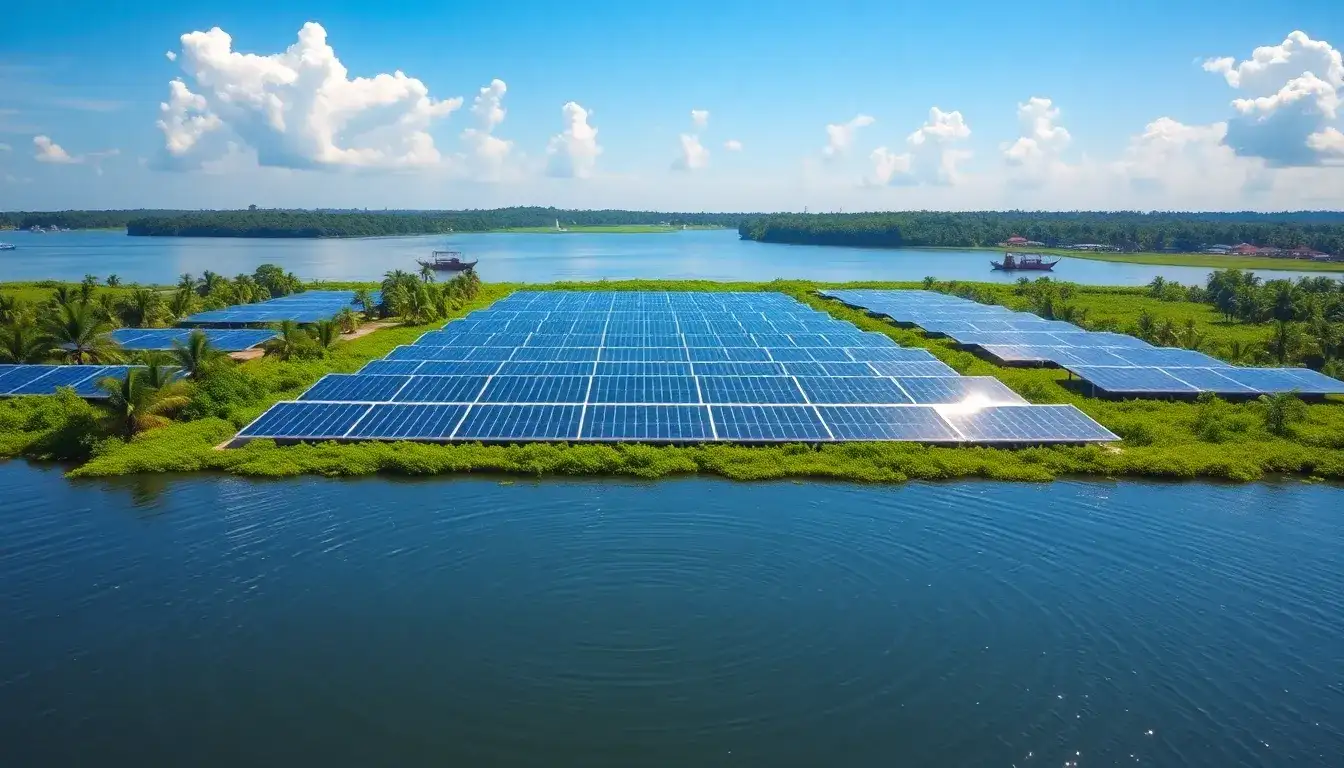
Indonesia’s 60MW Floating Solar Project Commences
On September 25, a groundbreaking ceremony was held for the 60MW floating solar project in Saguning, Indonesia, constructed by China Energy Engineering Group Gezhouba Company. This green energy project is expected to generate approximately 129 million kilowatt-hours of electricity annually. Once completed, it will save around 56,000 tons of standard coal each year and reduce carbon dioxide emissions by 149,000 tons, contributing to Indonesia’s renewable energy development and green transformation goals. The successful operation of this project will provide a replicable model for Indonesia’s energy transition and promote the implementation of more floating solar projects in its aquatic regions.
Inox Solar Sets New Standard for Energy Independence in India
Indian solar manufacturer Inox Solar has officially commenced commercial operations at its module manufacturing facility in Bavla, India, with an initial capacity of 1.2GW. The company is currently focused on fine-tuning the operations at this stage. Inox Solar plans to expand the plant’s production capacity to 3GW. Additionally, after acquiring land in April, the company is “establishing” a 4.8GW battery and module manufacturing facility in Dhenkanal, India. This news has been met with enthusiasm among Indian manufacturers, many of whom have recently developed advanced battery and module production facilities, including IBSolar and INASolar.
EU’s Ambitious Solar Manufacturing Goals Revealed
A recent study conducted by the Fraunhofer Institute for Solar Energy Systems, commissioned by the European Solar Association, concluded that the EU can technically and economically achieve a solar module manufacturing target of 30GW per year. To reach this target, the EU and its member states need to “act swiftly” while ensuring a favorable policy and investment environment. By 2030, the EU’s annual solar module nameplate capacity could potentially reach 44.6GW.
Mixed Trends in European Power Purchase Agreement Prices
According to data from Swiss consulting firm Pexpark, prices for power purchase agreements (PPAs) in Europe experienced a 0.6% decline between July and August. The European composite index used for PPA pricing fell to €48.78 per megawatt-hour by the end of August, down from €49.09 at the end of July. The PPA prices in Poland dropped by 2.9%, contributing to the overall decline across Europe. These transactions encompass a capacity of 421.3MW, indicating that the PPA contract capacity in September will at least match that of August.
Boviet Solar Expands Manufacturing Capacity Beyond 3GW
Boviet Solar began commercial operations at its photovoltaic module plant in Greenville in April. The company is looking to increase its battery manufacturing capacity while also expanding module production capabilities, completing external construction work for the battery manufacturing facility at the Greenville plant in August. Alongside Boviet Solar, ES Foundry is also advancing its own battery manufacturing plant in the U.S., breaking ground in February across the border in South Carolina.
Brookfield and Solarvest Join Forces for 1.5GW Solar Storage Project in Malaysia
Global investment firm Brookfield has signed a joint investment framework agreement with Malaysian developer Solarvest to construct, develop, and operate a large-scale solar and battery storage system combination project of at least 1.5GW over the next three to five years. Under the agreement, Solarvest will leverage its local expertise in project development within Malaysia. The interest in solar storage projects in Malaysia has been on the rise in recent years. Last month, Malaysian clean energy company Gentari Renewables and infrastructure firm Gamuda also announced a joint development of a 1.5GW solar storage project in the country.
Masdar Consortium Wins Oman 500MW Solar Project Bid
A consortium comprising Abu Dhabi Future Energy Company, Korea Midland Power Company, and Oman’s Al Khadra Partners has won the international tender for a 500MW solar independent power project in Oman. The Ibri III project, valued at €155 million, marks the fourth large solar project in Oman. The Oman Power and Water Procurement Company will sign a power purchase agreement with the consortium, with plans for commercial operations to commence in the first quarter of 2027. In June 2024, the qualification results for the Ibri III solar project were announced, with nine developers from Korea, France, and China passing the pre-qualification phase.
U.S. Solar Policies Threaten 330,000 Jobs Amid Layoff Concerns
Concerns are growing over layoffs in the U.S. solar industry due to manufacturing and policy issues. While this may be a positive development for U.S. solar deployment, the relative lack of manufacturing job opportunities is particularly worrisome. Looking ahead, an E2 report indicates that the passage of the Inflation Reduction Act could pose challenges to the continued growth of renewable energy jobs in the U.S. The report highlights that around 330,000 jobs in the solar industry could face “direct, indirect, and induced” risks, representing a threat to 89% of the current jobs in the U.S. solar sector.
Iraq Launches First Industrial-Scale Solar Power Plant in Karbala
Iraq officially inaugurated its first industrial-scale solar power plant in Karbala province, located southwest of Baghdad, on Sunday. Nasser Karim Sultani, head of the national solar project team from the Prime Minister’s office, revealed that the Karbala solar power plant will ultimately achieve a peak generation capacity of 300MW. This project is part of Iraq’s large-scale solar initiative. The Deputy Minister of Electricity, Adel Karim, stated that the total capacity of solar projects currently being implemented, approved, or negotiated nationwide has reached 12,500MW.
Solar Power Dominates Malaysia’s Renewable Energy Capacity
Official data from Malaysia indicates significant growth in the country’s solar power capacity, which now accounts for 92% of its total renewable energy installed capacity. Malaysia has set targets of achieving a renewable energy share of 31% by 2025 and 40% by 2035. To meet these goals, the Malaysian government has introduced various policies and incentives to stimulate renewable energy growth. Additionally, measures such as feed-in tariffs have been implemented to ensure the successful realization of renewable energy targets. However, industry insiders note that despite the rapid growth of renewable energy in Malaysia, challenges remain.
Original article by NenPower, If reposted, please credit the source: https://nenpower.com/blog/indonesia-launches-60mw-floating-solar-project-to-boost-renewable-energy-goals/

