

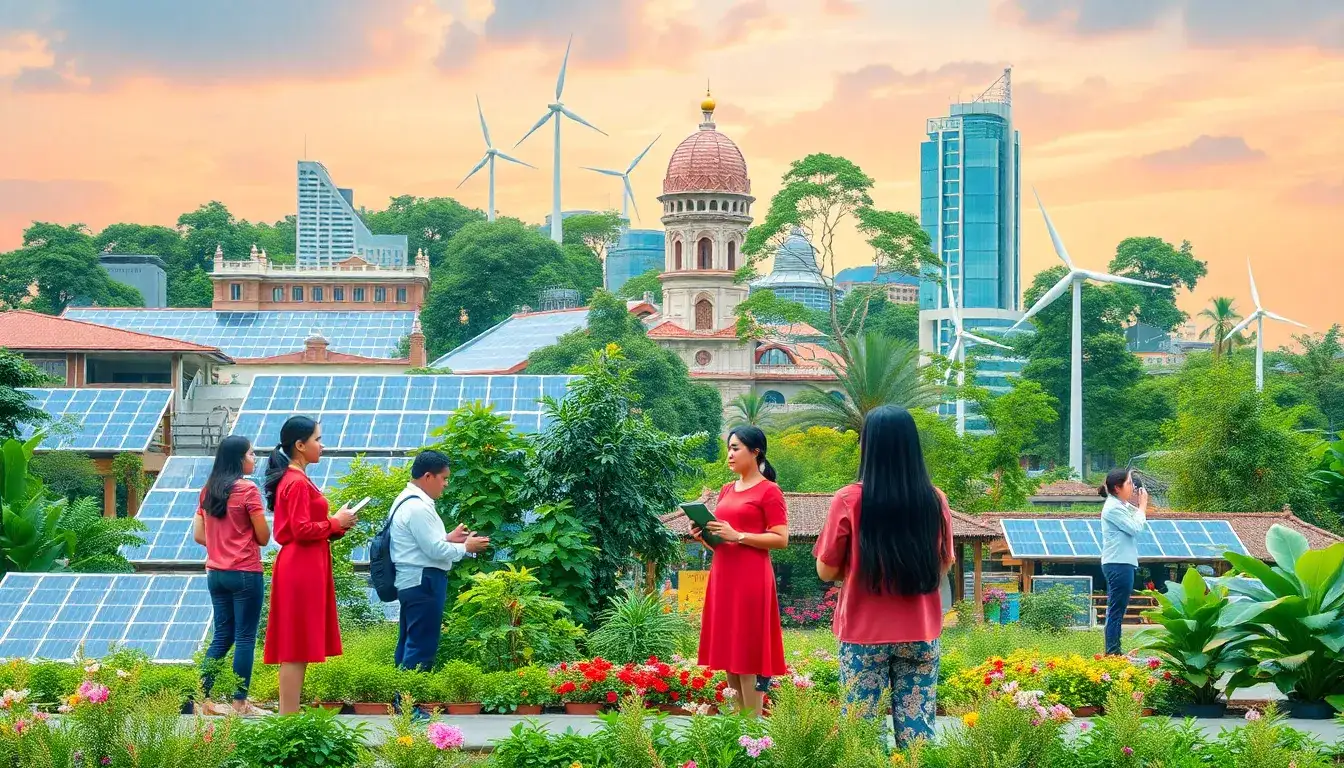
Indonesia is set to host the 2025 International Sustainable Development Forum on October 10-11, 2025, at the Jakarta International Conference Center. This event will reaffirm Indonesia’s role as a hub for regional and global green investment. Designed as a platform for discussion and action, the forum aims to connect global visions with concrete actions by bringing together governments, businesses, and international partners to accelerate the transition to an inclusive and sustainable green economy. With the theme “Investing in a Resilient, Sustainable, and Prosperous World,” the forum reflects Indonesia’s strategic direction of promoting green investment as the core engine for future economic growth.
Indonesia’s participation signifies its role not only as a participant in global dialogues but also as a bridge connecting the interests of both Northern and Southern countries, combining local relevance with global influence. The country’s strategic position as a center for green investment is supported by numerous complementary factors, including an immense renewable energy potential of approximately 3,700 gigawatts, sourced from various renewable sources such as solar, hydro, wind, geothermal, and biomass. This potential is further bolstered by the ambitious plans outlined in the “2025-2034 Electricity Supply Business Plan” and commitments to achieve net-zero emissions by 2060. Indonesia showcases its infrastructure and technological maturity through strategic projects such as the Cirata Floating Photovoltaic Power Plant and green hydrogen development. In addition, the presence of global cooperation mechanisms like the “Just Energy Transition Partnership” underscores Indonesia’s trustworthiness as a strategic partner in the decarbonization agenda.
On the policy front, new regulations, such as the Minister of Energy and Mineral Resources Regulation No. 5 of 2025, continue to optimize the investment environment through legal certainty and incentives for renewable energy. Positioned along the equator and strategically located between two continents and two oceans, Indonesia not only offers promising green investment opportunities but also possesses geopolitical and economic strategic value. This multilateral conference will serve as a crucial platform for connecting global investors with mature sustainable development projects. Through initiatives such as “Immediate Project Recommendations,” a variety of locally sourced projects that meet sustainable development standards will be presented, aiming to attract capital inflow while ensuring that investments support the transition to clean energy, green economic growth, and inclusive improvements in livelihoods.
Electrification of transportation is highlighted by Indonesia’s Minister of Infrastructure, Agus, as a key initiative for promoting sustainable economic growth. He pointed out the multiple benefits of transitioning from fossil fuels to electric vehicles, including reducing oil imports, saving energy subsidies, and modernizing the national transportation system. As of August this year, over 120,000 pure electric vehicles have been sold in Indonesia, capturing approximately 10% of the market share. The country is currently constructing several new factories, some of which are expected to be fully operational next year. However, he emphasized that electrification should not be limited to private vehicles, as the more daunting challenge lies in decarbonizing public transportation, logistics, and freight systems.
In addition to electrification, Agus stressed the importance of downstream industrial processing to create economic added value. Transforming raw materials into high-value products is crucial, allowing Indonesia to shift from merely exporting quantities to exporting value. He stated, “The successful downstreaming of the nickel industry has transformed Indonesia’s export structure and created greater national value. We are now targeting potential commodities such as copper, bauxite, palm oil derivatives, and seaweed to replicate this success.” Agus reiterated the necessity for cleaner production processes, indicating that the government is continuously promoting industrial decarbonization through energy efficiency improvements, digital transformation, hydrogen technology reserves, and carbon capture applications.
Regarding investments, he emphasized the need to establish partnerships between the government and the private sector. According to data from the National Development Planning Agency, Indonesia requires approximately $650 billion (around 10.7 trillion IDR) in infrastructure investments to achieve its target of 8% economic growth, with about $190 billion needing to come from private capital. Meanwhile, Indonesia’s Investment Minister, Rosan, announced that a waste-to-energy project will launch in early November, aiming to implement the initiative in 33 cities across Indonesia. The project will initially cover ten cities, including Tanggerang, Jakarta, Bandung, Yogyakarta, Semarang, Surabaya, Bali, and Makassar. In addition to generating clean electricity, the project is expected to improve environmental quality and create job opportunities. Within the next two years, major city waste will be converted into electricity, with the Danantara-supported waste-to-energy project capable of processing 1,000 tons of waste daily, anticipated to coincide with domestic job growth.
Investment in water resources has become a pressing issue to address the significant global funding gap in this sector. The United Nations Secretary-General’s Special Advocate for Water Resources, Retno, revealed at the forum that the annual investment demand for water supply and sanitation facilities globally ranges from $600 billion to $1 trillion, while current actual annual spending is only about $300 billion to $400 billion. According to World Bank data, developing countries invest only 0.5% of their GDP in water infrastructure. Retno noted that nearly 91% of annual expenditures in the water sector are still borne by the private sector.
She analyzed that the water sector is often viewed as high-risk and low-return, but this perception is misguided, as water investments can yield significant benefits. The former Indonesian Foreign Minister emphasized that water investments not only drive economic growth but also have profound impacts on public health, education, gender equality, and climate resilience. Using an example from Africa, she stated that every $1 invested in water infrastructure can generate $7 in returns. She reiterated the need to strengthen water resource investments continuously: “Specific measures include promoting blended financing models while ensuring public interests are safeguarded.” Retno also announced that investment topics will be a core agenda item at the UN Water Conference scheduled for December 2026 in the UAE and Senegal. She mentioned that during her 11 months as the UN Special Advocate for Water, water resource issues are gradually being integrated into high-level political agendas, with global coordinated actions and commitments to accelerate implementation becoming increasingly strengthened, though current progress remains insufficient to address the numerous challenges facing the water sector.
Despite the significant challenges in water development, Retno believes that these obstacles can be overcome. She pointed out that the world today possesses the knowledge, technological tools, and financial conditions to tackle these issues; what is needed now is to unite global political will, maintain policy coherence, and take collective action. This forum adheres to the core narrative of “Dialogue Today, Co-create Tomorrow.” Guided by the spirit of “From Global Forums to Collective Action,” Indonesia demonstrates that dialogue can translate into commitments, and visions can be realized through cross-sectoral collaboration. On this platform, the seeds of cooperation are being sown, with hopes that they will grow into a long-term partnership benefiting humanity and the Earth. Indonesia is not only ready but is also equipped to serve as a center for green investment—promoting sustainable development, connecting local opportunities with global agendas, and ensuring a cleaner, fairer future forged through collective strength.
Original article by NenPower, If reposted, please credit the source: https://nenpower.com/blog/indonesia-hosts-2025-international-sustainable-development-forum-to-position-green-investment-as-core-economic-growth-driver/

