

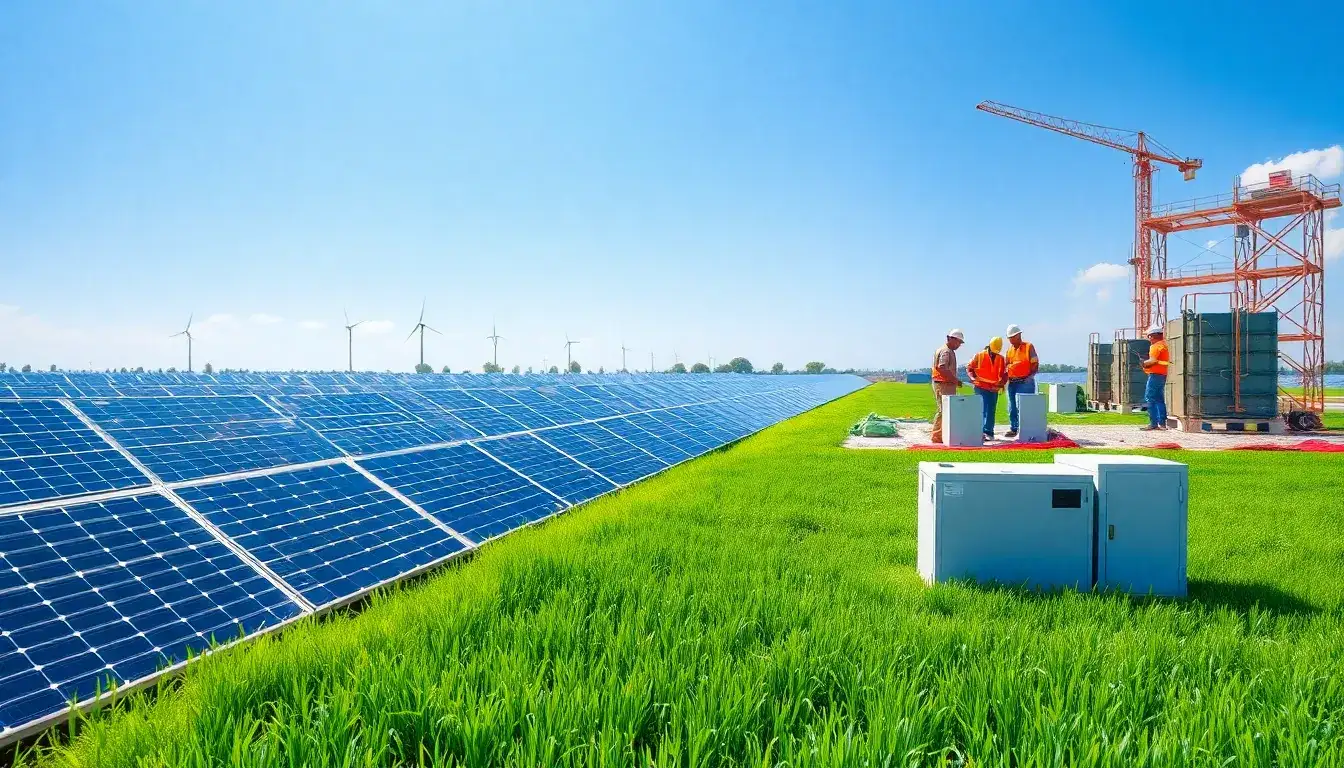
India’s renewable energy battery storage sector is advancing with new initiatives from state-run agencies SECI (Solar Energy Corporation of India) and CEA (Central Electricity Authority). Recently, SECI announced a substantial tender for 1,200 MW of solar photovoltaic (PV) generation combined with 600 MW/3,600 MWh of battery storage, which will be linked to the Inter-State Transmission System (ISTS).
SECI, which operates under the Ministry of New and Renewable Energy (MNRE) and is pivotal in promoting the National Solar Mission, issued a Request for Selection (RfS) on June 19, 2025, for this competitive solicitation. As with previous solar-plus-storage tenders, winning bidders will secure a 25-year power purchase agreement (PPA) with SECI for their build-own-operate (BOO) projects. SECI will then sell the power produced and stored by these projects to designated Buying Entities.
The inclusion of battery storage will allow electricity to be supplied during peak demand periods. Successful bidders will be required to provide clean energy for six hours daily during peak times, specifically from 6 PM to 9 AM the following morning. During each of these six hours, the batteries must be capable of discharging continuously for one hour. Developers must ensure they can supply 3,000 kWh of energy for every MWac of installed solar PV capacity during these specified peak hours. A pre-bid meeting is scheduled for July 10, 2025, with bidding set to open on August 21.
Tenders from SECI and other government agencies have been instrumental in advancing procurement within India’s developing energy storage sector. At a recent workshop held by the CEA, SECI representatives discussed BESS (Battery Energy Storage Systems) tenders, tariff trends, and their experiences with operational and under-construction BESS projects. According to a CEA briefing, SECI reported that its Solar+BESS tender tariffs decreased from IR6.99/unit in August 2018 to IR3.09/unit by September of the previous year.
In a Guest Blog for Energy-Storage.news, Debmalya Sen, president of the India Energy Storage Alliance (IESA), detailed the transformative effects of three main types of tenders integrating energy storage: standalone BESS, solar-plus-storage, and Firm, Dispatchable Renewable Energy (FDRE). SECI has conducted two Solar+BESS tenders to date, awarding 1,200 MW of solar PV and 1,200 MWh of BESS in March 2024, and 2,000 MW of PV and 4,000 MWh of BESS in August 2024. Despite these successes, it remains early days for India’s solar-plus-storage tenders. According to Sen’s data, only 200 MW of solar PV and 200 MWh of battery storage have been operationalized through Solar+BESS tendering. An additional 1.2 GW of PV and 1.2 GWh of BESS capacity is currently under construction, while 3.4 GW of PV and 5.4 GWh of BESS have been awarded but are yet to be built, indicating that project durations are increasing. Some tendered projects have also faced cancellation, highlighting the challenges in this sector.
In related developments, the CEA has released new safety regulations for battery storage installations, which will take effect upon publication in the authority’s Official Gazette. These regulations outline rules for installing and operating BESS assets, focusing on battery management systems (BMS) and power conversion systems (PCS).
The regulations include general guidelines, such as the necessity for fire and explosion testing according to relevant standards, ensuring chargers are designed for the specific battery chemistry, and integrating two-fault tolerance into designs to prevent catastrophic failures. More specific requirements encompass explosion-proof designs at the container level, maintaining 7.5-meter clearances between BESS enclosures and external structures, and mandating large-scale fire testing, ventilation, hazard detection and suppression, security systems, and emergency shutdown technologies.
The CEA will also require third-party fire safety audits, with reports to be submitted to relevant fire inspectors, and trained professionals must be available in case of emergencies. These new regulations come in response to growing calls for BESS safety standards globally, particularly in European Union territories and the US, which has more developed codes and standards. The forthcoming edition of the National Fire Protection Association (NFPA) standard NFPA 855 includes large-scale fire testing requirements, which many companies in the industry have already adopted as best practices.
The CEA projects that India will require significant energy storage capacity—74 GW/411 GWh from both batteries and pumped hydro energy storage (PHES) by 2031-2032—to achieve its goal of 500 GW of non-fossil fuel electricity by 2030 and to remain on track for a net-zero electricity system by 2070. During the recent workshop, CEA staff and participants emphasized the need to better realize BESS’s value in providing a wider range of grid applications, including frequency regulation, ancillary services, and voltage support. They also recommended establishing a national testing and certification laboratory for BESS compliance and enhancing the credibility of domestic systems. Additionally, incentives for critical component production, such as BMS, fire protection equipment, liquid-cooling thermal management, and BESS containers, were suggested.
Original article by NenPower, If reposted, please credit the source: https://nenpower.com/blog/indias-seci-issues-major-solar-and-battery-storage-tender-amid-new-safety-regulations-from-cea/

