

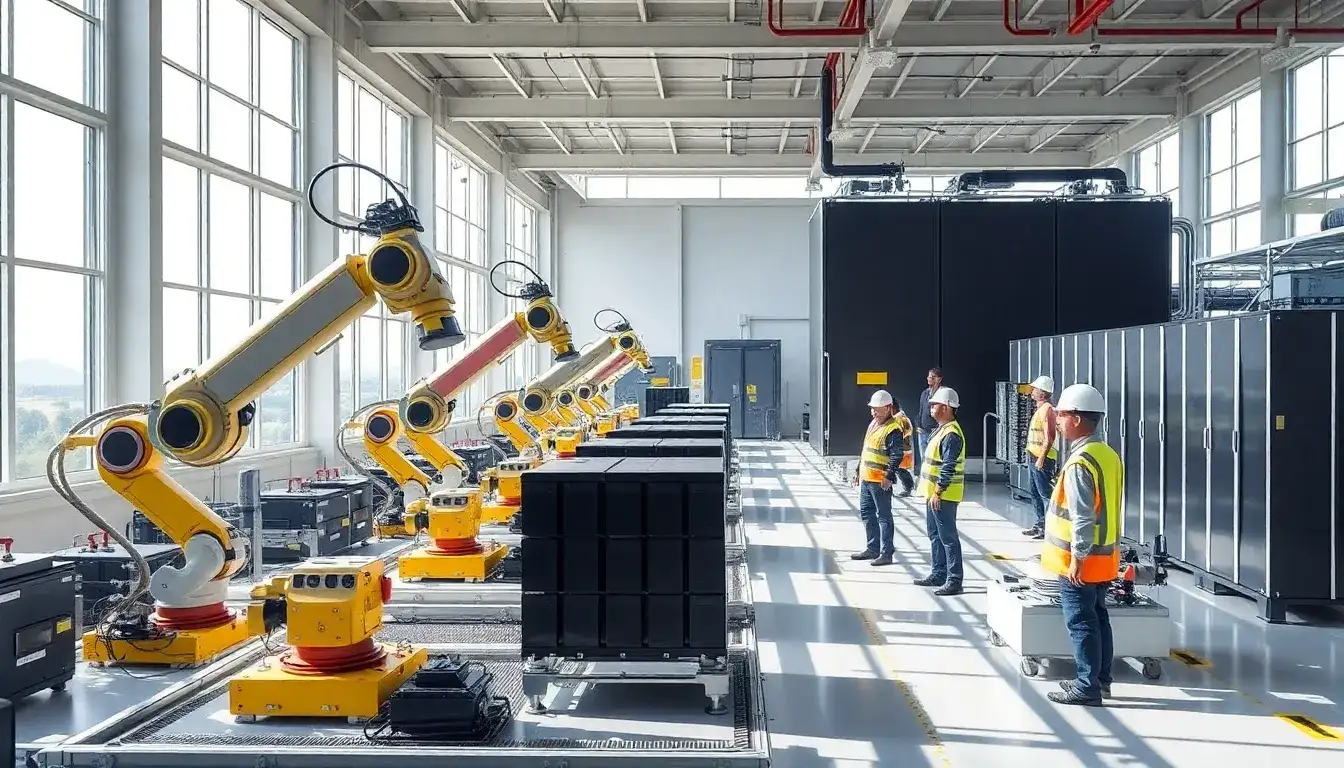
India’s First Fully Automated BESS Factory Opens in Karnataka
—
India has marked a significant milestone with the opening of its first fully automated Battery Energy Storage System (BESS) factory in Karnataka. The inauguration took place on June 27, 2025, in Bengaluru, the state capital. The factory, operated by Lineage Power, specializes in power conversion systems (PCS) and power plant controls, drawing on its expertise from the telecommunications sector. The facility has a production capacity of 5 Gigawatt-hours (GWh).
During the opening ceremony, Karnataka’s energy minister, KJ George, emphasized the vital role of energy storage in harnessing solar and wind power effectively. He announced that battery storage systems would be integrated into all solar photovoltaic (PV) power plants, enabling the storage of excess energy for grid supply when needed. According to a tweet from the state government’s Department of Information and Public Relations (DIPR), George noted that renewable energy sources like wind and solar now account for 65% of Karnataka’s energy generation. He highlighted the necessity of effective storage systems to manage energy supply during peak demand periods.
While the Deccan Herald reported that mandatory storage requirements were not explicitly stated by George, the DIPR tweet suggested that some form of regulation could be forthcoming.
### Advancing Towards Renewable Energy Goals
The new factory, located in Bidadi in Bengaluru’s South District, is described by Pace Digitek—Lineage Power’s parent company—as a unique, fully automated BESS manufacturing facility. Pralhad Joshi, India’s Union Minister of New and Renewable Energy, was also present at the event. He stated that the factory would produce 5 Megawatt-hours (MWh) DC blocks designed for utility-scale applications, paired with a 2.5MW PCS, with an annual production capacity of 5GWh.
Joshi asserted that as renewable energy integration into the grid increases, reliable and scalable energy storage solutions will become crucial. He added that projects like the Lineage Power factory are instrumental in achieving India’s target of 500 Gigawatts (GW) of non-fossil fuel capacity by 2030.
In a recent guest blog for Energy-Storage.news, Debmalya Sen, president of the India Energy Storage Alliance (IESA), pointed out the Union government’s focus on promoting domestic supply chains for energy storage. Despite the provision of subsidies for the manufacture of 40 GWh of advanced chemistry cell (ACC) batteries through the national Production-Linked Incentive (PLI) scheme, the production of battery cells has yet to gain momentum in India. However, there is an expectation of reaching 225 GWh of annual production capacity for battery packs by the decade’s end.
The Indian energy landscape is also exploring various storage technologies beyond batteries. The Central Electricity Authority (CEA) has indicated that energy storage should be a mandatory component in solar PV tenders and has projected a significant need for pumped hydro energy storage (PHES) to provide long-duration energy storage alongside BESS. In Karnataka, minister KJ George mentioned plans for a 2 GW battery storage project and three PHES plants, including the 2 GW Sharavathi project, 1.5 GW Varahi project, and 1 GW Pavagada project. Additionally, state-owned NTPC is piloting the deployment of flow battery storage and a carbon dioxide-based long-duration energy storage technology from the Italian company Energy Dome.
Original article by NenPower, If reposted, please credit the source: https://nenpower.com/blog/india-launches-its-first-fully-automated-battery-energy-storage-system-factory-in-karnataka/

