

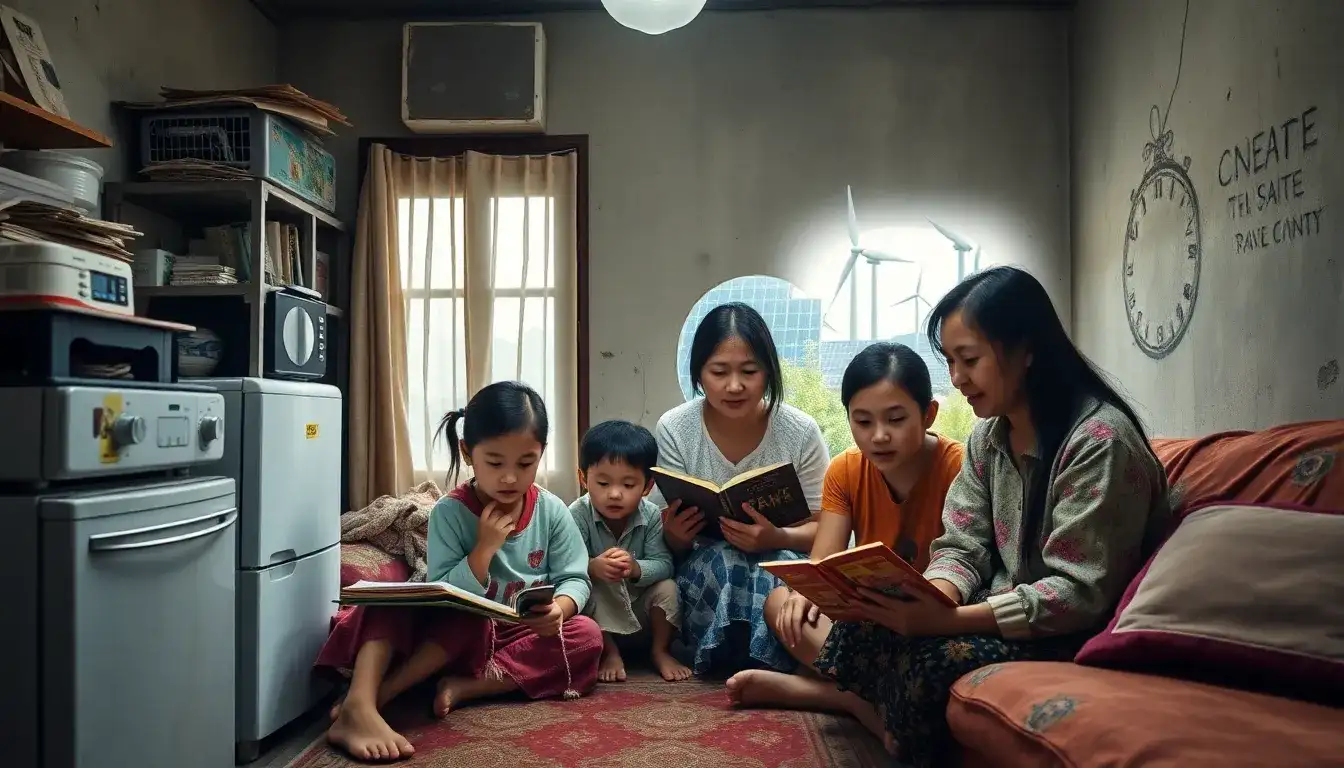
In response to the International Day for the Eradication of Poverty on October 17, the Child Welfare League Foundation (CWLF) is urging society to pay attention to the profound impact of energy poverty on underprivileged families and children. Amid the global energy transition and climate change, CWLF’s long-term observations and research indicate that energy poverty has become a hidden challenge for disadvantaged households, adversely affecting children’s health, education, and development opportunities.
To address this issue, CWLF has been implementing the “Home Living Environment Improvement Program” since 2022, which assists families with home repairs, utility maintenance, and equipment upgrades. Over the past three years, this initiative has invested NT$12.4 million, benefiting more than 2,000 households and over 3,000 children.
On October 15, CWLF hosted the “Energy Equity: International Perspectives on Energy Security for Disadvantaged Families” forum, inviting officials from the Ministry of Health and Welfare, legislators, and scholars from the United States, New Zealand, and South Korea to discuss energy justice for children and families. The forum aimed to inspire local action through international experiences.
CWLF calls on the government to expedite the implementation of energy equity policies and hopes to mobilize resources to eliminate energy poverty, ensuring that every family can access affordable and safe energy.
According to a CWLF survey conducted in collaboration with the Industrial Technology Research Institute, 61.2% of disadvantaged families reported having difficulty paying utility bills, and 35.5% of households spent more than 10% of their income on energy, indicating severe energy poverty. Over 40% of these families use old or second-hand appliances, with 33.5% having refrigerators over ten years old, leading to high energy consumption, safety concerns, and reduced spending on children’s education and health.
The “Home Living Environment Improvement Program” aims to illuminate the hopes of disadvantaged families by providing necessary support for home repairs and equipment upgrades. The program has replaced 939 energy-efficient appliances, including refrigerators and air conditioners, for 829 households through the “Good Life Project.” Additionally, under the “Good Reading Project,” lighting quality has been improved in 385 households by replacing fixtures with LED smart ceiling lights and providing 1,555 LED desk lamps to create safe and bright learning spaces for children.
For instance, one family, living in a dimly lit home with outdated fluorescent lights, struggled with reading and faced increasing vision problems. During a home visit, a CWLF social worker recognized their need and utilized the program to upgrade their lighting, significantly enhancing their living conditions.
By organizing forums on energy poverty, CWLF seeks to learn from international experiences to promote children’s welfare. Experts such as Steven Nadel, Executive Director of the American Council for an Energy-Efficient Economy, and Dr. Kimberley O’Sullivan from the University of Otago in New Zealand shared insights on energy burdens, efficiency strategies, and relevant policies from their countries.
During the discussions, the U.S. definition of energy burden was analyzed, comparing short-term bill subsidies and long-term efficiency improvement strategies across nations. New Zealand scholars highlighted the impact of energy poverty on children’s health and education, discussing the effectiveness of government insulation and winter energy subsidies. Additionally, South Korean researchers explained the legislative responsibilities under the national Energy Law, including measures like energy vouchers and efficiency improvement programs.
CWLF Chairman Liu Bangfu stated, “There are many approaches being explored internationally to address energy poverty. We hope that by sharing global experiences, we can translate these into concrete actions and advance ‘housing justice’ and ‘energy justice’ in line with the SDGs.”
On this International Day for the Eradication of Poverty, CWLF emphasizes the importance of addressing energy poverty. It is not just an economic issue for families; it also impacts health, living conditions, and social participation, significantly affecting the quality of life and dignity of economically disadvantaged children. Witnessing children unable to access cooling or heating due to financial constraints, or lacking adequate lighting for studying, compels us to take action to improve their environment.
CWLF will continue to advocate for energy equity, bringing together government, business, and civil society to create a safe and conducive living and learning environment for children.
CWLF Executive Director Zhou Dayao remarked, “As we celebrate our 75th anniversary, we remain committed to ending poverty. Looking ahead, we will enhance the precision of our services and assist families in improving their living conditions based on evidence. We will continue to pay attention to the multiple challenges faced by disadvantaged families to ensure the effectiveness of policy-making and support services, striving to help them gradually escape poverty through public-private collaboration.”
Original article by NenPower, If reposted, please credit the source: https://nenpower.com/blog/improving-living-conditions-addressing-energy-poverty-for-vulnerable-families-in-taiwan-on-international-day-for-the-eradication-of-poverty/

