

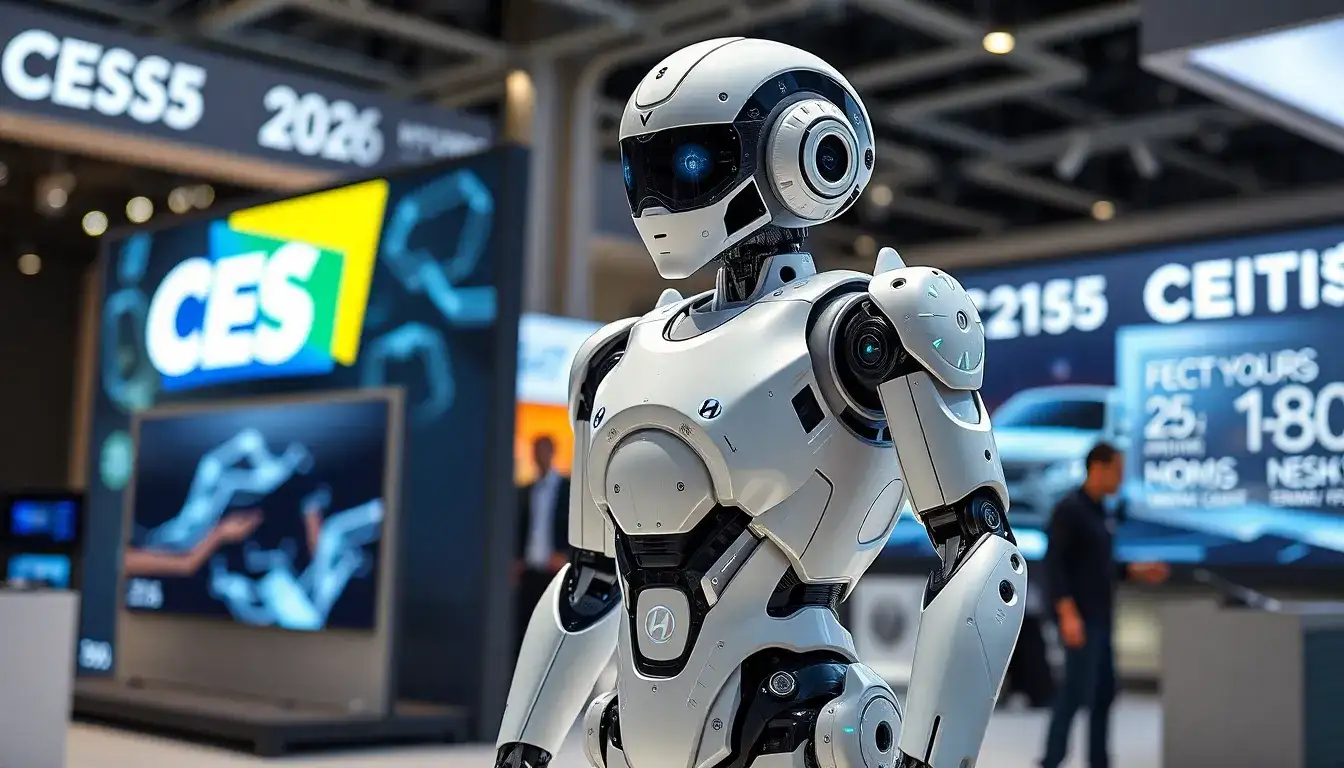
Automotive companies are creating robots equipped with tactile sensors and joints that can rotate 360 degrees. On January 5, 2026, at CES 2026 in Las Vegas, Hyundai Motor Group unveiled its next-generation humanoid robot, “Atlas,” for the first time globally. This event highlighted a vision for AI robot technology that focuses on collaboration with humans, transitioning from merely replacing humans in hazardous jobs to a goal of coexisting and cooperating with digital colleagues.
The theme for this year’s CES, “AI Robot Technology: Beyond the Laboratory into Life (Partnering Human Progress),” represents an evolution from Hyundai’s 2022 focus on expanding mobility experiences. Over the past three years, automobiles have transitioned into Software Defined Vehicles (SDVs), and robots have entered an era where their performance is determined by software and data.
At CES 2026, Hyundai’s core message centers around developing robots that go beyond hardware, enabling them to perform cognitive, judgment-based, and action-oriented tasks as “embodied AI.” The company outlined three main strategies for a long-term roadmap:
- Initiating human-robot collaboration in manufacturing environments
- Integrating AI robot technology across its subsidiaries
- Establishing partnerships with leading AI companies
The physical model of the next-generation humanoid robot “Atlas” was presented for the first time at this CES. Developed in collaboration with Boston Dynamics, Hyundai’s U.S. subsidiary, Atlas comes in two versions: a prototype for research and a product version designed for practical use. The production version features 56 fully movable joints, hands equipped with tactile sensors, and cameras capable of 360-degree recognition, enabling it to perform tasks similar to those of humans. It can lift items weighing up to 50 kilograms and operates effectively in environments ranging from -20 to +40 degrees Celsius.
Hyundai plans to begin phased implementation of Atlas at its “Hyundai Motor Group American Plant” in Georgia starting in 2028. Initially, the robot will be used in processes that have proven safety and efficiency, such as parts sorting, with broader applications like assembly expected by 2030. The company aims for a gradual expansion of tasks, prioritizing safety and quality, starting with repetitive, high-weight, and high-risk jobs to enhance the safety of factory workers.
The core of Hyundai’s AI robot technology strategy focuses on manufacturing environments, designating HMGMA as a “Software Defined Factory” (SDF), which will serve as a testing ground for robot learning and validation. SDF operates as a cutting-edge smart factory based on data and software, where robots will play a crucial role in maximizing flexibility throughout the manufacturing process to improve production efficiency. To support the learning and performance of AI robots, the factory will provide a development environment based on vehicle manufacturing data, enabling robots to learn from actual process data and enhance their performance through a positive feedback loop. By the end of the year, Hyundai plans to establish a dedicated robot learning space called the “Robot Super Factory Application Center (RMAC)” in the U.S. This center will facilitate data exchange between robots trained through mapping techniques and practical experience acquired in the SDF.
Hyundai’s subsidiaries have clearly defined roles: Hyundai and Kia will provide manufacturing infrastructure and process data, Hyundai Mobis will supply crucial components like robot actuators, and Hyundai Glovis will handle logistics automation and supply chain optimization. The company aims to establish a mass production system capable of manufacturing 30,000 robots annually by 2028.
Furthermore, Hyundai is enhancing its AI capabilities through partnerships with major tech companies like NVIDIA and Google DeepMind. Hyundai and NVIDIA have formed a strategic partnership aimed at achieving embodied AI, planning to leverage NVIDIA’s GPUs, simulators, and AI frameworks. Recently, Hyundai has also collaborated with the South Korean Ministry of Science and ICT to bolster South Korea’s embodied AI capabilities. Boston Dynamics is working with Google DeepMind to develop a foundational AI model specifically for humanoid robots, which involves extensive data training to cater to various tasks. Google DeepMind is continuously optimizing its “Gemini Robotics” model based on the generative AI model Gemini, aiming to combine it with Boston Dynamics’ advanced robotic technologies.
Hyundai is also introducing a “Robot as a Service” (RaaS) model, allowing customers to access robots through subscription or usage fees, rather than outright purchases. This model will include software upgrades, maintenance, and remote management services, targeting expansion into manufacturing, logistics, construction, and facility management sectors. Hyundai’s strategy also outlines a plan to invest a record 125.5 trillion won (approximately 6.063 trillion RMB) over the next five years in South Korea and 26 billion dollars in the U.S. from 2025 to 2028, primarily focusing on partnerships for AI and autonomous driving technologies.
A Hyundai representative stated, “What matters is not what technology can do, but what humans can achieve through technology.” The company aims to demonstrate a vision of true collaboration between humans and robots for human advancement, continuing to pursue its corporate value of “Progress for Humanity.”
Original article by NenPower, If reposted, please credit the source: https://nenpower.com/blog/hyundai-unveils-next-generation-humanoid-robot-atlas-with-advanced-ai-and-sensory-technology-at-ces-2026/

