

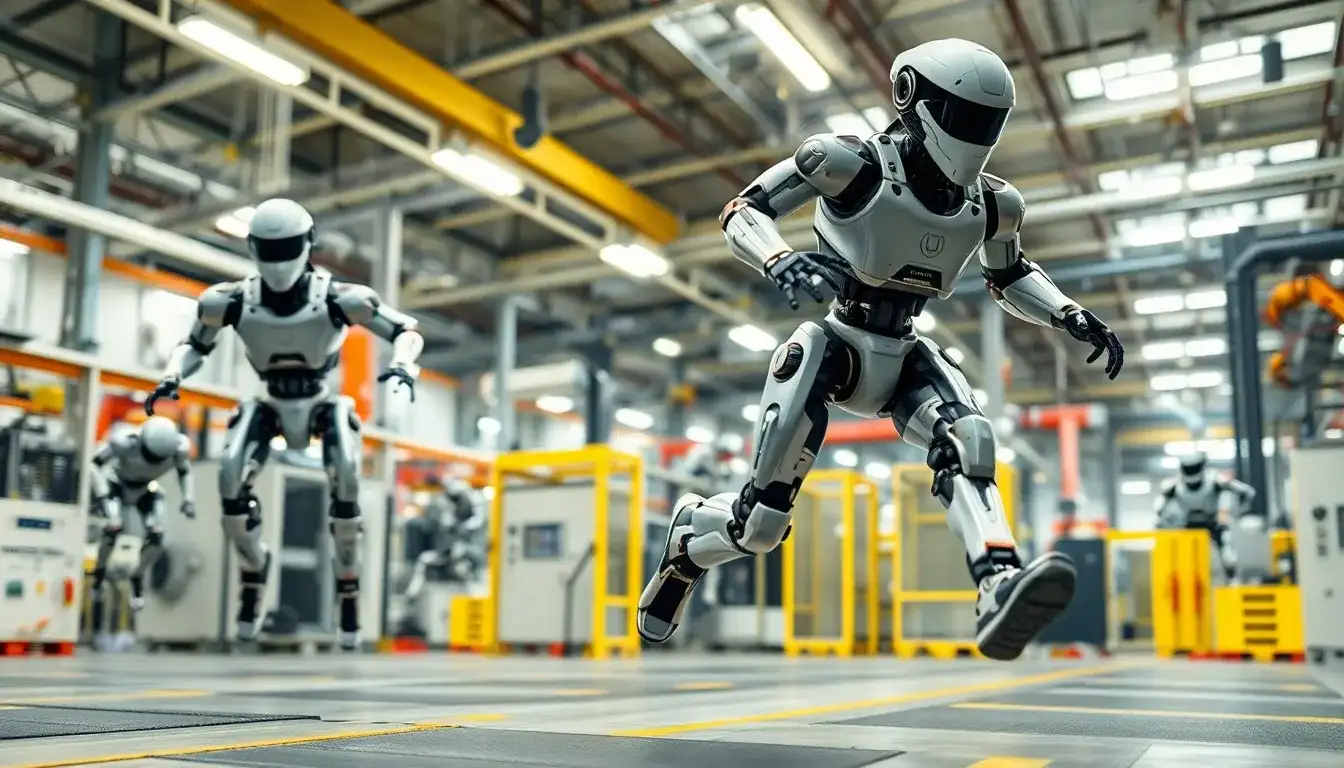
Humanoid robots are becoming increasingly intelligent and agile, with plans to start production on assembly lines by 2026. As technology continues to advance, humanoid robots are being trained using artificial intelligence (AI) models, enabling them to mimic human movements more closely. Their running and jumping abilities are becoming more coordinated and fluid, leading to new opportunities for applications in various fields.
This year, humanoid robots are expected to establish a foothold on factory assembly lines, utilizing their upper body dexterity and hand movements effectively. This development is set to create new business opportunities. During the Spring Festival Gala aired by China Central Television on February 16, robots participated in various performances, dancing alongside human performers and showcasing martial arts skills. One segment, titled “Martial Bot,” featured a robot master performing flips and using nunchucks, demonstrating impressive control and balance, which sparked considerable public interest.
Additionally, Boston Dynamics, a robotics company acquired by Hyundai Motor Group, unveiled its latest version of the humanoid robot Atlas at the Consumer Electronics Show (CES) in early January. The robot exhibited seamless movements such as walking, squatting, standing up, turning, bending, and performing backflips, which left the audience in awe.
In December 2025, electric vehicle giant Tesla and AI robotics startup Figure released a short video of their humanoid robot running. The robot’s movements appeared smooth and rhythmic, requiring no engineer to accompany or operate it, achieving a level of balance and stability comparable to that of a human being, which amazed many observers.
While humanoid robots running is not entirely new, as China hosted a marathon featuring humanoid robot runners in April 2025, their movements were still somewhat stiff at that time. Although they could operate autonomously, they required multiple technicians for support. Looking back to 2024, both Chinese and American humanoid robots could only walk at a slow pace with rigid gait. In just over a year, there has been remarkable progress in their agility. Key breakthroughs in algorithms, hardware-software coordination, and sensory capabilities have been crucial in this advancement.
According to Chuo Wang, chairman of Hiwin Technologies Corp., the smooth movements of humanoid robots rely heavily on critical components such as joint modules, reducers, cross-roller bearings, planetary roller screw elements, and the ball screw of dexterous hands. High levels of integration and coordination are necessary, while also ensuring lightweight design to minimize battery consumption.
Huang Shizhong, the Chief Operating Officer of Daming, noted that programming “cerebellum” controls for tasks like kicking a ball or running has reached a certain level of functionality in humanoid robots. The maturation of large language models (LLMs) and vision-language models (VLMs) is accelerating the robots’ real-time problem-solving capabilities.
Looking ahead, industry leaders including Chuo Wang, Huang Shizhong, Zhang Jinfeng of Futen Electric, and Chen Zhenglong of Solomon agree that humanoid robots will initially focus on integrating upper body functions, such as arms and hands, with lower body autonomous mobile design (AMR). Chen anticipates that wheel-based robots may be deployed first due to their more stable lower body, reducing concerns about the stability of humanoid robots. Huang explained that to meet the practical needs of manufacturing assembly lines, the focus can be on designing the brain and upper body functions without emphasizing foot support, thus minimizing safety risks associated with potential falls.
Chuo Wang also believes that using wheel-based designs for the lower body in humanoid robots is a pragmatic approach. Such robots can meet the established flow designs and operational needs of factory assembly lines while avoiding the risks of losing balance during foot movement, which would complicate design and increase costs, as well as energy consumption.
Chuo Wang emphasized that humanoid robots should not merely showcase technology; their practical applications and market opportunities must be clear to attract ongoing investments in the humanoid robot industry. Chen Zhenglong pointed out that whether in terms of brain or cerebellum functions, AI capabilities are essential for humanoid robots. Continuous training on universal vision-language action (VLA) models and enhancing visual perception are crucial for improving their movement coordination and real-time responsiveness.
Original article by NenPower, If reposted, please credit the source: https://nenpower.com/blog/humanoid-robots-to-run-and-jump-smarter-set-for-factory-operations-by-2026/

