

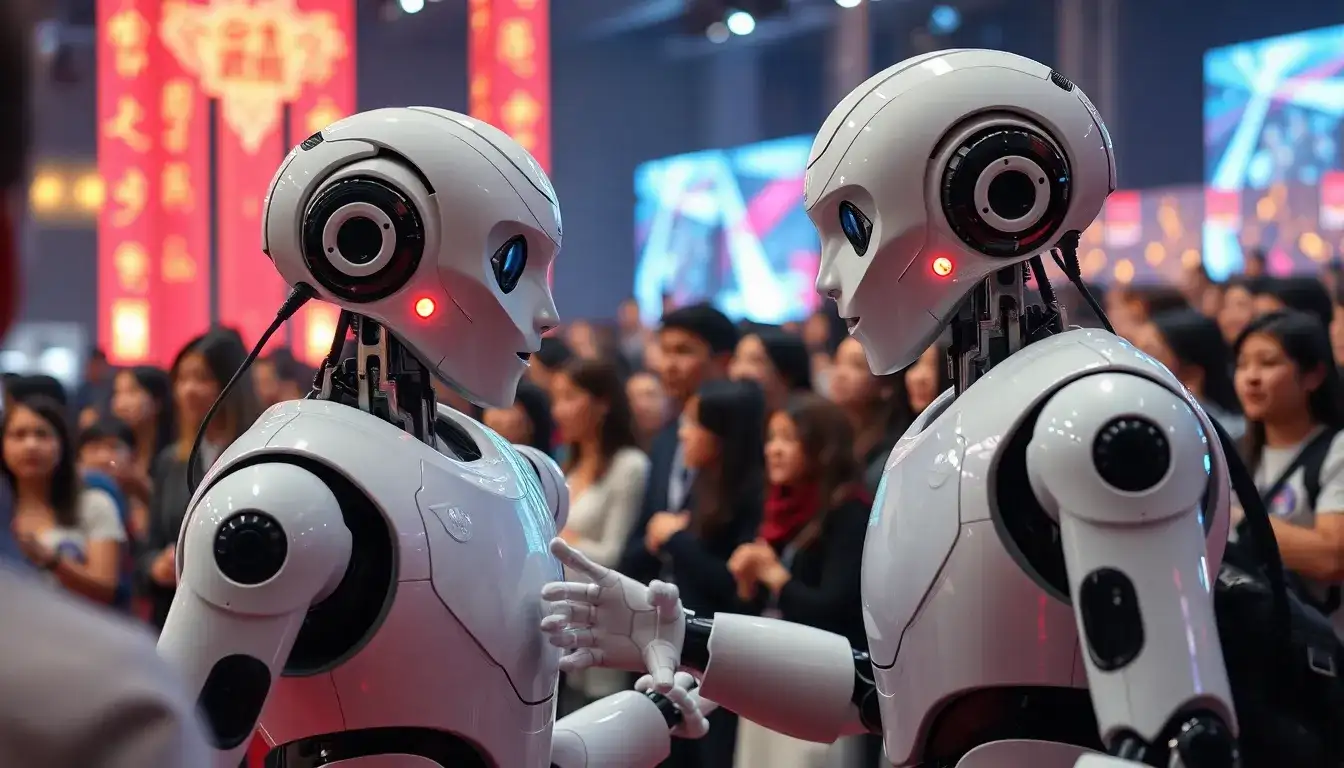
The Return of Humanoid Robots to the Spring Festival Gala: Investors Seek Practical Applications
Humanoid robots are set to make a return to the Spring Festival Gala in 2025, with industry focus shifting towards practical applications, resulting in an anticipated surge in shipments. Experts emphasize that relying solely on performances is not sustainable; robots must demonstrate value in real-world scenarios, such as factories. The industry has diversified into three main technological paths, each with its strengths and challenges, particularly in terms of endurance, stability, and cost-effectiveness. The next three to five years are crucial for establishing practical applications, as competition among these technological routes will be tested in real-world settings, driving a trend towards domestic innovation.
One of the highlights of this year’s Spring Festival Gala was the performance of humanoid robots, with last year’s gala featuring the Yushu robot in a bright red outfit performing traditional dances, which significantly boosted interest in the humanoid robot sector. It is projected that the domestic shipment of humanoid robots will increase by over 650% by 2025. However, can investors and industry stakeholders continue to support robots that only dance? Recent discussions with investors and key product leaders in the humanoid robotics field reveal a shift in focus towards practical applications. An investor candidly stated, “Robots that can only dance won’t sell anymore; they must be integrated into real scenarios to survive.”
As the industry evolves from mere performers to practical laborers, the question arises: can the technological capabilities of robots support this transition? Interviewees discussed the broader category of intelligent robots rather than focusing solely on humanoids. The race among three technological paths has intensified: Can Figure AI’s humanoid robots and Zhiyuan’s “general intelligence” VLA model adapt to factory assembly lines? How does Tesla’s “world model” use simulation data to cut costs? And how does Boston Dynamics’ hierarchical decision-making ensure long-term error-free operation? Endurance, stability, and cost have become the harsh tests facing these three technological paths as they prepare for mass production—robots must learn to “work.”
Investors’ Perspectives on Valuation and Funding
During the 2025 CCTV Spring Festival Gala, the humanoid robot from Hangzhou Yushu Technology, dressed in a red cotton jacket, captivated audiences worldwide. After a year’s hiatus, humanoid robots are making a comeback. Yushu is a partner for the gala, and the newly introduced Galaxy Universal Robot is designated as the gala’s embodied large model robot. Viewers may witness stunning flips and twists performed by humanoid robots once again, further elevating industry attention. Data from institutions reflects optimism regarding the production situation in 2025. According to the High-tech Industrial Research Institute, the domestic shipment of humanoid robots is expected to reach 18,000 units by 2025, soaring over 650% compared to 2024, and may rise to 62,500 units in 2026.
On January 22 of this year, a tender notice caught the attention of the press, issued by the North China Oilfield Company of China National Petroleum Corporation. The successful bidder was Sichuan Tianlian Robot Co., Ltd., which is developing humanoid robots for fueling applications at gas stations. This indicates that we may soon see humanoid robots taking on tasks such as refueling. As the spotlight shifts, industry professionals are reevaluating the role of robots, which must transition from being mere performers on stage to proving their worth as “laborers” in factories, construction sites, and logistics warehouses, rather than remaining expensive “toys.”
On February 6, a seasoned investor in humanoid robots, who was once a major shareholder in a robotics company, expressed, “Today, the companies that can deeply explore specific application scenarios and establish a solid foundation will have a future. Whether developing hardware or software, it must be integrated with real-world applications.” Over the past year, he has communicated with many investors in humanoid robotics, and there is a consensus: companies that focus solely on developing technology without real-world applications will eventually be phased out. “We now prioritize whether a company has viable applications. If there are no established products, we generally won’t consider investing. We avoid companies that are cobbled together by a handful of people seeking valuation and funding; they often fail quickly,” he explained.
From Performance to Practical Work: The Need for Real-World Applications
Qiu Dicong, founder of Yakobi Robotics, told reporters, “Regardless of how advanced the technology or design is, it ultimately needs to form a marketable product to generate economic value.” The industry has frequently compared various technological paths, as if possessing a technical advantage could ensure market success. “In the end, you’ll find that technology is just one aspect, and at times, not even the most important part in the later stages of development.” Although Qiu himself engages in academic research on AI robotics, he maintains that technological advancement does not directly translate to commercial success. “In the coming period, the competition in embodied intelligence will focus on practical implementation—implementation, implementation, and implementation.” The central question remains: “How can we ensure that there are sufficiently powerful products that are recognized by customers and can be scaled up for mass sales?”
Qiu further emphasized that regardless of the funding scale, the focus must return to the essence of business: accountability for sales. “Otherwise, if the valuation and sales ratio is too high, it results in significant funding with minimal business transactions, which wastes investment.” What kind of robot can genuinely “survive” and expand its application scenarios? The three technological paths different companies are investing in are providing distinct answers.
Technological Paths and Their Implications
On February 3, Tian Feng, director of the Kuai Si Man Xiang Research Institute, told reporters, “In 2026, the bottleneck for intelligent robots will shift from ‘can they move?’ to ‘how long can they work?’ and ‘are they stable enough?'” He noted that 2026 is expected to be a pivotal year for robots entering service industry applications. The current focus of technology is shifting from motion control to enhancing the “robot brain” capabilities to improve understanding and execution of complex environments and tasks. Dr. Lü Tong, product director at the Chengdu Humanoid Robot Innovation Center, mentioned that the industry must rethink how to enable robots to perform tasks like screwing, packaging, and handling with precision and stability, akin to humans. This transformation is particularly challenging, as endurance, real-time responsiveness, and maintenance costs become critical tests for all technological paths.
As the industry splits into three main technological paths, each represents a different vision for the future of smart robots. The first path is the VLA (Visual Language Action) model route, which aims for “general intelligence,” attempting to enable robots to perceive visually, understand language, and execute actions directly. Companies like Figure AI and Zhiyuan Robotics are betting on this path. Tian Feng highlighted its core characteristics: “It relies on vast amounts of data training to handle unknown environments and tasks, pursuing an end-to-end single model.” Its strength lies in powerful semantic understanding, capable of interpreting vague instructions like “clean the table.” However, he also pointed out its limitations: “End-to-end models have high computational costs and demand significant hardware endurance and cooling capabilities.”
Since last year, companies like Zhiyuan Robotics and UBTech have demonstrated the operational capabilities of humanoid robots in factory settings. At this year’s CES, some non-humanoid robotics companies have also entered this field. For instance, Sutech Ju Chuang showcased a high-stability robotic operating system. On February 3, a Sutech Ju Chuang expert in AI stated, “VLA is a technological paradigm that leverages the emergent capabilities of large language models to achieve operational intelligence.” However, he highlighted the hidden challenges of this route: “Simply providing robots with an image does not allow them to gauge how many centimeters a box is from their mechanical hand. Yet, the output of VLA is a series of real-number coordinates and orientations in a 3D world, meaning that the end-to-end VLA still needs to implicitly utilize a significant number of parameters to address spatial perception issues.” Additionally, when a robot’s hand approaches an object in the “last centimeter,” most contact surfaces are obscured by the dexterous hand itself, underscoring the importance of tactile and force feedback.
Sutech Ju Chuang’s solutions primarily involve two aspects: integrating 3D point cloud and tactile information into the traditional pure visual VLA framework. “By effectively utilizing point clouds, our data demands have significantly decreased, as this approach bypasses the reliance on massive data for implicit spatial perception learning.” Secondly, tactile feedback is incorporated as another input modality for VLA. The unnamed expert emphasized that the tactile technology currently faces three significant industry challenges: first, high-quality, high-signal-to-noise ratio tactile sensors are still scarce; second, there is no mature method to efficiently utilize tactile data; and third, there is a lack of large-scale public or private tactile datasets.
The second path is the world model route, with Tesla as a representative. This route builds a simulator of the physical world within AI systems, allowing robots to predict the consequences of their actions. Tian Feng summarized this as “injecting intuitive understanding of physical laws into robots, enabling them to predict the outcomes of their actions through reasoning and planning.” This path heavily relies on high-quality simulation data, but once the simulator is completed, it can significantly reduce reliance on expensive real-world data.
The third path is the hierarchical decision-making and hardware-software collaboration route, represented by companies like Boston Dynamics and Zhiyuan Robotics. This route breaks complex tasks into simpler components, using large models for task semantic understanding and decomposition while traditional algorithms handle positioning, navigation, and precision control. Tian Feng noted that the modular architecture’s advantage lies in its fault isolation, decoupling complex reasoning tasks from high-frequency real-time control, ensuring rapid response in control loops, which is more evident in real-world assembly lines. However, Lü Tong believes that the various technological routes do not exclude one another; hierarchical structures, 3D scene graphs, and world models are all advancing in parallel. He asserts that VLA end-to-end and world model paths are not mutually exclusive; they need to develop in tandem. Robotics is a system engineering endeavor, and technology selection must consider deployment environments, network conditions, and computational support, rather than discussing performance divorced from practical conditions.
Generalization and Stability: Key Challenges Ahead
Different enterprises have provided varied technological answers based on their unique characteristics, but regardless of the route, a core challenge remains—the need to enhance robots’ generalization capabilities in diverse scenarios. Qiu Dicong elaborated, “The core pursuit of robot control is addressing the generalization problem.” The earliest methods relied on model predictive control, freeing robots from fixed trajectories. This method dynamically associates environmental perception with actions, allowing them to adapt to changes within a preset range. However, its limitation is that it fails when encountering unforeseen situations. To overcome this constraint, the VLA model emerged. Its objective is to enable robots to receive instructions in natural language, similar to humans, and complete tasks autonomously using visual perception. VLA models are typically trained on large-scale visual language models, combined with human operational data, giving them strong understanding and generalization capabilities, yet they also face challenges like high data costs, significant computational consumption, and slow execution speed.
The current technological routes can be broadly categorized into model-driven approaches (such as model predictive control, which is stable but limited in generalization) and data-driven methods (including reinforcement learning and imitation learning). The VLA model can be seen as a combination of the latter two, representing a significant direction towards achieving general-purpose robots. The Sutech Ju Chuang expert remarked, “The essence of generalization is interpolation.” As long as the model is exposed to a sufficiently diverse range of scenarios—such as varied lighting conditions, different table heights, and various placement distances—it can make reasonable judgments in unknown situations. However, this is not enough; “the data must be sufficiently clean. The cleaner the dataset, the easier it is for the model to generalize.” He pointed out that both the autonomous driving and robotics fields suffer from issues related to “dirty data,” which severely undermines the model’s generalization abilities. The diversity and cleanliness of data are two distinct concepts, which many professionals often overlook. He also emphasized that enhancing the “lower bounds” of AI operating systems is much more challenging and valuable for the industry than merely showcasing “upper bounds.” “Even if the model tries 100 times, only a few will present highlights; however, improving the lower bounds means enabling robots to work continuously for 10 hours without errors, which is what truly creates value.”
Lü Tong added that industry demands are shifting from merely pursuing large data volumes to emphasizing “data diversification” and more convenient collection methods, such as video-based data acquisition. The industry is also exploring how to integrate the physical and natural knowledge accumulated by human society into world models, which might become a focal point in the future.
In addition to data, computational deployment is also a key issue. The industry widely believes that high-frequency local inference is crucial for ensuring robot stability. A system capable of achieving a 10Hz inference frequency means that small disturbances can be processed within 0.1 seconds. “If the system’s inference frequency is only 2 to 3Hz, it would require a wait of 0.4 to 0.5 seconds, and combined with control delays from execution mechanisms and inference misalignment, this significantly impacts task success rates.” The next three to five years will be critical for the practical deployment of robots in specific scenarios.
Shifting Demand and Future Directions
Xie Tiandi, market director at Sutech Ju Chuang, noted that the next three to five years will be a pivotal period for deploying robots in specific scenarios. The value of robots lies in their ability to supplement human labor. Human practical experience is invaluable; robots can learn to replicate the skills and knowledge of seasoned workers, and clients are willing to pay for robotic solutions that can replicate human expertise. Although current embodied robots may only accomplish half or less of a human’s workload in the same time frame, they can work at night and during holidays. Another case arose at last year’s robotics conference, where many manufacturing leaders from the Jiangsu and Zhejiang regions directly inquired, “Can we buy robots to set up production lines?” While market demand is urgent, there remains a gap between technology and commercialization. Currently, only entertainment robots that sing and dance can achieve stable revenue, while the entire robotics industry is still in the “transition from research and development to engineering” phase. However, the excitement generated by entertainment scenarios has significantly accelerated the development of robots’ practical capabilities.
Presently, the market demand for robots is evolving towards a more pragmatic direction. “Users seek specific scenarios to achieve highly closed loops,” Lü Tong stated. Users’ specific demands focus on three aspects: reducing production costs, liberating humans from repetitive or hazardous tasks, and providing emotional value in fields such as culture and tourism. “The advent of robots is fundamentally aimed at solving practical issues at various levels.” Currently, cutting-edge embodied intelligent technologies are still in the development phase, and their stability has not yet reached industrial-grade levels. Truly reliable technologies (like those used in industrial assembly lines and household refrigerators) have become so commonplace that they no longer attract special attention.
Qiu Dicong stated that factory scenarios are relatively simple, with fixed items (like specific screws) and environments; operations are precise but highly repetitive. In contrast, supermarket scenarios present higher complexity, requiring the ability to recognize hundreds of thousands of products with high demands for understanding items, yet operations primarily involve “picking, placing, and arranging.” The home scenario remains the ultimate challenge for robots: spaces and items vary drastically, and tasks encompass a range of complex actions, including cleaning and cooking, which require a high degree of generalization. From a return on investment (ROI) perspective, the home scenario is currently not economical: a single robot can cost tens of thousands or even hundreds of thousands, which is not proportionate to the limited services it can provide.
Commercial scenarios are becoming the breakthrough point. For example, in retail warehouse picking scenarios, if robots can address item generalization issues, operational efficiency can increase by 30% to 90%, providing clear commercial value. However, Qiu Dicong noted that cutting-edge embodied intelligent technologies are still in the research phase, and their stability is generally not yet at an industrial level. Ultimately, the success of technological paths will be determined by their performance in specific scenarios, as the industry moves towards convergence and domestic technological competition.
Tian Feng analyzed, “Long-term stable operation is the ‘secret’ to commercial viability. Different technological paths dictate the cost-effectiveness and survival rate of robots in various scenarios.” In relatively structured factory and logistics environments, there is no need for extremely high VLA semantic understanding capabilities but a demand for high mean time between failures (MTBF) and low power consumption, making the “hierarchical decision + hardware-software collaboration” route more suitable. Tian Feng further pointed out, “A modular actuator solution has absolute advantages in production costs and post-maintenance.” In complex and variable construction site scenarios, the world model combined with hybrid wheeled-leg architecture proves more adaptable. He cited Zhuji Power as an example: “By predicting terrain through the world model, it can automatically switch movement modes to accomplish tasks, achieving energy efficiency 3 to 5 times higher than pure legged robots, significantly reducing long-term operational endurance pressure.”
In cultural, tourism, and home service scenarios, the service industry demands high standards for human-robot interaction, and the VLA architecture precisely equips robots with the ability to understand differentiated and vague human instructions. Xie Tiandi believes that the current commercial model in the robotics industry is gradually clarifying: targeting B-end clients (enterprises) and collaborating with manufacturers and scenario providers to push for solution validation. “We need to find partners with real production scenarios, such as logistics packing and automotive parts assembly, to collaboratively drive implementation and validation.” He candidly stated that the core value of robots lies in their ability to “coexist and operate with humans in the same environment without needing to modify existing infrastructure—such as in factories where humans work during the day and robots take over at night.”
Looking toward the future from the current competitive landscape of the industry, the humanoid robot sector is revealing several clear trends. From a timeline perspective regarding technological advancements, Lü Tong believes that current robot technology is rapidly iterating on a monthly basis, and the industry continues to maintain a high-speed momentum in both capital and technology. However, the integration of cutting-edge technologies with practical applications is still in the maturation and trial-and-error phase. “The entire industry remains in the maturation process on the application side, which will inevitably involve trial and error.” He has also observed that the boundaries between academia and industry are becoming increasingly blurred, with many new technologies arising from feedback and demands originating in frontline practice.
Tian Feng anticipates that technological paths will gradually converge: “Drawing lessons from the hardware development history of PCs and smartphones, the hardware architecture of intelligent robots will gradually unify.” In the software architecture domain, “there may no longer be a pursuit of pure end-to-end systems; instead, a decoupled three-layer architecture of ‘semantic parsing layer—environment mapping layer—motion execution layer’ may emerge.” In terms of enterprise route selection, deep collaboration between hardware and software will become a priority direction. “Core components must be deeply compatible with algorithms; those companies that merely assemble components may be eliminated from the industry,” Tian Feng noted.
A critical judgment point is: “By 2026, the hardware gaps among various enterprises will rapidly narrow, and the real core barrier will be the non-standard environmental operation data accumulated from long-term operations.” The data loop capabilities formed by robot enterprises that have achieved significant deployment will become their core competitive barriers. Another important trend is domestic innovation. “By 2026, domestic planetary roller screws and high-power density servo motors will gradually achieve mass production and replacement, with intelligent robots integrating domestic components for self-research, modification, and optimization becoming a trend,” Tian Feng concluded.
Xie Tiandi believes that the ultimate value of robots is not to replace humans but to inherit human experience—operating in environments where humans cannot adapt and during times when humans rest. This involves transforming the skills of seasoned workers and the knowledge of experts into data models, allowing robots to complement human labor. “This is the future of industrial intelligence.” Qiu Dicong summarized that while robot technology is essential for driving productivity innovation, efficiency improvement, and experience enhancement, it must be placed in the right context. Technology is a means to achieve excellent products, not an end in itself. The “grounding” of robots tests the complete compatibility between technology and commercial scenarios. “If you can solve 90% of the problems but cannot address the remaining 10%, the entire scenario becomes unusable, rendering the preceding 90% meaningless.” This signifies that companies must comprehensively consider whether the advancement of technology aligns with the demands of the scenario, the stability and reliability of the robots, the design and user interaction experience, and whether the overall solution can establish a closed loop within an acceptable ROI range. Any detail that affects the final experience constitutes a decisive factor in product strength. Whether in entrepreneurship or new technologies, the ultimate question remains simple: is this product user-friendly? And would you be willing to pay for it? If the answer is yes, then it is a success.
Original article by NenPower, If reposted, please credit the source: https://nenpower.com/blog/humanoid-robots-set-to-shine-again-at-2025-spring-festival-gala-as-industry-shifts-focus-to-practical-applications-and-competition-among-three-tech-paths/

