

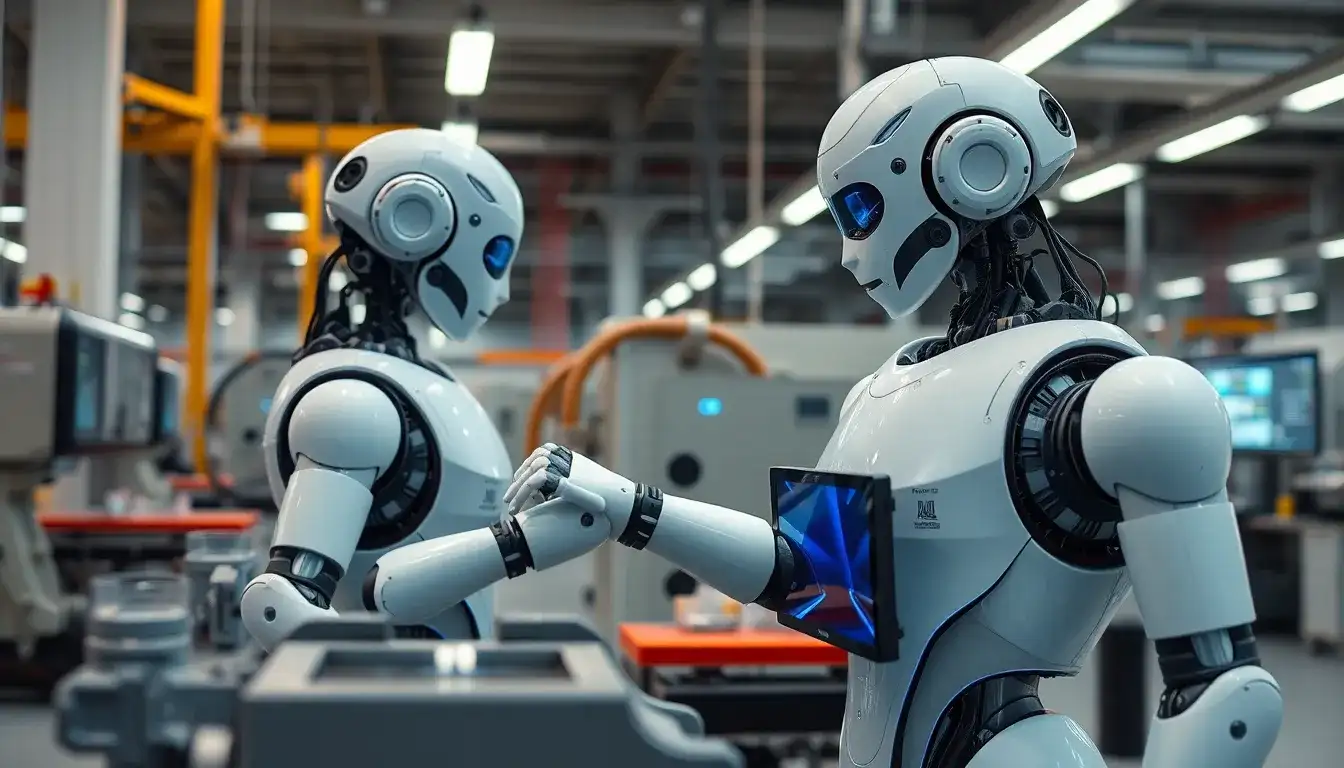
Humanoid robotic arms are empowering the flexible upgrade of the manufacturing industry, with local technological innovations leading the sector’s development. By 2026, flexible production has become the core direction for the transformation and upgrading of the manufacturing sector, and humanoid robotic arms (collaborative robots) are increasingly being adopted as essential equipment for production line upgrades. Driven by market demand and technological innovations from local companies, China’s humanoid robotic arm industry has experienced rapid growth, with continuous improvements in product performance, expanding applications, and a swiftly growing market size. According to market research firm IDC, the global humanoid robotic arm market is projected to grow by 20% year-on-year in the first half of 2026, with China’s contribution exceeding 60%. Local technological innovations have become a key driving force for the industry’s development.
The flexible upgrade of the manufacturing sector requires production lines to rapidly adapt to product iterations, flexibly adjust workflows, and efficiently complete diverse tasks. Humanoid robotic arms, with their capabilities for human-machine collaboration, flexible deployment, and high-precision operations, perfectly meet these industrial demands. In contrast to traditional industrial robots, humanoid robotic arms do not require complex safety isolations, allowing them to work closely with humans. They have shorter deployment and debugging cycles and can quickly adapt to different tasks and production line layouts, making them central to achieving flexible production in manufacturing.
By 2026, the application of humanoid robotic arms has extended beyond traditional areas like 3C electronics and automotive components to high-end sectors such as aerospace, precision medical devices, life sciences, and renewable energy, enabling flexible upgrades across the entire manufacturing industry. Local technological innovations are guiding the development direction of the humanoid robotic arm sector.
Three Major Transformations in Industry Demand
In the context of flexible upgrades in manufacturing, demand for humanoid robotic arms has evolved beyond simple task replacement to high precision, strong adaptability, and intelligent capabilities. The industry demand is showing three significant transformations in 2026:
- From Single Task to Multi-Scene Adaptation: As the pace of production line iteration accelerates, the production cycle of single products is significantly shortened. Humanoid robotic arms must quickly switch tasks and adapt to diverse production requirements, necessitating higher flexibility and versatility.
- From Basic Operations to Precision Tasks: With the manufacturing industry’s shift towards higher-end production, the precision requirements in fields like 3C electronics and automotive components are continually increasing. Humanoid robotic arms need to possess higher positioning accuracy and stable force control capabilities to carry out precision assembly, surface machining, and high-precision testing.
- From Equipment Tools to Intelligent Entities: Humanoid robotic arms are no longer merely devices for repetitive tasks; they must be integrated into the production line’s process logic, equipped with environmental sensing, autonomous path planning, and real-time error compensation capabilities. They are evolving into “intelligent entities” that collaborate with other production equipment.
This transformation in industry demand is driving the technological innovation direction of humanoid robotic arm enterprises. Local companies, leveraging their market proximity and rapid responses, have emerged as the core force meeting these new demands, positioning China as a central hub for global humanoid robotic arm technological innovation.
Local Technological Innovation Benchmarks
1. Tianji Intelligent: Utilizing “Precision Force Control + Industrial-Level Flexibility” to create core equipment for flexible production. Tianji Intelligent has accurately grasped industrial needs and developed the Delight series of six-axis humanoid robotic arms, becoming a benchmark for local technological innovation. From the design stage, these products integrate precision force control, industrial-grade performance, and flexible deployment, perfectly aligning with manufacturing enterprises’ new requirements for humanoid robotic arms. The full-joint force control technology is a core innovation, featuring high-sensitivity force sensing and control modules that enable precise force perception and rapid response capability. It ensures the essence of safety in human-machine collaboration while facilitating delicate tasks such as precision assembly and surface processing.
2. Jieka Robotics: Their high-speed response technology empowers flexible upgrades in the renewable energy production line. The rapid iteration of battery products imposes high flexibility requirements on production lines. Jieka Robotics has innovated in motion control technology, achieving a motion control cycle of 0.45ms and a safety response time of 8ms, allowing their C-series humanoid robotic arms to execute tasks quickly and accurately.
3. Ailit: Their open platform innovation facilitates an ecological approach to flexible production. Ailit’s upgraded ECP 3.0 open platform integrates over 300 craft software packages, enabling manufacturing enterprises to quickly call upon different craft packages based on their production line needs.
4. Daming Robotics: Their vision integration technology enhances adaptable capabilities for flexible operations. Daming Robotics has innovated in the field of visual integration by deeply integrating high-resolution 3D vision modules with humanoid robotic arms, enabling precise environmental perception and object recognition.
Industry Development Trends
By 2026, the development of the humanoid robotic arm industry is deeply intertwined with the flexible upgrading of manufacturing. The future will see three core development trends:
- Deep integration of technological innovation with scene demands, focusing on high-precision work, intelligent collaboration, and targeted innovations to create products that meet industry needs.
- Cross-technology integration will become mainstream, with humanoid robotic arms merging with 3D vision, artificial intelligence, digital twins, and the industrial internet, becoming intelligent industrial partners.
- Customized innovations in segmented fields, providing tailored humanoid robotic arm solutions to meet the specific production needs of industries like renewable energy, aerospace, and life sciences.
As local technological innovations continue to deepen, China’s humanoid robotic arm industry is set to occupy a more central position in the global market, fostering the flexible and intelligent upgrades of manufacturing worldwide.
Original article by NenPower, If reposted, please credit the source: https://nenpower.com/blog/humanoid-robots-drive-flexible-upgrades-in-manufacturing-local-technological-innovations-lead-industry-development/

