

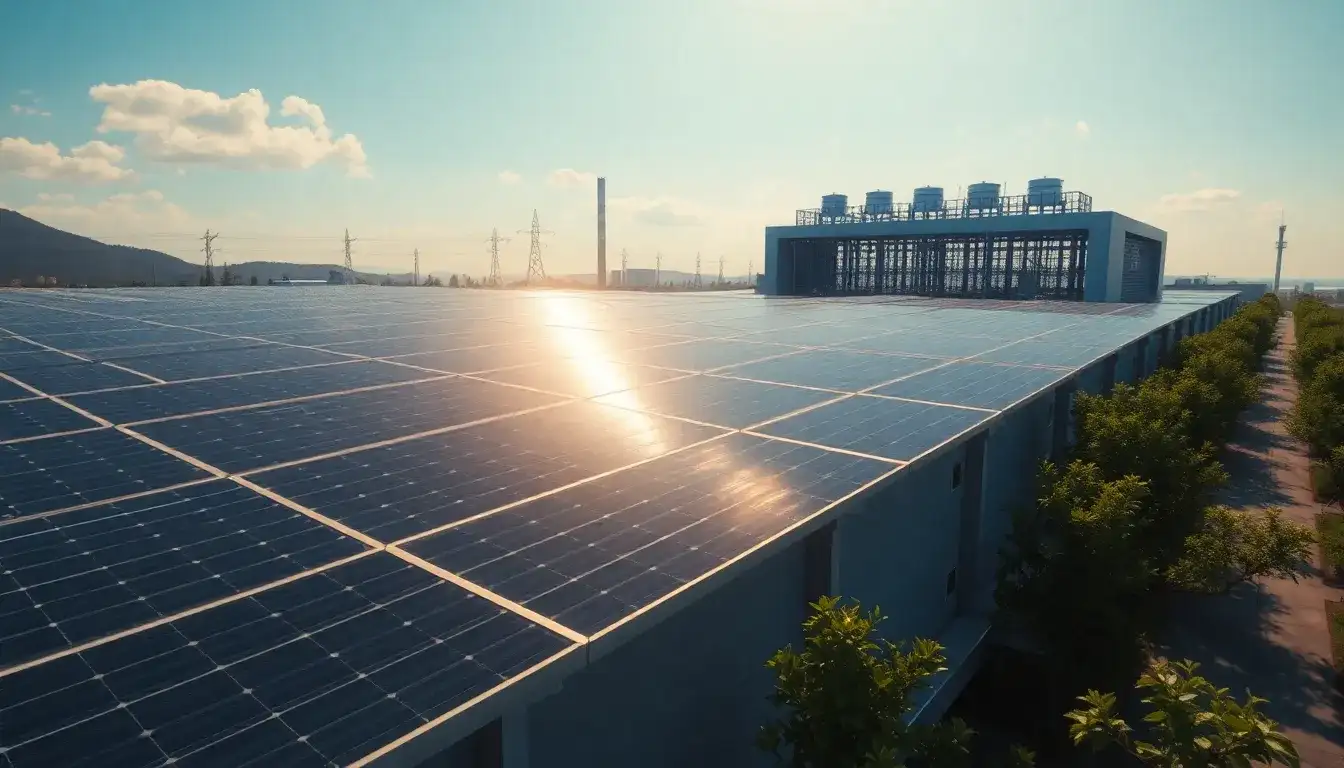
Significant Changes in the Photovoltaic Industry: Huawei Releases Top 10 Trends for 2026
The global photovoltaic industry is undergoing a profound paradigm shift, moving from “quantitative changes” to “qualitative changes.” A landmark event in this transformation is the bidding for a 3.5 million kW solar power station and a 4.5 million kWh grid-connected energy storage project in the Philippines. This signifies a declaration from the industry: what the power grid requires now is not intermittent energy, but reliable power sources that can be as stable, dispatchable, and supportive as traditional thermal power.
In this critical turning point, Huawei has unveiled its report on the Top 10 Trends for Intelligent Photovoltaics in 2026, providing a systematic roadmap and action framework for the industry to progress towards “value cultivation.” These ten trends are not isolated technical points, but rather a comprehensive strategic map that covers both “scenarios” and “technologies,” linking the “generation side” to the “consumption side.”
In terms of scenario construction, four major trends have emerged: the synergy of solar, wind, and storage; ubiquitous grid-connected energy storage; coordinated source-grid-load-storage systems; and AI-native home solar and storage solutions. These trends define the core values of new energy as a stable power source, a key resource for the grid, a regional autonomous unit, and a smart energy terminal.
On the technological support side, six trends are identified: high frequency and high density, high voltage and high reliability, system-level battery management, mature grid-connected technologies, intelligent empowerment, and quantifiable safety. These trends ensure a full-stack capability guarantee from components and devices to systems, enabling the realization of the aforementioned values.
Collectively, these ten trends point to a core conclusion: the competitive dimension of the industry has evolved from a focus on installed capacity and cost to a comprehensive competition based on “system reliability.” In this context, three critical capabilities—grid connectivity, artificial intelligence, and high quality—serve as the foundational pillars for transforming Huawei’s ten trends from plans into reality and building the next generation of “reliable power stations.”
Transforming Photovoltaics into Active Grid Stabilizers
The traditional power grid is undergoing a painful transformation. As the penetration of new energy sources continues to rise, an increasing number of mechanical electromagnetic systems are being replaced by power electronic devices. The “rigidity” of the grid is weakening, and “flexibility” challenges are becoming more pronounced. The randomness and volatility of new energy output, combined with the inherent shortcomings of power electronic devices, such as poor overload capacity and lack of inertia support, make the balance and safety of the grid precarious.
Huawei has prioritized the trends of “solar, wind, and storage synergy as a stable power source” and “full scenario grid connectivity,” directly addressing these core contradictions. The essence of grid connectivity technology is to empower photovoltaic and storage systems with the ability to “actively build the grid.” Through intelligent algorithms, these devices can construct and stabilize grid voltage and frequency, providing critical inertia support just like traditional synchronous generators. This marks a shift in the role of new energy from “passive followers” to “active supporters” of the grid.
Global Standards and Local Practices
This transformation is evolving from cutting-edge technology to a global standard. The European Union’s RfG 2.0 grid code explicitly states that from 2027 onwards, all new energy stations connecting to the grid must possess grid connectivity capabilities. Major markets like China and Australia are also accelerating the development of related standards. Lacking grid connectivity capability may result in losing the qualification to connect to the grid in the future.
Practical examples are already ahead of the standards. At the Mambande copper mine in the Democratic Republic of the Congo, a 100% renewable microgrid has completely replaced diesel generators, ensuring uninterrupted power supply while reducing electricity costs by 50%. These cases validate the feasibility of “100% renewable microgrids” and open new market opportunities, proving that through the synergy of solar, wind, and storage, combined with grid technology, new energy can indeed serve as a primary power source for urban areas.
AI Revolutionizing Energy Management
As the number of components in a photovoltaic power station reaches the millions, traditional operation and maintenance management approaches are becoming obsolete. Huawei’s trend report indicates that “full lifecycle intelligence” and “intelligent empowerment of stations” are the necessary paths forward, aiming for “autonomous operation” of power stations. This means AI will transition from being a supportive tool to becoming the core decision-making entity in station operations.
AI’s impact spans the entire lifecycle of the station: during the design phase, AI algorithms can conduct massive simulations to complete optimal layout designs automatically; during construction, drones equipped with AI visual recognition can achieve millimeter-level precision in quality inspections.
Over a 25-year operational period, the value creation capability of AI will be fully unleashed. It must address two types of uncertainties: natural uncertainties and market uncertainties. In the Wuhan Binhai Shuanghe Pharmaceutical Park project, the AI-based solar and storage dispatch system acts like a tireless “super trader,” learning in real-time to dynamically optimize multiple objectives such as self-consumption of solar energy, energy storage arbitrage, and demand charge management, ultimately enhancing the project’s overall revenue by over 10%. This exemplifies the best interpretation of “solar-storage-charging-use synergy” and “flexible adaptation of commercial models.”
Redefining Safety and Quality in the Industry
Safety and quality are non-negotiable; without them, discussions about efficiency and profitability become moot. This consensus has emerged in the photovoltaic industry following multiple safety incidents, including fires. Huawei’s trend report clearly states that the industry is moving towards a new phase of “quantifiable safety.” This signifies a fundamental conceptual shift: safety is transforming from a difficult-to-measure “hidden cost” and a passively met “compliance requirement” into an assessable, verifiable, and comparable “explicit asset.” It is becoming a core credit certificate for financing, insurance, and long-term operation of power stations.
To achieve this, Huawei has proposed an all-encompassing safety architecture that spans from the cell level to the grid. At the cell level, AI is used for early risk diagnosis; at the battery pack level, innovations like “positive pressure oxygen blocking” physically sever the combustion chain; at the system level, electrical topology design can isolate the impact of grid faults. The goal of this multi-layered defense system is to ensure that “smoke does not lead to explosions and fires do not spread.” This verifiable safety provides a credible foundation for the rapid advancements of the other two technology trends.
The Challenge of System Capability for Photovoltaic Enterprises
The release of Huawei’s top ten trends report resonates with the bidding requirements in the Philippines, clearly indicating that the path for photovoltaics to become a primary power source is set, but the entry barriers have significantly increased. Future photovoltaic power stations will be super systems integrating high-performance power electronics, advanced electrochemistry, complex algorithms, and massive data.
The evaluation criteria will be multidimensional: grid dispatch departments will focus on their grid support capabilities, capital providers will calculate their full lifecycle revenue models, and insurance companies will assess their quantifiable risk levels. Huawei’s top ten trends in the photovoltaic industry are not merely predictions; they serve as a “new rulebook.” They declare that the era of relying solely on production scale, single equipment costs, or advantages in specific technological segments is coming to an end. Competition in the industry will elevate to a system capability contest centered on “grid stability, AI intelligence, and high-quality full lifecycle management.”
By defining these ten trends, Huawei outlines a future pathway; its deep investments in grid connectivity, AI, and essential safety demonstrate the necessary “ship and navigational skills” to reach the destination. For all industry participants, when the stars of the main power source become clearly visible, the competition will no longer be about the courage to set sail but rather the comprehensive ability to navigate through complex deep seas.
Original article by NenPower, If reposted, please credit the source: https://nenpower.com/blog/huawei-unveils-2026-trends-in-photovoltaics-redefining-next-gen-reliable-power-plants-with-three-key-innovations/

