

Strengthening Through the Sea! Huawei Assists China General Nuclear Power in Creating the Nation’s First Full-Capacity Grid-Connected Pile-Foundation Offshore Solar Project
On May 27, the China General Nuclear Power Group’s 400 MW offshore solar project in Yantai Zhaoyuan achieved full-capacity grid connectivity, making it the first pile foundation fixed offshore solar power station in the country to be completed and operational. This project utilizes Huawei’s intelligent solar solutions and is equipped with thousands of Huawei inverters, expected to generate an average annual electricity output of approximately 694 million kilowatt-hours. This significant power generation not only provides robust green energy support for the Jiaodong Peninsula but also serves as an important demonstration for the development of the offshore solar industry in China.
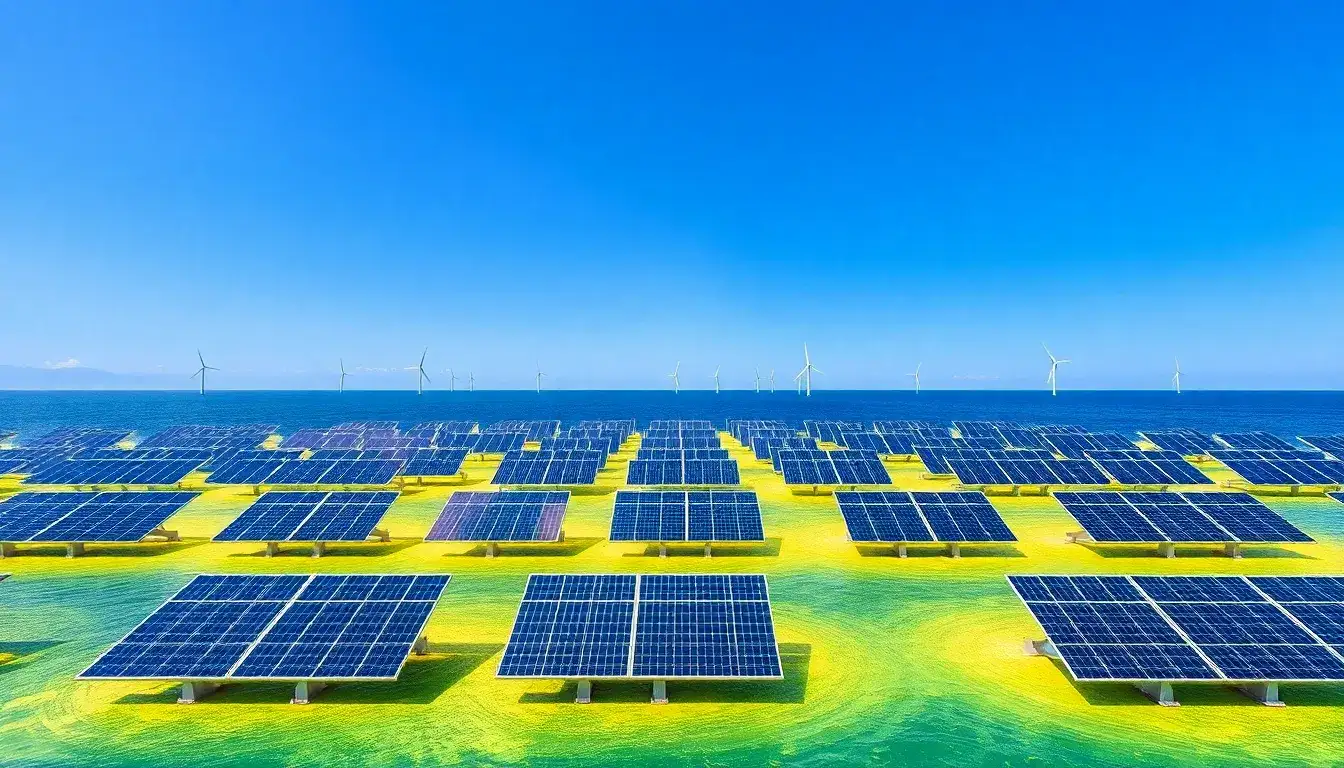
In the vast sea of Laizhou Bay, the shimmering waves reflect the densely arranged solar arrays, creating a magnificent “offshore blue field” panorama. The massive piling ships roar as 121 solar sub-arrays rise like a steel forest above the waves. Workers traverse between the pile foundations and grid frameworks, constructing a maritime energy wall with millimeter-level precision—this is the construction site of the China General Nuclear Power’s 400 MW offshore solar project in Yantai Zhaoyuan.
As the first pile foundation fixed offshore solar power station to achieve full-capacity grid connection in the country, this project is developed by China General Nuclear Power New Energy and is recognized as one of the most challenging sites due to its deep water, construction difficulties, and complex development conditions in Shandong Province’s first batch of competitive offshore solar projects. This initiative is part of Shandong’s “Strong Marine Province” action plan, promoting the upgrade of marine resources from traditional fishing to integrated new energy development.
Behind this monumental project, Huawei’s smart solar technology deeply empowers the safe and efficient operation of the offshore power station. The entire project employs 1,331 Huawei SUN2000-300KTL inverters. Comprising 121 solar sub-arrays, each sub-array is equipped with 11 Huawei inverters. These inverters convert the electricity generated by the solar panels and connect it to a 220 kV onshore boosting station via 16 sets of 35 kV collection lines. With an average annual output of 694 million kilowatt-hours of clean electricity, the project is projected to reduce standard coal consumption by about 208,700 tons and cut carbon dioxide emissions by approximately 535,800 tons, equivalent to planting 1,562 hectares of trees, thereby injecting strong green development momentum into the Jiaodong Peninsula.
Efficient Power Generation: The “Energy Engine” in Salt Spray
Huawei inverters are equipped with intelligent MPPT algorithms, ensuring stable power generation and higher conversion efficiency, even in the high-salinity and temperature-variable environment of Laizhou Bay. This performance enhancement leads to an increase in electricity generation of over 1% compared to other products, thus providing a solid guarantee for the project’s power generation efficiency.
Ultimate Safety: Addressing Deep Sea Hazards with Four Key Safety Innovations
Huawei inverters are designed with four key safety technologies: equipment safety, technical safety, electrical safety, and information safety, ensuring stable and safe operation throughout the lifecycle of the offshore solar power station. The entire unit is built with C5-M corrosion resistance and IP66 protection, effectively dealing with harsh marine conditions such as high humidity, salt spray, and strong winds. Intelligent string disconnection, temperature detection of terminals, MPPT-level insulation monitoring, and Huawei’s intelligent solar PID solutions protect the photovoltaic DC system and ensure personnel safety. Moreover, the proprietary IGBT modules are developed in-house, ensuring core technology independence and control; the products have professional ICSL certification and are the first in the industry to achieve CC certification, with a product safety capability level of SL2, safeguarding end-to-end information security for the power station.
Intelligent Operation and Maintenance: The “AI Guardian” in the Depths of the Ocean
In terms of intelligent operation and maintenance, Huawei’s 300K inverters also demonstrate exceptional performance. Their intelligent fan dust removal feature ensures that the inverters can operate without downtime throughout their lifecycle, reducing maintenance tasks caused by blockages from bird feathers and dust. By sampling power from the inverters, precise power information can be obtained, accurately calculating electricity generation losses and providing corresponding suggestions, thereby supporting the long-term stable operation of the project.
The successful grid connection of the Zhaoyuan project by China General Nuclear Power is a vivid representation of Huawei Digital Energy’s vision to “integrate digital technology and power electronics, develop clean energy and energy digitization, promote energy revolution, and build a green and beautiful future.” Looking ahead, Huawei aims to collaborate with partners to accelerate the development of marine energy through innovative technologies, enabling every inch of maritime territory to release green energy and contribute to the global carbon neutrality goal.
Original article by NenPower, If reposted, please credit the source: https://nenpower.com/blog/huawei-partners-with-china-general-nuclear-to-launch-chinas-first-full-capacity-offshore-photovoltaic-project/

