

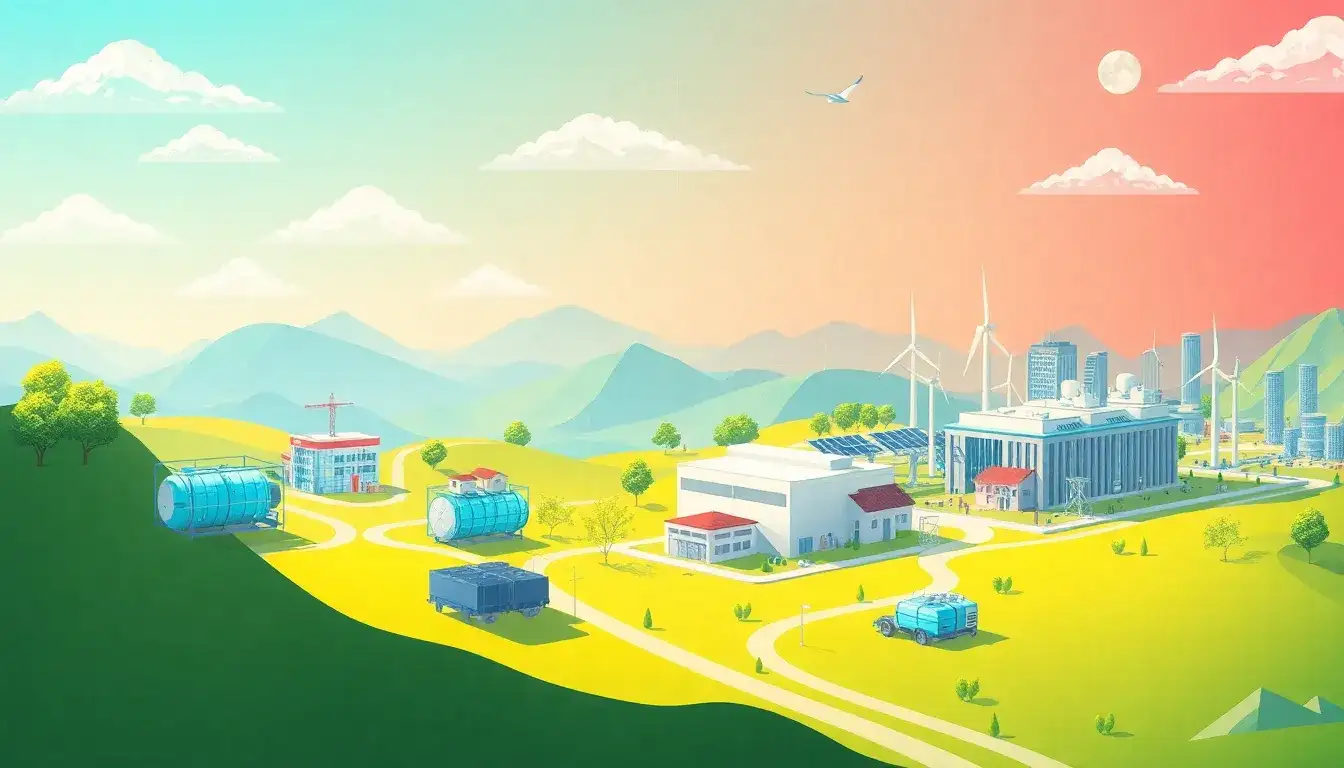
Liquid Air Energy Storage (LAES) technology is highly scalable and adaptable for a broad spectrum of energy storage needs, ranging from industrial and commercial applications to grid-scale energy storage. Several key points highlight its scalability and suitability:
Scalability of LAES Technology
- Wide Range of Applications: LAES systems can be designed and scaled to meet varying energy storage demands, from smaller commercial installations to very large grid-scale plants capable of handling hundreds of megawatts of output.
- Grid-Scale Capability: Existing LAES plants have demonstrated the ability to store and discharge significant energy quantities. For example, Highview Power’s facility in Greater Manchester stores up to 15 MWh and delivers peak outputs around 5 MW, illustrating practical scalability in a real-world setting.
- Location Flexibility: Unlike pumped hydro storage—which requires specific topography—LAES plants can be sited almost anywhere, including urban environments, due to their independence from geographical features.
- Long-Term Storage: LAES is suitable for long-duration energy storage (days or longer), which is critical for grid stability and integration of intermittent renewables.
Economic and Operational Scalability
- Competitive Levelized Cost of Storage (LCOS): Studies show that the LCOS for LAES can be around $60 per megawatt-hour, which is about one-third that of lithium-ion batteries and half that of pumped hydro, making it economically attractive at large scales even though it may not yet be fully investment-viable in all contexts.
- Durability and Reliability: The components used in LAES, such as cryogenic tanks and turbines, have long operational lifespans, supporting scalability through sustained reliability and minimal degradation over time.
- Environmental Sustainability: LAES uses abundant, non-toxic air as the storage medium, with a low environmental impact compared to chemical batteries or large hydro installations, further supporting its deployment at scale without significant ecological constraints.
Performance Metrics
- LAES systems typically have a round-trip efficiency of about 50–60%, which is reasonable for large-scale storage solutions and continues to improve with advances in technology.
Summary Table: LAES Scalability Features
| Aspect | Details |
|---|---|
| Energy Capacity | From commercial scale to hundreds of MW for grids |
| Location Flexibility | Can be sited anywhere, including urban areas |
| Duration of Storage | Suitable for long-duration (days+) storage |
| Economic Competitiveness | LCOS approx. $60/MWh, cheaper than batteries/hydro |
| Operational Lifespan | Long-lasting cryogenic tanks and turbines |
| Environmental Impact | Low; uses abundant, non-toxic air |
In conclusion, LAES technology offers scalable, flexible, and competitive energy storage solutions that can be adapted to diverse energy needs from small-scale industrial use to large grid applications, positioning it as a promising option for future clean energy infrastructure.
Original article by NenPower, If reposted, please credit the source: https://nenpower.com/blog/how-scalable-is-laes-technology-for-different-energy-storage-needs/

