

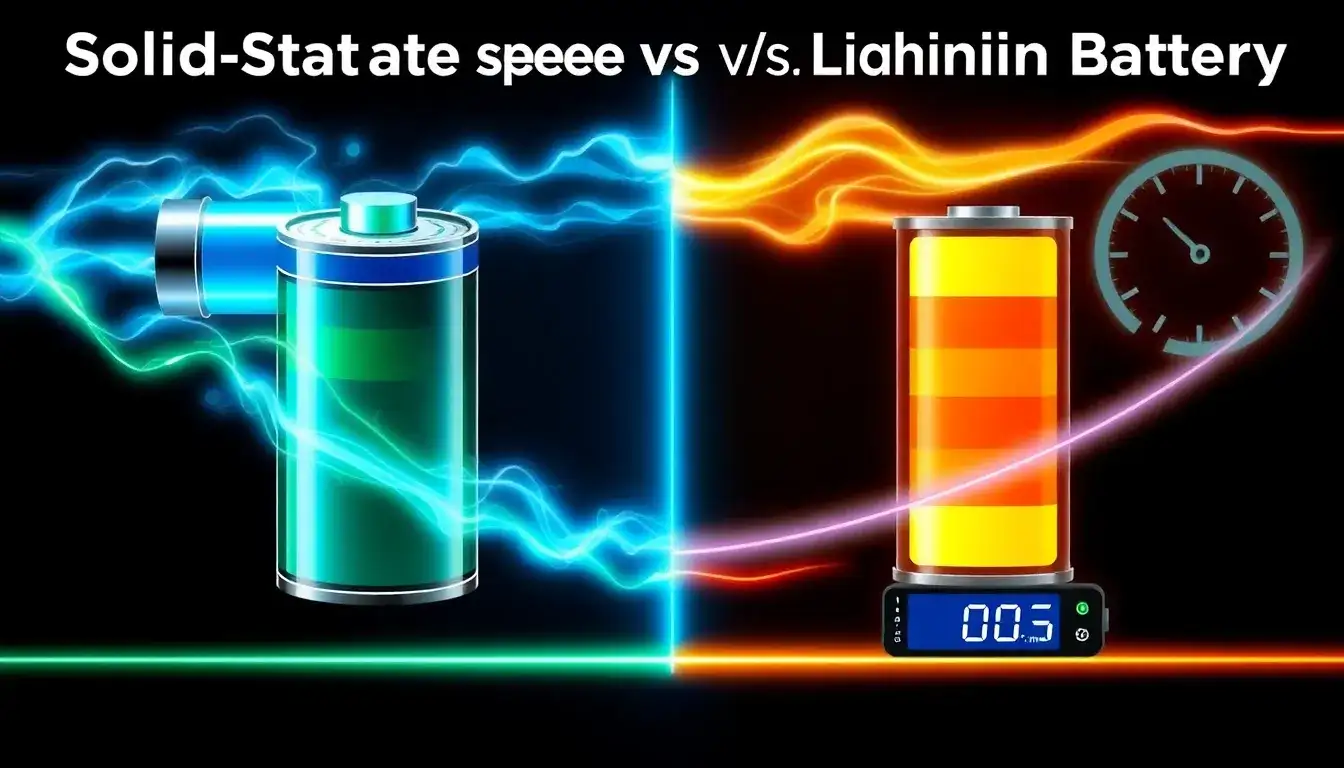
Solid-state batteries can be charged significantly faster than conventional lithium-ion batteries. While typical lithium-ion batteries require at least 40 minutes to recharge at a DC fast-charging station, solid-state batteries can achieve a full charge in as little as 10 to 15 minutes. Some advanced solid-state battery designs can recharge in about 10 minutes due to improved plating and stripping on even electrode surfaces.
In practical terms, this represents a reduction in charging time from roughly 30-40 minutes for lithium-ion cells down to around 10 minutes for solid-state ones, a decrease of 50-75% or more. Cutting-edge “doped” solid-state batteries have demonstrated charging to 80% capacity in just nine minutes in laboratory settings, compared to about 25 minutes for high-end lithium-ion cells like the Panasonic 21700 used in Tesla Model 3.
This faster charging capability is primarily due to the solid electrolyte, which avoids the ionic transport limitations found in liquid electrolytes used in lithium-ion batteries. The solid electrolyte allows ionic conductivity comparable to liquid ones but with less impedance on charge rate, especially near the anode, enabling much faster energy insertion.
In summary:
| Battery Type | Typical Fast Charge Time | Notes |
|---|---|---|
| Lithium-ion | 30-40 minutes | Liquid electrolyte limits rate |
| Solid-state | 10-15 minutes | Solid electrolyte enables faster charging |
| Advanced doped solid-state | ~9 minutes (to 80%) | Lab results, promising future breakthrough |
Solid-state batteries thus offer a 2-4 times faster charging capability than current lithium-ion batteries, potentially revolutionizing electric vehicle charging experiences.
Original article by NenPower, If reposted, please credit the source: https://nenpower.com/blog/how-quickly-can-solid-state-batteries-be-charged-compared-to-lithium-ion-batteries/

