

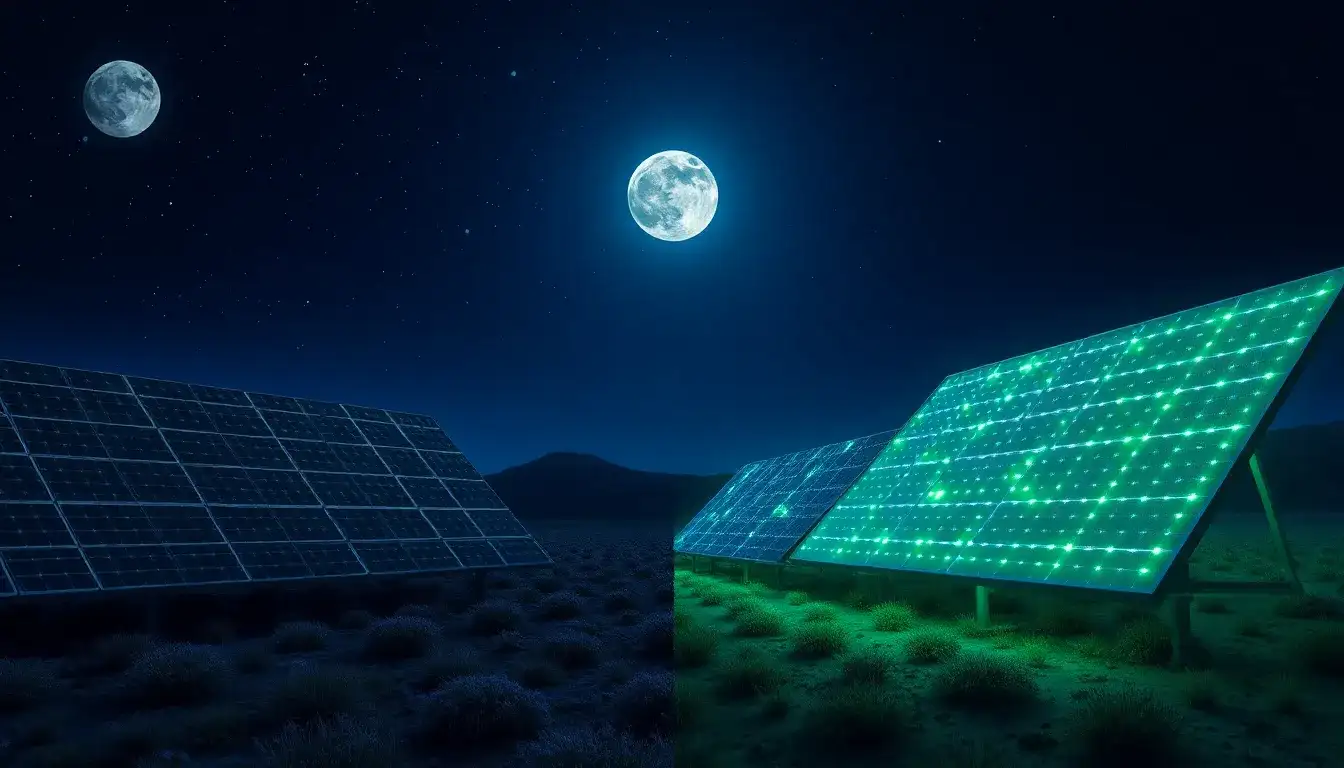
Traditional solar panels generate no electricity at night under normal operation, as they rely on sunlight to activate photovoltaic cells. However, experimental nighttime solar panels developed at Stanford University using radiative cooling technology can generate 50 milliwatts per square meter (0.05 W/m²) at night.
Comparison of energy generation:
| Type | Daytime Output | Nighttime Output |
|---|---|---|
| Traditional Solar Panels | ~200 W/m² | 0 W/m² |
| Nighttime Solar Panels (experimental) | N/A | 0.05 W/m² (or 2.2 W/m² in newer prototypes) |
For daytime performance, nighttime panels are not designed as replacements for traditional panels. Stanford’s latest system (separate from the 0.05 W/m² setup) achieves 2.2 W/m² at night, with daytime potential estimated at 3-4× higher (6.6–8.8 W/m²), but this is still ~25–44× less than traditional panels’ daytime output.
Key takeaway: Nighttime panels generate minimal energy compared to traditional ones but address a critical gap in 24/7 renewable power. Current prototypes produce 0.025–1.1% of traditional panels’ daytime output, depending on the design.
Original article by NenPower, If reposted, please credit the source: https://nenpower.com/blog/how-much-more-energy-can-nighttime-solar-panels-generate-compared-to-traditional-solar-panels/

