

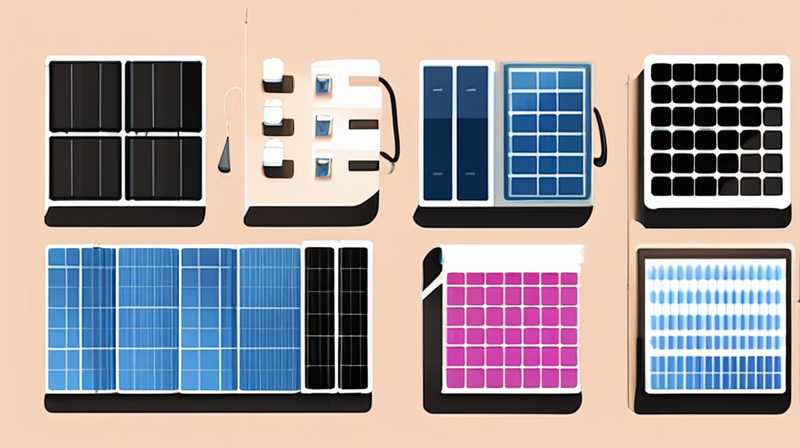
1. The number of solar panels required to constitute a group varies widely based on specific factors, 2. Common configurations include arrays of single panels, interconnected modules, or more extensive systems, 3. A typical residential installation may involve up to 20 panels, while commercial projects might feature hundreds to thousands, 4. Ultimately, several variables dictate the ultimate quantity, including system design, energy needs, and available space. The objective is to achieve maximum efficiency in energy production.
INTRODUCTION TO SOLAR PANEL GROUP CONFIGURATIONS
The usage of solar panels has significantly advanced over the last two decades, leading to a remarkable transformation in how energy is harnessed. Their effectiveness and adaptability have made them increasingly prominent in both residential and commercial sectors. A fundamental aspect of solar panel deployment revolves around how they are grouped or configured. This grouping can range from a few panels installed on a single rooftop to extensive arrays sprawling over vast fields.
Different installation scenarios yield various configurations, posing questions about how many panels typically form a cohesive group. This query does not have a one-size-fits-all answer; rather, it depends on a multitude of factors including energy demands, available space, and system efficiency goals. Understanding how configurations operate is essential for optimizing both energy production and investment returns.
FACTORS INFLUENCING SOLAR PANEL GROUPS
ENERGY DEMAND
Energy demand is a primary factor influencing the number of solar panels in a group. Individual energy consumption varies widely based on several determinants, including household size, energy efficiency practices, and geographical location. For instance, larger families typically consume more energy than smaller ones. Therefore, their solar installations may comprise more panels to meet these heightened demands.
Moreover, evaluating energy needs goes beyond simply counting devices that require power. Seasonal variations can create significant fluctuations in demand. For example, areas with extreme weather conditions may exhibit higher energy requirements during winter months for heating expenses or summer months due to air conditioning. Consequently, homeowners are compelled to install a sufficient number of solar panels to guarantee an adequate supply throughout the year.
AVAILABLE SPACE
The spatial limitations of an installation site also play a crucial role in determining how many solar panels can be grouped together. Rooftop installations are confined to the area available for mounting panels, which is often a limiting factor in residential settings. Consequently, homeowners must calculate the optimal configuration based on the roof’s size and the angle of installation to achieve maximum sunlight exposure.
In contrast, commercial enterprises frequently command larger swaths of land. This affords more flexibility in arranging extensive arrays, which can encompass hundreds or even thousands of solar panels. However, careful planning is essential to maximize performance and minimize impediments such as shading from surrounding structures or trees.
CONFIGURATION TYPES AND PATTERNS
SINGLE PANEL CONFIGURATION
Single panel configurations typically manifest in residential settings, where homeowners install a single solar panel to augment their energy consumption. Though this might sound inadequate for substantial energy generation, strategic placement can yield remarkable benefits. A lone solar panel can serve a specific device or application, effectively reducing energy costs for that particular usage.
In instances where multiple single panels are installed, the arrangement mimics a small-scale grouping. Such mini-configurations permit homeowners to expand their solar capacities incrementally, making it easier and more affordable to finance additional panels progressively. Furthermore, a staggered installation allows for flexibility; owners can upgrade their systems as economic circumstances evolve and demands increase.
INTERCONNECTED MODULES
Interconnected modules represent a more blended approach, often observed in residential and commercial contexts. This configuration entangles several panels into a singular system designed to function synchronously. Interconnected arrays are engineered to enhance energy collection efficiency, optimizing output.
For example, a typical residential installation might involve an array of 15 to 20 interconnected panels. These connected modules harness energy collectively, which amplifies the overall performance. In commercial projects, grid-tied systems featuring interlinked solar panels can exceed 1,000 units, capitalizing on expansive open spaces to provide energy to the grid or on-site operations.
ADVANCED SOLAR CONFIGURATIONS
LARGE-SCALE ARRAYS
Large-scale solar arrays are a significant trend in recent years, particularly within commercial and utility-scale developments. These colossal configurations can accommodate thousands of solar panels arranged across expansive landscapes. Organizations commit substantial resources into these systems, driven by their scale, which achieves remarkable efficiencies through economies of scale.
Through embracing local solar energy production, communities also harness benefits such as reduced energy costs while promoting sustainability initiatives. An illustrative example revolves around utility-scale solar farms, which typically house thousands to tens of thousands of solar panels. These setups contribute significantly to local energy grids, ensuring that surrounding regions benefit from renewable energy utilization.
MODULAR ARRAYS
Modular arrays integrate technology in an innovative fashion, allowing for the administration of independent, interchangeable sections or modules. This design offers flexibility to energy producers, permitting easy scaling as necessary. Diverse configurations emerge, permitting projects to evolve through ongoing advancements in technology and shifting energy demands.
Modular systems can also facilitate maintenance; individual components can be serviced or modified without necessitating complete disassembly of the entire configuration. For instance, if one module exhibits inefficiencies while others operate effectively, technology allows technicians to isolate and correct faults, enhancing overall output while minimizing downtime.
SOLAR PANEL CONFIGURATION EFFICIENCIES
CALCULATING EFFICIENCY RATES
Efficiency ratings of solar panels heavily influence how many are included in a configuration. Various panel types exhibit differing efficiencies based on their technology, generally illustrating how much sunlight can be converted to electricity. Conventional crystalline silicon panels boast lower efficiency percentages compared to emerging technologies like perovskites or thin-film cells, which may yield better outputs even from smaller surface areas.
Higher efficiency translates to fewer solar panels being necessary to accomplish the same energy objective. For instance, a conventional crystalline panel possesses an average efficiency of around 15-20%, while newer technologies may reach upwards of 25%. Thus, choosing more efficient options can considerably reduce the number of panels required, enabling tighter configurations without sacrificing performance.
PERFORMANCE OVER TIME
Monitoring performance over time is critical for assessing the arrangement and viability of solar panels within any grouping. Solar panels may demonstrate degradation as their life cycle progresses, prompting the need for replacements within a configuration. Tracking their production metrics can encourage prompt maintenance or upgrades, ensuring that the configuration remains productive.
Conducting regular assessments can help identify underperforming panels, leading to strategic decisions about optimizing or adapting existing groups. The evolution of optimized technologies allows owners to enhance previous configurations while transitioning to newer, more efficient options without necessitating a complete overhaul, thus maximizing sustainability.
FREQUENTLY ASKED QUESTIONS
HOW MANY SOLAR PANELS DO I NEED FOR MY HOME?
The quantity of solar panels required for a residential installation largely depends on factors such as household energy consumption, geographic location, and the efficiency of the chosen solar technology. Typically, a standard household might need between 15 to 30 solar panels to meet its energy demands adequately.
To determine your specific needs, you should first analyze your average monthly electricity usage, usually reflected in kilowatt-hours (kWh). Most solar providers offer consultations to accurately assess your consumption patterns and provide a tailored solution that aligns with your specific requirements. An additional consideration is the efficiency of the selected solar panels, as higher efficiency ratings will result in fewer panels required to achieve the desired energy output.
WHAT IS THE AVERAGE COST OF SOLAR PANELS?
The average cost of solar panels can fluctuate widely, contingent upon numerous factors, including the type of panels, installation complexity, and regional pricing trends. In general, homeowners may anticipate a price range of $15,000 to $25,000 for a complete solar array system before applying any tax credits or incentives.
Various financing mechanisms, such as leasing options or power purchase agreements, may reduce initial upfront costs, facilitating easier access to solar technology. Moreover, numerous states and federal programs actively incentivize solar installations by offering rebate systems, tax deductions, and other economic benefits that can alleviate the overall burden from consumers.
HOW LONG DO SOLAR PANELS LAST?
The lifespan of solar panels typically extends around 25 to 30 years**, although many can continue functioning beyond this period with appropriate maintenance. Most manufacturers offer warranties for their products spanning 25 years, assuring that the panels will maintain a specified efficiency level during their operational life.
As advancements in technology occur, the effectiveness and durability of newer solar panels are continually improving. Keeping solar panels clean, monitoring their performance, and addressing any issues promptly can enhance their longevity. Regular maintenance checks will also help to identify signs of wear, allowing for necessary replacements or repairs before they significantly impact energy output.
Engaging with solar technology represents not only a pathway toward sustainability but also an invaluable investment for the future. The number of solar panels forming a cohesive group hinges on myriad factors such as energy requirements, available space, panel efficiency, and selected array configurations. A meticulous approach to each aspect can lead to successful installations tailored to meet individual energy needs. Over time, as technology advances and infrastructure evolves, solar energy will continue to emerge as a prominent player in the global energy landscape. By investing in, understanding, and optimizing solar panel configurations, individuals and businesses alike will increasingly gain the advantages offered by renewable energy sources, paving the way toward a greener and more sustainable future.
Original article by NenPower, If reposted, please credit the source: https://nenpower.com/blog/how-many-solar-panels-make-up-a-group/

