

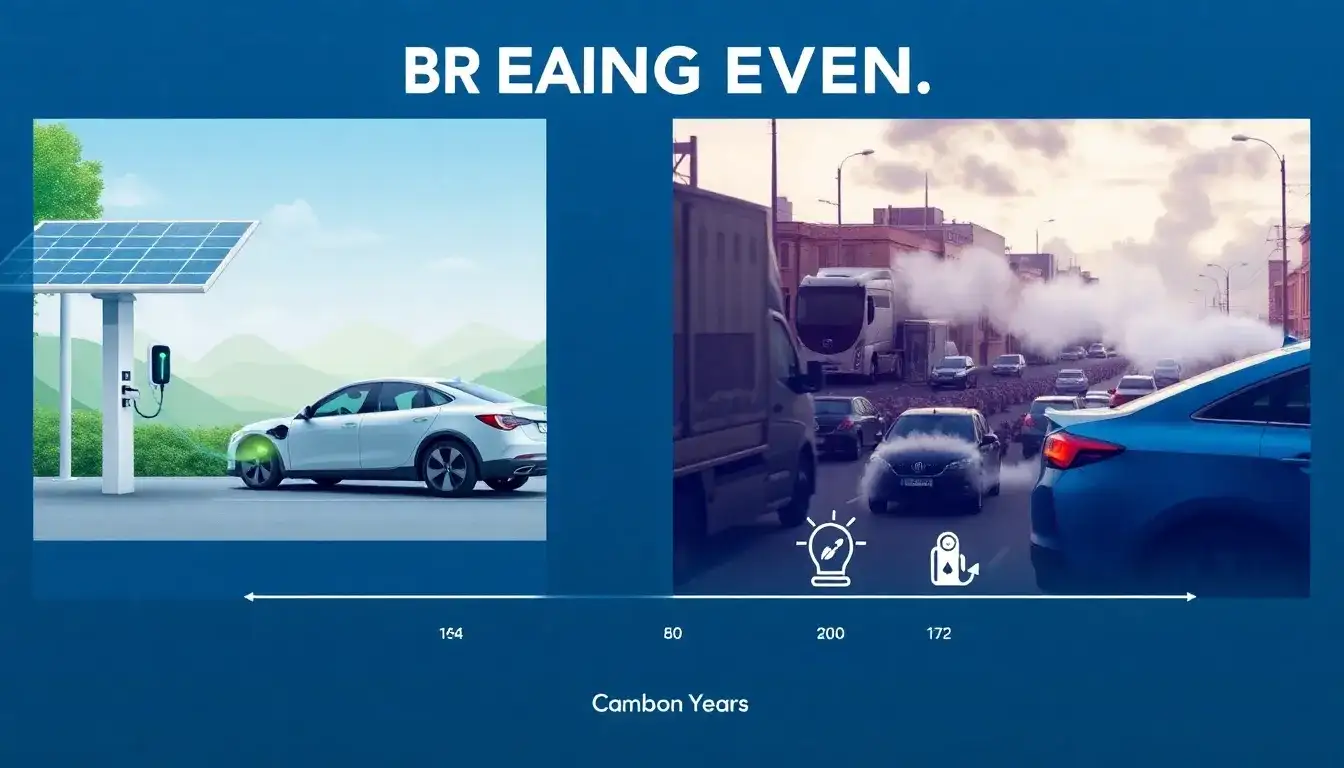
The time it takes for an electric vehicle (EV) to “break even” with a gasoline car in terms of greenhouse gas emissions generally ranges from about 18,000 km (11,000 miles) to around 41,000 km (25,000 miles), or roughly between one to two years of typical driving. This means that despite the higher emissions initially caused by EV manufacturing—especially battery production—EVs offset that “carbon debt” relatively quickly through their lower emissions during use compared to internal combustion engine (ICE) vehicles.
Key Findings on Break-Even Time
- In the United States, a Bloomberg analysis found that the break-even point occurs at approximately 41,000 km (about 25,000 miles), which corresponds to around two years of average driving (19,000 km per year). After this point, the EV produces significantly lower emissions than the equivalent gasoline vehicle—27% to 71% lower overall emissions across the lifecycle.
- In Europe and the UK, the International Council on Clean Transportation (ICCT) reports break-even points as low as 18,000 km (11,000 miles) to 21,000 km (13,000 miles) for new EVs, depending on the country and electricity grid cleanliness. For example, a Tesla Model Y in the UK breaks even after about 21,000 km (13,000 miles), which is less than two years of typical driving.
- When replacing an older gasoline car (“old banger”) with a new EV, the carbon payback can take longer—around 32,000 to 50,000 km (20,000 to 32,000 miles), or about four years—because the emissions saved by retiring an inefficient car are greater, making it harder to offset the additional emissions from EV manufacturing quickly. Still, it remains beneficial emissions-wise over time.
- The break-even point is influenced by the cleanliness of the electrical grid. As grids incorporate more renewable energy, EVs pay back their carbon debt faster. Massachusetts and Rhode Island, for instance, with cleaner grids than the US average, see shorter break-even points. If grids reach 95% renewable energy, break-even distances could drop to around 12,600 to 14,800 miles.
- Studies estimate it takes between one and two years of typical driving for an EV to offset its higher initial emissions relative to a gasoline car. This timeframe improves as battery production and electricity generation become greener.
Summary Table of Break-Even Estimates
| Region | Break-Even Distance | Approximate Timeframe | Notes |
|---|---|---|---|
| United States | ~41,000 km (25,000 mi) | ~2 years (19,000 km/year) | Average driving distance; emissions 27-71% lower overall in EV lifecycle. |
| Europe & UK | 18,000-21,000 km (11,000-13,000 mi) | <2 years | Varies with grid mix; Tesla Model Y example. |
| Replacing Old Gas Car (UK) | 32,000-50,000 km (20,000-32,000 mi) | ~4 years | Longer due to emissions saved by scrapping old vehicle. |
| With cleaner grids (US states like MA, RI) | 20,000-24,000 km (12,600-14,800 mi) | ~1-1.5 years | Grid decarbonization reduces break-even distance. |
Conclusion
An EV typically breaks even with a gasoline car in terms of emissions after about one to two years of driving, depending on the region and electricity grid mix. This break-even period is expected to shorten as battery manufacturing becomes cleaner and electricity generation becomes greener, making EVs increasingly beneficial for reducing overall transportation emissions over their lifetime.
Thus, despite the higher manufacturing emissions upfront, EVs provide a solid emissions advantage over gasoline cars within a relatively short driving distance and time frame, substantiating their role in climate mitigation strategies.
Original article by NenPower, If reposted, please credit the source: https://nenpower.com/blog/how-long-does-it-take-for-an-ev-to-break-even-with-a-gasoline-car-in-terms-of-emissions/

