

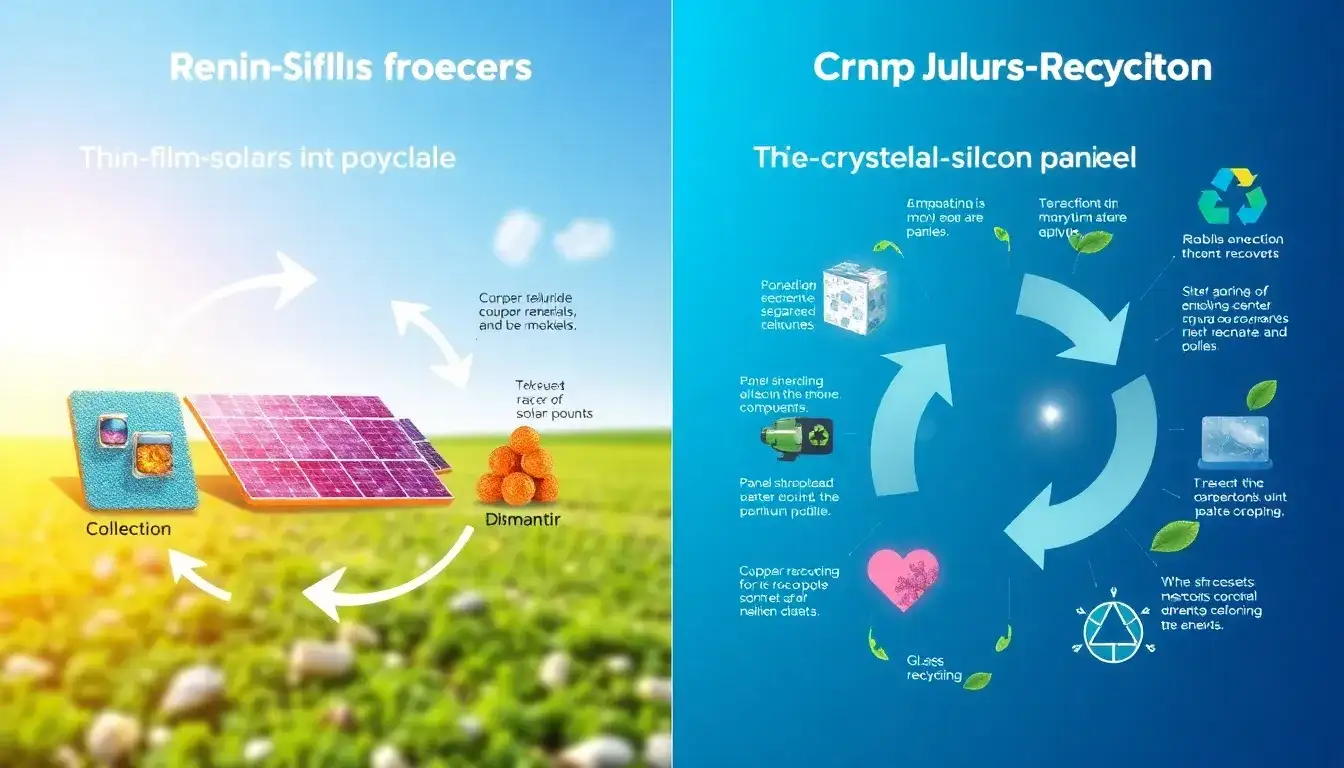
Crystalline-Silicon Solar Panels Recycling
- The process begins with disassembling the panel to separate the aluminum frame and glass components.
- Almost all the glass (about 95%) is recovered and reused.
- External metal parts are collected to be remolded into new frames.
- The remaining panel materials undergo thermal processing at around 500°C, which burns off the encapsulating plastic, leaving silicon cells intact.
- The silicon wafers are then physically separated and further refined.
- Acid etching is used to remove silicon particles from wafers, and broken wafers can be melted down for reuse in manufacturing new silicon modules.
- This process achieves roughly an 85% recycling rate of silicon material.
- Encapsulating plastic residues are reused as a heat source during thermal treatment, minimizing waste.
This method efficiently recovers glass, aluminum, and silicon for reuse in new solar panels or other products.
Thin-Film Solar Panels Recycling
- Thin-film panels, such as cadmium-telluride types, require a different, more chemical-intensive recycling approach.
- Initially, panels are shredded and then ground into small particles (around 4-5 mm) in a hammermill.
- This mechanical breakdown breaks the lamination layers, allowing the separation of inner materials.
- A key step is selective acid leaching (e.g., using nitric acid, HNO3) to dissolve and recover valuable semiconductor metals like cadmium and tellurium.
- The process aims to recover both the semiconductor materials and other components such as glass and copper.
- Some thin-film panel recycling facilities specialize in these processes, enabling recovery of metals that are less commonly reclaimed in crystalline-silicon panel recycling.
- New research focuses on eco-friendly acid leaching methods that can achieve near-complete recovery of valuable metals without harsh environmental impacts.
Summary Table
| Aspect | Crystalline-Silicon Panels | Thin-Film Panels |
|---|---|---|
| Initial step | Disassembly (frame, glass separation) | Shredding and hammermilling |
| Thermal processing | Yes, at ~500°C to remove plastics | Not typically used |
| Chemical treatment | Acid etching to recover silicon wafers | Acid leaching (selective metal dissolution) |
| Materials recovered | Glass, aluminum, silicon, sometimes silver | Glass, copper, cadmium, tellurium |
| Recycling complexity | Moderate, established processes | More complex due to chemical recovery |
| Recycling focus | Silicon and common metals | Semiconductor metals specific to thin films |
| Environmental approach | Thermal + mechanical + chemical | Eco-friendly chemical leaching researched |
In essence, crystalline-silicon panels rely heavily on thermal and mechanical separation with some chemical etching of silicon, while thin-film panels require more specialized chemical leaching to selectively recover scarce and toxic metals like cadmium and tellurium, reflecting their different materials and market presence.
This distinction makes thin-film solar panel recycling more chemical-intensive but can yield valuable recovery of unique semiconductor metals that are not present in conventional crystalline panels.
Original article by NenPower, If reposted, please credit the source: https://nenpower.com/blog/how-is-the-recycling-process-for-thin-film-solar-panels-different-from-crystalline-silicon-panels/

