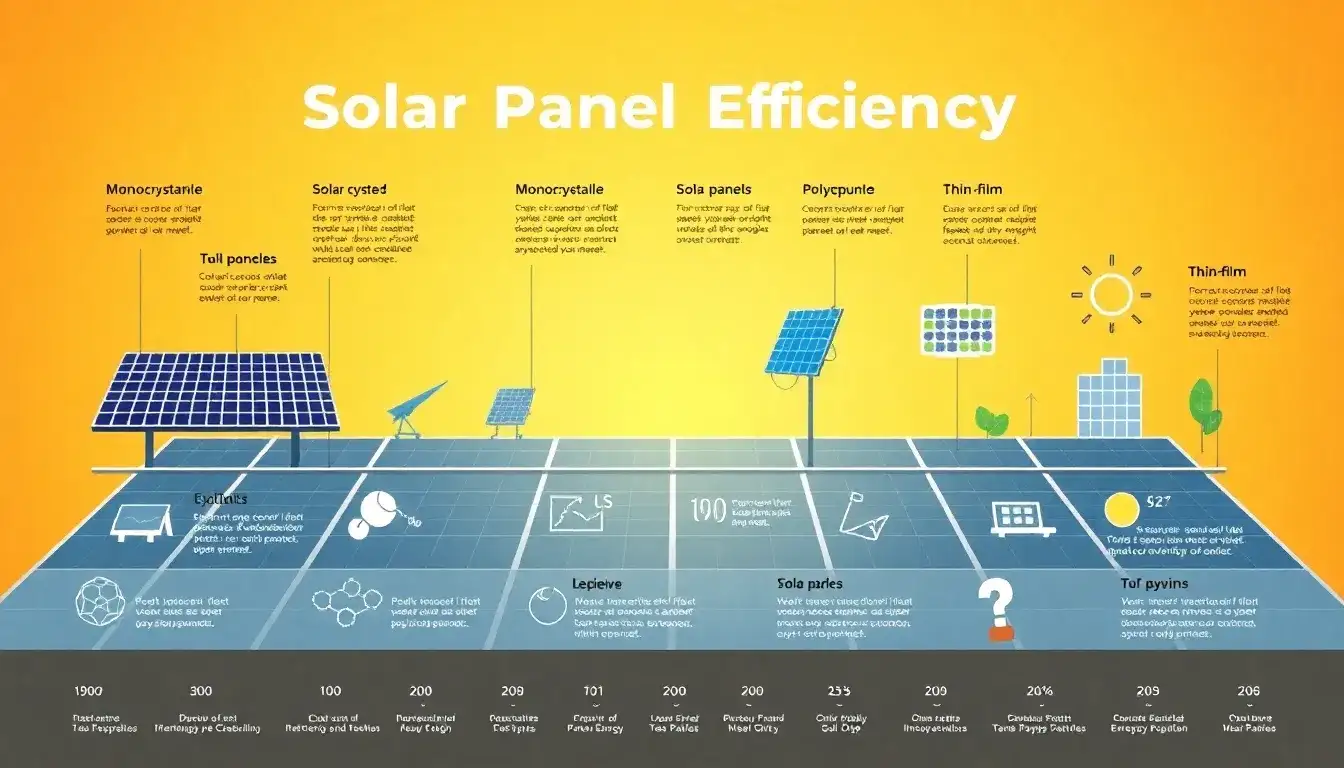
The efficiency of solar panels has undergone significant improvements over the years, driven by advancements in technology and materials. Here’s a summary of these developments:
Early Years
- 1830s: The photovoltaic effect was discovered, but early solar cells had efficiencies below 1%.
- 1954: The first practical silicon solar cell was invented with an efficiency of about 6%.
- Late 1950s: Commercial silicon solar cells achieved efficiencies up to 10%.
Mid-20th Century to Late 20th Century
- 1960s: Solar cells used in space applications reached efficiencies up to 14%.
- 1970s: Terrestrial solar cells achieved efficiencies between 13% and 15%.
- 1985: Laboratory tests demonstrated solar cells with over 20% efficiency.
- 1990s: Commercial panels typically offered efficiencies of 14% to 15%.
21st Century
- Early 2000s: Commercial panels reached efficiencies of about 15% to 17%.
- Mid-2000s: Efficiency continued to rise as new technologies emerged.
- 2015: SunPower developed a commercial panel with 22.8% efficiency.
- 2019: Laboratory settings achieved efficiencies up to 47.1% with multi-junction cells.
- 2021: Oxford PV broke a record with 29.5% efficiency using perovskite-silicon tandem cells.
- 2022: Fraunhofer ISE set a new world record with a III-V four-junction CPV cell at 47.6% efficiency.
Current Status
- 2024: Top commercial panels offer efficiencies up to 24%, with most commercially available models ranging from 20% to 22%.
- High-end panels, often using technologies like PERC and perovskite materials, can achieve efficiencies over 25%.
These improvements have made solar energy more viable and cost-effective, driving its adoption globally.
Original article by NenPower, If reposted, please credit the source: https://nenpower.com/blog/how-has-the-efficiency-of-solar-panels-changed-over-the-years/