

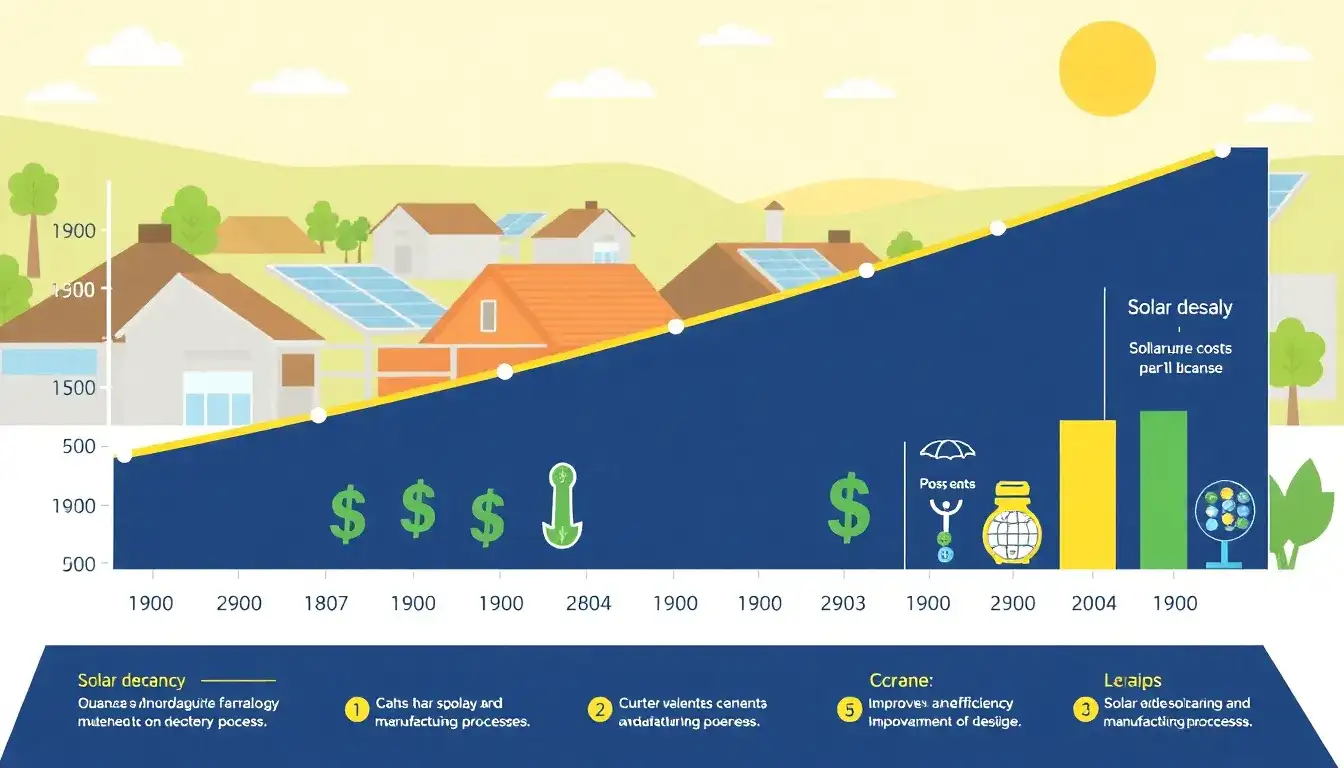
The cost of solar panels has decreased significantly over the past decade, driven by technological advancements, economies of scale, and policy incentives. Here’s a breakdown:
Price Trends (2014–2024)
- 2014: $4.00–$4.50 per watt.
- 2015: Dropped to $3.80–$4.20 per watt.
- 2016: $3.50–$3.80 per watt.
- 2017: $3.20–$3.50 per watt.
- 2023: Fell to $2.40–$2.60 per watt.
- 2024: $2.50–$3.00 per watt (average installed cost), with module prices around $1 per watt for manufacturers.
Key Drivers
- Technological improvements: Efficiency rose from ~15% (2010) to 22% (2024), reducing the number of panels needed per installation.
- Economies of scale: Increased global production capacity lowered per-unit costs.
- Competition: Proliferation of manufacturers reduced prices further.
- Policy incentives: Tax credits (e.g., 30% federal tax credit in 2025) accelerated adoption.
Recent Market Dynamics
While prices have stabilized slightly in 2024–2025 due to supply chain pressures and inflation, long-term trends remain favorable, with projections suggesting costs could drop below $0.50 per watt by 2030.
| Year | Cost per Watt | Efficiency |
|---|---|---|
| 2014 | $4.00–$4.50 | ~15% |
| 2024 | $2.50–$3.00 | ~22% |
For homeowners, a 5 kW system cost fell from ~$20,000–$22,500 (2014) to $12,500–$15,000 (2024) before incentives. Commercial payback periods now average 5–10 years.
Original article by NenPower, If reposted, please credit the source: https://nenpower.com/blog/how-has-the-cost-of-solar-panels-changed-over-the-past-decade/

