

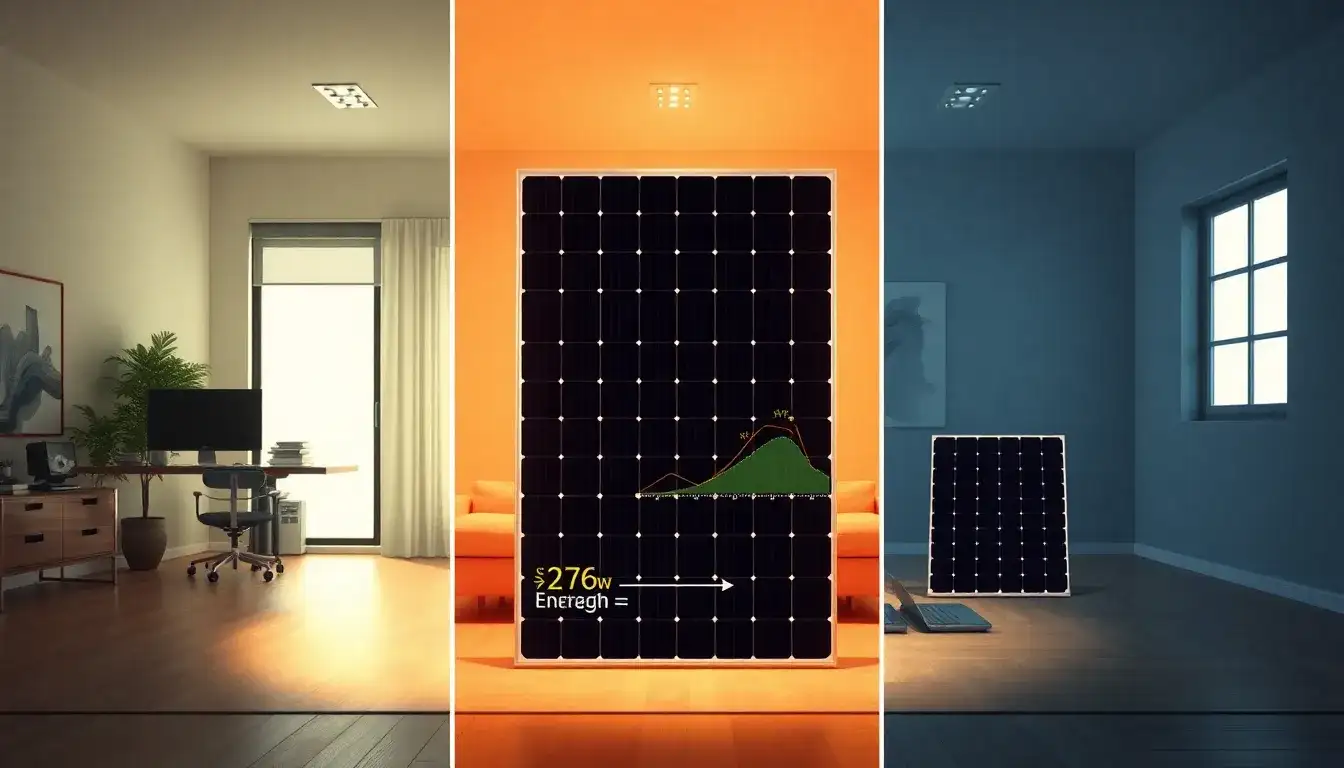
Perovskite solar panels exhibit high efficiency under various indoor lighting conditions, making them highly suitable for indoor energy harvesting applications.
Efficiency Under Indoor Lighting
- Recent research demonstrates that indoor perovskite solar cells (PSCs) can achieve power conversion efficiencies above 40%. A notable result is a 42% efficiency achieved under 3,000 K LED illumination at 1,000 lux using self-assembled monolayers to improve perovskite growth and optoelectronic properties.
- High-bandgap perovskite solar cells are particularly efficient for indoor use due to their ability to absorb the spectrum of common LED lighting effectively. Studies have shown good performance over a wide range of illuminance, from 5 to 40,000 lux, indicating versatility under different indoor lighting levels, including white LED lamps.
Performance Details and Practical Implications
- A year-long study monitoring perovskite solar cells under realistic indoor conditions found that a 1 cm² PSC could generate enough energy to power typical IoT devices most days of the year, outperforming crystalline silicon cells threefold in energy yield (148.8 mWh/cm² for PSCs versus 46.0 mWh/cm² for silicon). Optimal positioning of the cells indoors improved performance by 36%, while poor orientation reduced it by 72% relative to horizontal placement.
- These findings highlight the practical utility of perovskite panels indoors, especially for powering low-power electronics such as sensors and IoT devices where ambient light is often low and variable. However, energy storage may still be needed during very low-light days.
Advances in Material and Device Optimization
- Perovskite solar cells benefit from tunable bandgaps and strong light absorption, which can be tailored to match indoor light spectra (LEDs, fluorescent lamps). Advances in defect passivation and interfacial engineering also enhance indoor efficiency and stability.
- Additionally, emerging strategies incorporating AI and machine learning are accelerating improvements in device design and stability, ensuring that these cells maintain high performance under diverse indoor lighting environments.
Summary Table: Perovskite Solar Cell Efficiency in Indoor Lighting
| Indoor Lighting Condition | Efficiency / Performance | Notes |
|---|---|---|
| 3,000 K LED at 1,000 lux | ~42% power conversion efficiency | Using self-assembled monolayers |
| White LED, 5–40,000 lux | High efficiency due to suitable high-bandgap materials | Wide operating range |
| Typical indoor IoT environment | ~3x energy yield over crystalline silicon | 1 cm² cell powers IoT devices; orientation impacts performance significantly |
| Low-intensity, realistic indoor | Consistent energy harvesting over months | Stability maintained with encapsulation; energy storage recommended for low light periods |
In conclusion, perovskite solar panels show remarkable efficiency under various indoor lighting conditions, with demonstrated efficiencies above 40% under standard LED illumination and strong performance adaptability across different indoor light intensities and spectra. These characteristics make them highly promising for powering indoor low-power devices and IoT applications.
Original article by NenPower, If reposted, please credit the source: https://nenpower.com/blog/how-efficient-are-perovskite-solar-panels-under-different-indoor-lighting-conditions/

