

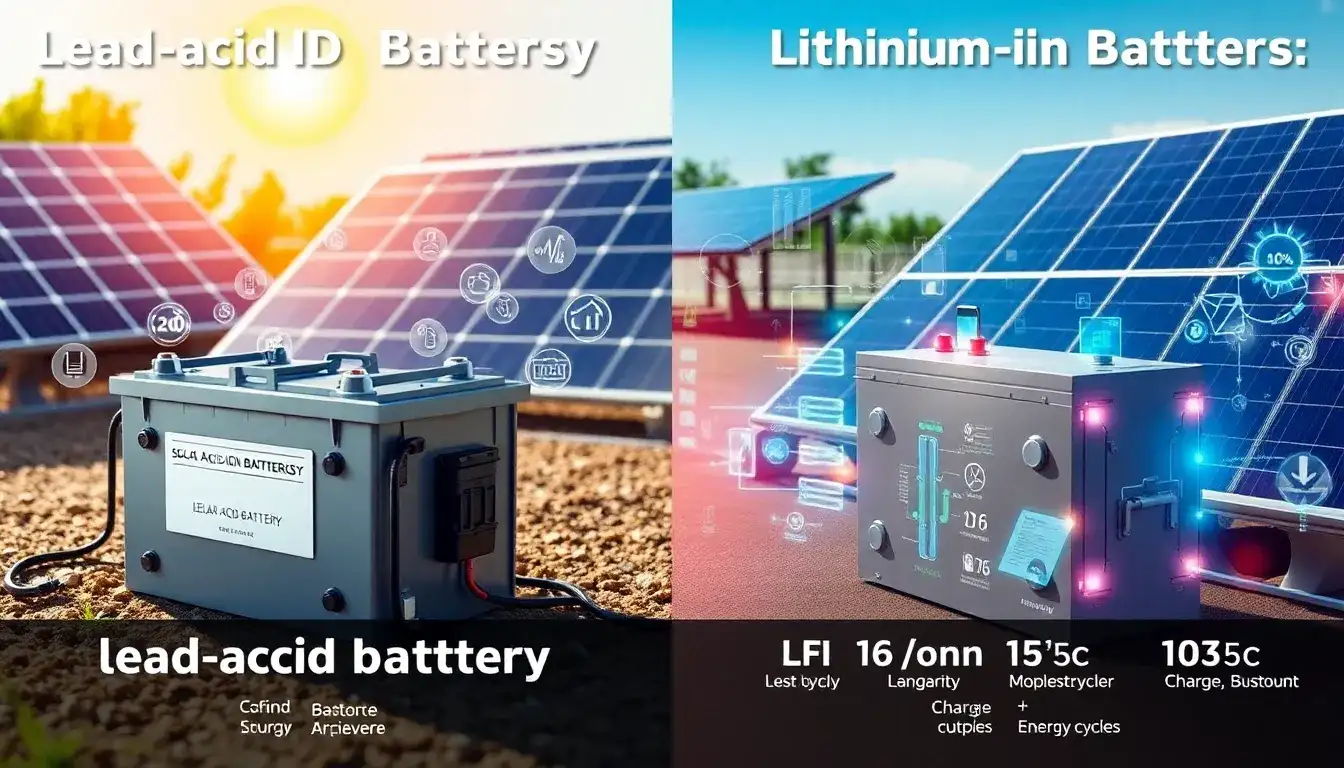
Lead-acid and lithium-ion batteries serve different purposes when it comes to storing solar energy due to their varying characteristics.
Comparison Points
Efficiency
- Lithium-ion Batteries: Generally offer about 95% efficiency, meaning they can store and deliver a high percentage of the solar energy captured.
- Lead-acid Batteries: Have lower efficiency, ranging from 80% to 85%. This means they lose more energy during charging and discharging.
Depth of Discharge (DoD)
- Lithium-ion Batteries: Can safely discharge up to 80% or more without significant degradation, allowing for more usable energy storage.
- Lead-acid Batteries: Should be kept below a 50% DoD to maximize lifespan, limiting their effective storage capacity.
Capacity
- Lithium-ion Batteries: Typically offer larger capacities (15+ kWh) and higher energy density, allowing for more compact designs.
- Lead-acid Batteries: Generally smaller capacities (1.5-5 kWh) and require more space for equivalent storage.
Lifespan
- Lithium-ion Batteries: Last longer, typically between 10 to 15 years, and perform more cycles (up to 5,000 or more).
- Lead-acid Batteries: Shorter lifespans (3-12 years) and fewer cycles (around 500-1,000), necessitating more frequent replacements.
Cost and Maintenance
- Lithium-ion Batteries: Are more expensive upfront but require little to no maintenance, making them a good long-term choice.
- Lead-acid Batteries: Less expensive initially but demand regular maintenance and have a higher overall cost over time due to frequent replacements.
Conclusion
Lithium-ion batteries are generally more effective for storing solar energy due to their higher efficiency, capacity, lifespan, and depth of discharge. However, lead-acid batteries can still be viable for infrequently used systems or cases where budget constraints are a priority.
Original article by NenPower, If reposted, please credit the source: https://nenpower.com/blog/how-effective-are-lead-acid-batteries-compared-to-lithium-ion-batteries-for-storing-solar-energy/

