

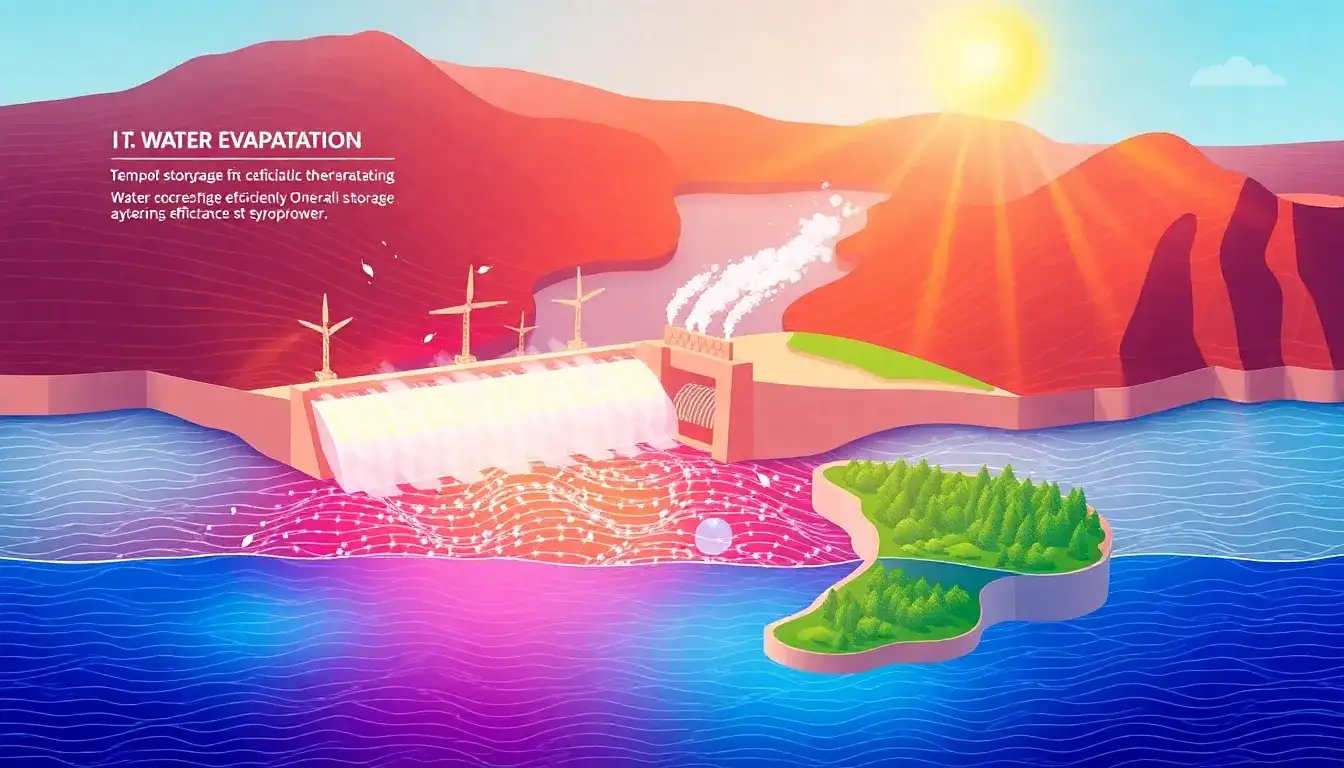
Water evaporation impacts the overall efficiency of pumped hydroelectric energy storage by causing a loss of stored water volume, which directly reduces the amount of potential energy available for conversion back to electricity. This loss manifests as a decrease in the system’s energy recovery efficiency.
More specifically, pumped-storage hydroelectric systems typically achieve energy recovery efficiencies in the range of 70–80% or more when considering conversion losses and evaporation losses from the exposed water surface. Evaporation represents a non-recoverable loss of water that must be compensated for, often by adding make-up water from nearby sources, otherwise the energy storage capacity gradually decreases over time.
Because the energy stored in pumped hydro systems depends on the volume of water and the height difference between reservoirs, evaporation effectively reduces the usable volume of water in the upper reservoir. This leads to a lower total energy storage capability, which in turn reduces the overall round-trip efficiency—meaning that less electricity can be generated for the same amount of electricity used to pump water uphill.
Evaporation losses are especially significant in regions with large surface areas exposed to dry, hot climates. Closed-loop pumped hydro systems, where both reservoirs are man-made and isolated from natural inflows, may be more sensitive to evaporation losses because they rely solely on stored water without replenishment from natural sources.
In summary:
- Evaporation causes loss of water volume from the upper reservoir.
- This loss reduces the potential gravitational energy stored.
- Reduced stored energy leads to a lower round-trip efficiency (energy recovery efficiency).
- Typical pumped hydro systems account for these losses and still achieve about 70–80% overall energy efficiency.
- Mitigation may include design considerations to minimize exposed water surface, choices of site geography, or replenishment strategies.
Thus, while evaporation does impact the overall efficiency of pumped hydroelectric energy storage, it is one of several factors considered in the system design and operation, and these systems remain among the most efficient large-scale energy storage technologies available.
Original article by NenPower, If reposted, please credit the source: https://nenpower.com/blog/how-does-water-evaporation-impact-the-overall-efficiency-of-pumped-hydroelectric-energy-storage/

