

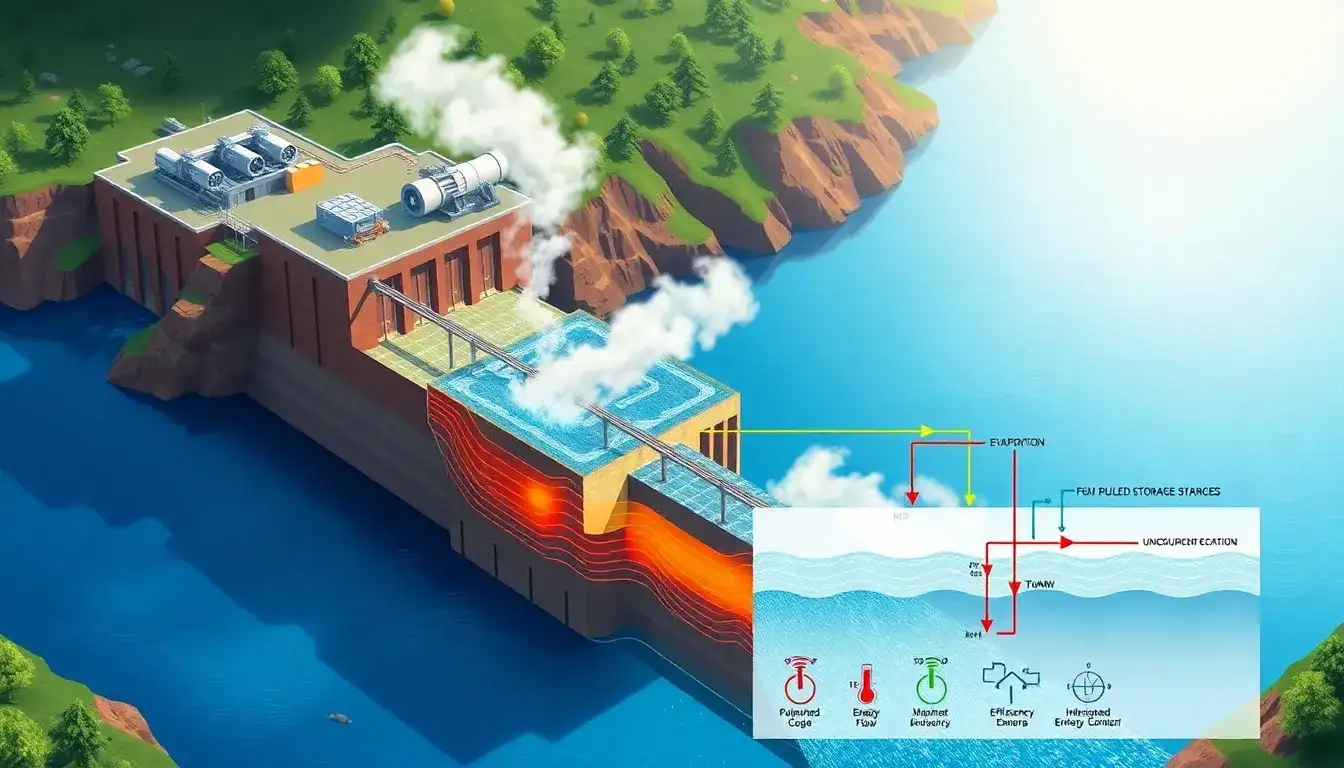
Water evaporation impacts the efficiency of pumped hydroelectric storage primarily by reducing the volume of water available in the reservoirs, which in turn decreases the amount of potential energy that can be stored and later converted to electricity. This loss due to evaporation constitutes part of the overall energy losses in the system, alongside conversion losses during pumping and generating processes.
How Evaporation Affects Efficiency
- Efficiency Loss Component: Evaporation causes water volume reduction, which means less water can be cycled between the upper and lower reservoirs. This effectively lowers the storage capacity and energy output potential of the system. The round-trip efficiency of pumped hydro storage (PSH) typically ranges between 70% and 80%, and evaporation losses are factored into this range along with other losses such as seepage and conversion inefficiencies.
- Magnitude of Evaporative Losses: The extent of evaporation depends heavily on the local climate and environmental conditions. In dry, hot climates, evaporation can be more significant, whereas wetter environments may naturally replenish water losses. Losses might be on the order of a couple hundred acre-feet per year for large projects, which is relatively small compared to the total water volume used, but still impacts storage efficiency.
- Modeling Evaporation: In system modeling, evaporation losses are typically included by adjusting parameters that represent the fraction of stored energy available after accounting for such losses. Some models assume all losses happen during charging (pumping), simplifying calculations, but in reality, evaporation and seepage losses affect both charging and discharging cycles.
Operational and Economic Implications
- Water Management Needs: Since pumped storage plants rely on water replenishment from rainfall or external sources, evaporation can necessitate additional water input to maintain reservoir levels. This is especially important in closed-loop systems that do not receive inflows from natural streams or rivers.
- Cost-Effectiveness and Location: Evaporation losses, while reducing efficiency, generally do not negate the economic advantages of pumped hydro storage, which remains among the most cost-effective large-scale energy storage methods. However, site selection is crucial; areas with lower evaporation rates are preferred to maximize efficiency and reduce operational water needs.
- Environmental Considerations: In some cases, managing evaporation includes trade-offs such as sealing reservoirs or using floating covers, which can add to capital or maintenance costs but improve the overall water retention and efficiency of the system.
Summary
Water evaporation impacts pumped hydroelectric storage by decreasing the net water volume available for energy storage, lowering round-trip efficiency within the typical 70-80% range. The significance of evaporation losses depends on local climate and reservoir design but generally represents a small fraction of water use. These losses are accounted for in efficiency models and influence operational water requirements and site selection to optimize performance and economic returns.
Original article by NenPower, If reposted, please credit the source: https://nenpower.com/blog/how-does-water-evaporation-impact-the-efficiency-of-pumped-hydroelectric-storage/

