

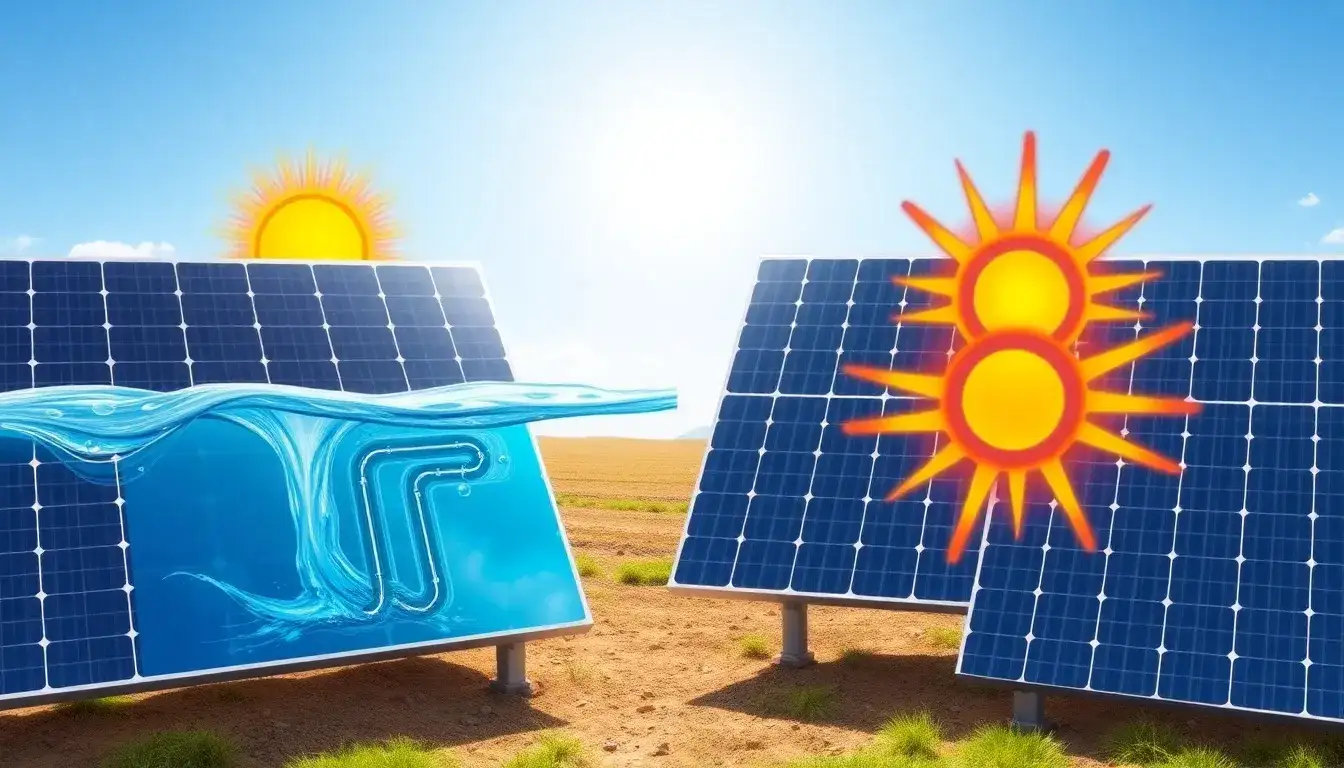
Water cooling generally outperforms air cooling for solar panels in terms of cooling efficiency, resulting in improved photovoltaic (PV) performance and longevity.
Cooling Efficiency and Performance
- Thermal Conductivity and Cooling Effectiveness: Water has a much higher thermal conductivity than air, making it more effective at absorbing and removing heat from solar panels. This leads to better cooling performance under both natural and forced circulation conditions.
- Temperature Reduction: Studies report that water cooling can significantly reduce the operating temperature of PV panels, with reductions of around 13°C or more achievable through active water cooling systems like water spraying or immersion cooling. Such temperature drops correspond directly to improved electrical output.
- Improvement in Electrical Efficiency: Water-cooled PV panels can generate up to 15% more electricity compared to air-cooled ones. For instance, experimental work showed a 59% increase in power output and an 8% increase in efficiency with water-based immersion and spraying cooling methods, compared to air cooling. Another study found a 14.3% efficiency improvement using a water spray cooled system integrated with geothermal cooling.
- Hybrid Cooling: Combining water and air cooling in hybrid systems can yield even better performance than either method alone, further reducing panel temperature and increasing efficiency by several percentage points.
Practical and Economic Considerations
- Installation Complexity and Cost: Natural air cooling systems are simpler, cheaper, and easier to install and maintain due to fewer moving parts and no need for water circulation infrastructure. They are thus more suitable for large-scale, low-cost applications.
- Energy Consumption: Active water cooling requires pumps and additional equipment, which consume energy and increase operational costs. Forced air cooling also requires fans but usually at a lower power penalty.
- Water Use and Maintenance: Water cooling systems demand water resources and involve more maintenance due to risks of leaks, evaporation, and potential corrosion. This can affect reliability and suitability depending on local water availability and climate.
- Longevity and Reliability: By keeping cell temperature lower and more uniform, water cooling reduces long-term degradation rates of PV modules, which extends module lifespan and reduces maintenance costs.
Summary Table
| Feature | Water Cooling | Air Cooling |
|---|---|---|
| Cooling Efficiency | Higher (due to better thermal conductivity) | Lower |
| Temperature Reduction | Significant (e.g., ~13°C or more) | Moderate (~10–13°C with active forced air) |
| Efficiency Improvement | Up to ~15% electrical output gain | Lower, around 4–8% |
| Installation Complexity | Higher (pipes, pumps, maintenance) | Lower (fans or natural ventilation) |
| Energy Consumption | Higher (pumps) | Lower (fans or none if natural) |
| Water Resource Dependence | Yes | No |
| Maintenance | More intensive | Less intensive |
| Suitable Applications | High-efficiency systems, hot climates, PV/T hybrid systems | Low-cost, large-scale, dry locations |
Conclusion
Water cooling provides superior cooling performance for solar panels compared to air cooling, resulting in higher electrical efficiency and longer PV module lifespan. However, these benefits come with higher installation complexity, operational energy consumption, and water resource requirements. Air cooling remains attractive for cost-sensitive and water-scarce environments. Hybrid cooling systems integrating both methods can leverage the strengths of each to optimize cooling and efficiency gains.
Original article by NenPower, If reposted, please credit the source: https://nenpower.com/blog/how-does-water-cooling-compare-to-air-cooling-for-solar-panels/

