

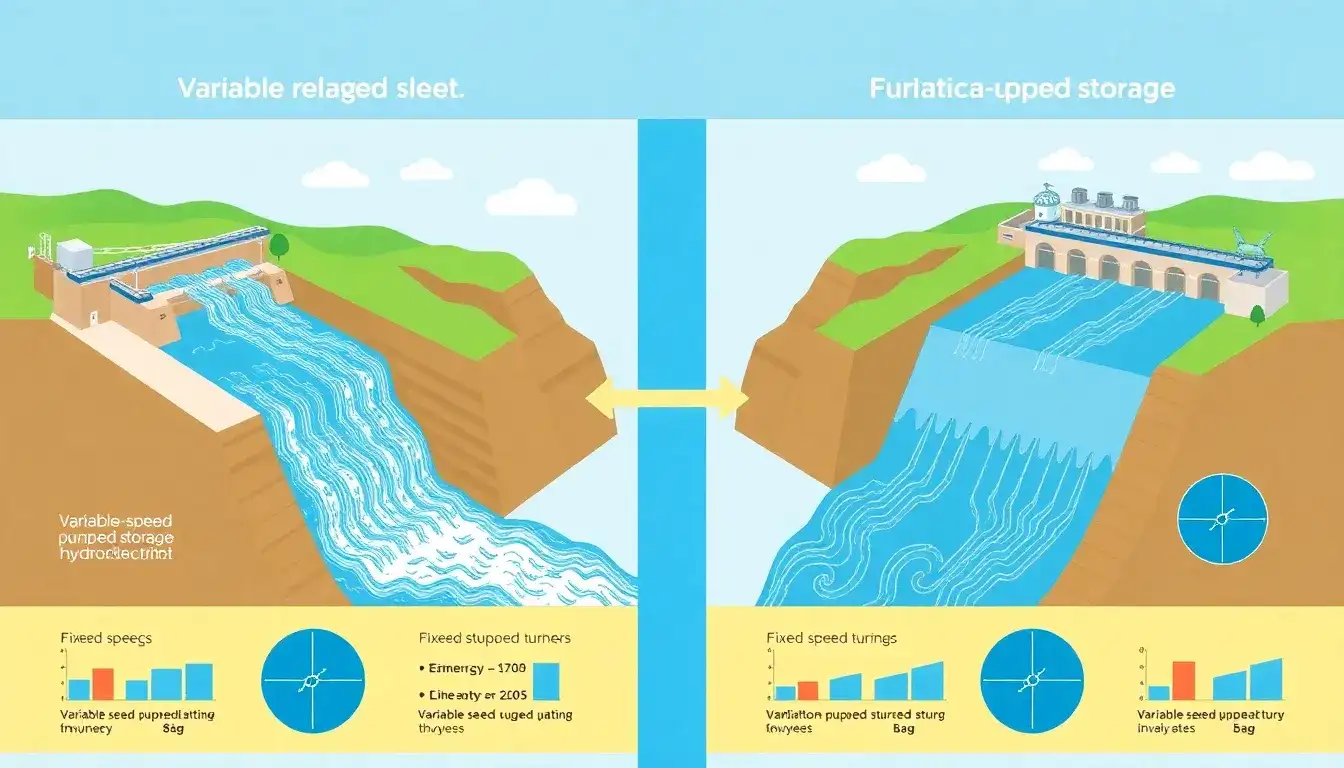
Variable-speed pumped storage hydropower (VS-PSH) generally offers higher efficiency and greater operational flexibility compared to traditional constant-speed pumped storage systems.
Efficiency Comparison
- Higher Round-Trip Efficiency: Traditional pumped storage hydropower typically achieves round-trip efficiencies between 70% and 80% due to inherent losses in the pumping and generating processes. Variable-speed units can improve on this by allowing the turbine and pump to operate closer to their optimal efficiency points independently, thus increasing the overall plant efficiency.
- Optimized Operation in Both Modes: In traditional systems with constant-speed operation, the turbine runner speed is fixed, which means the design must compromise between optimal pumping and generating efficiency. Typically, the optimum speed for pumping is around 1.1–1.2 times the generating speed, but constant-speed machines cannot achieve maximum efficiency simultaneously in both modes. Variable-speed technology resolves this by adjusting turbine speed dynamically, enabling independent optimization of pumping and generating operations.
- Quantified Efficiency Gains: According to GE Vernova, variable-speed hydro generators can operate closer to the turbine’s optimal efficiency point, resulting in over a 1% weighted average efficiency increase in turbine mode and significant improvements during pumping. This gain might seem modest, but it translates into substantial energy savings and better grid performance over time.
Additional Benefits Affecting Efficiency and Grid Support
- Reduced Hydraulic Instability and Cavitation: Variable-speed operation avoids certain hydraulic instabilities and cavitation issues common in traditional systems due to constant speed surging, leading to improved reliability and lower maintenance costs.
- Improved Grid Ancillary Services: Variable-speed units can act as synchronous condensers or provide static synchronous compensator (STATCOM) modes, offering enhanced grid stability and faster response without stopping the machine or dewatering reservoirs, which indirectly supports efficient energy use and system reliability.
- Operational Flexibility: Variable-speed units enable faster startup in pumping mode and broader operating ranges, which improves the plant’s availability and its ability to respond to grid demands, contributing to overall system efficiency.
Summary Table
| Aspect | Traditional Pumped Storage | Variable-Speed Pumped Storage |
|---|---|---|
| Round-trip efficiency | 70–80% | Slightly higher (e.g., >1% improvement in turbine mode) |
| Turbine/Pump speed control | Fixed speed (compromise between modes) | Variable speed (independent optimization) |
| Hydraulic stability | Potential cavitation and surging issues | Reduced cavitation and surging |
| Grid ancillary services | Limited | Supports synchronous condenser, STATCOM modes |
| Startup time | Longer, may require dewatering | Shorter, no dewatering needed |
| Operational flexibility | Narrow operating range | Wider head range and operating flexibility |
In conclusion, variable-speed pumped storage hydropower systems improve efficiency by allowing independent optimization of pump and turbine speeds, reducing hydraulic issues, and enhancing grid support capabilities compared to traditional constant-speed systems. These improvements make VS-PSH an increasingly attractive option as grids incorporate more intermittent renewable energy sources.
Original article by NenPower, If reposted, please credit the source: https://nenpower.com/blog/how-does-variable-speed-pumped-storage-hydropower-compare-to-traditional-pumped-storage-in-terms-of-efficiency/

