

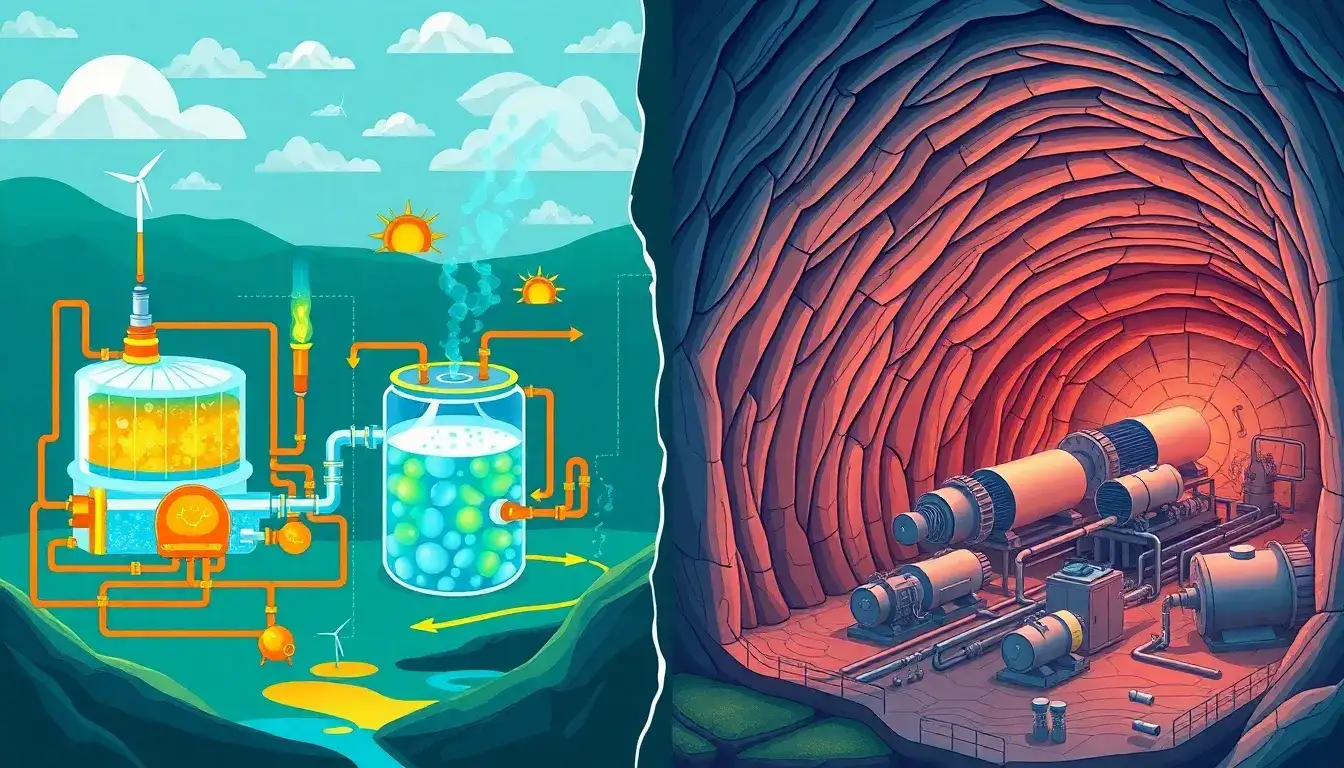
Thermochemical energy storage (TCES) and traditional Compressed Air Energy Storage (CAES) systems share the goal of enhancing energy efficiency, but they approach this objective differently.
Traditional CAES
- Mechanism: Traditional CAES involves compressing air during off-peak hours and storing it in underground caverns. The compressed air is then expanded during peak demand to generate electricity. However, much of the heat generated during compression is lost, reducing efficiency.
- Efficiency: The efficiency of traditional CAES systems is typically lower compared to adiabatic systems. Diabatic systems, which are the most common form of CAES, suffer from lower round-trip efficiencies due to heat loss during compression and expansion.
- Cost and Advantages: Conventional CAES systems have a relatively low cost compared to many other energy storage technologies like batteries. They are particularly suitable for large-scale applications due to their cost-effectiveness.
Thermochemical Energy Storage in CAES
- Mechanism: TCES aims to improve CAES efficiency by capturing and storing the heat generated during air compression in chemical bonds. This heat can then be reused during air expansion to increase the efficiency of power generation. Techniques involve using metal oxide redox reactions or similar chemical reactions that can store energy effectively.
- Efficiency: By recovering the heat through chemical reactions, TCES has the potential to significantly increase the overall efficiency of a CAES system. This approach could lead to higher round-trip efficiency rates compared to traditional CAES systems.
- Cost and Advantages: While traditional CAES systems are cost-effective, the integration of TCES could further enhance their economic advantages by improving efficiency. However, detailed cost analyses are still needed to fully understand the economic impact of TCES in CAES systems.
Overall, the integration of TCES into CAES offers a promising path to enhance efficiency and potentially maintain or improve the cost-effectiveness of CAES systems, making them more attractive for large-scale energy storage applications.
Original article by NenPower, If reposted, please credit the source: https://nenpower.com/blog/how-does-thermochemical-energy-storage-compare-to-traditional-caes/

