

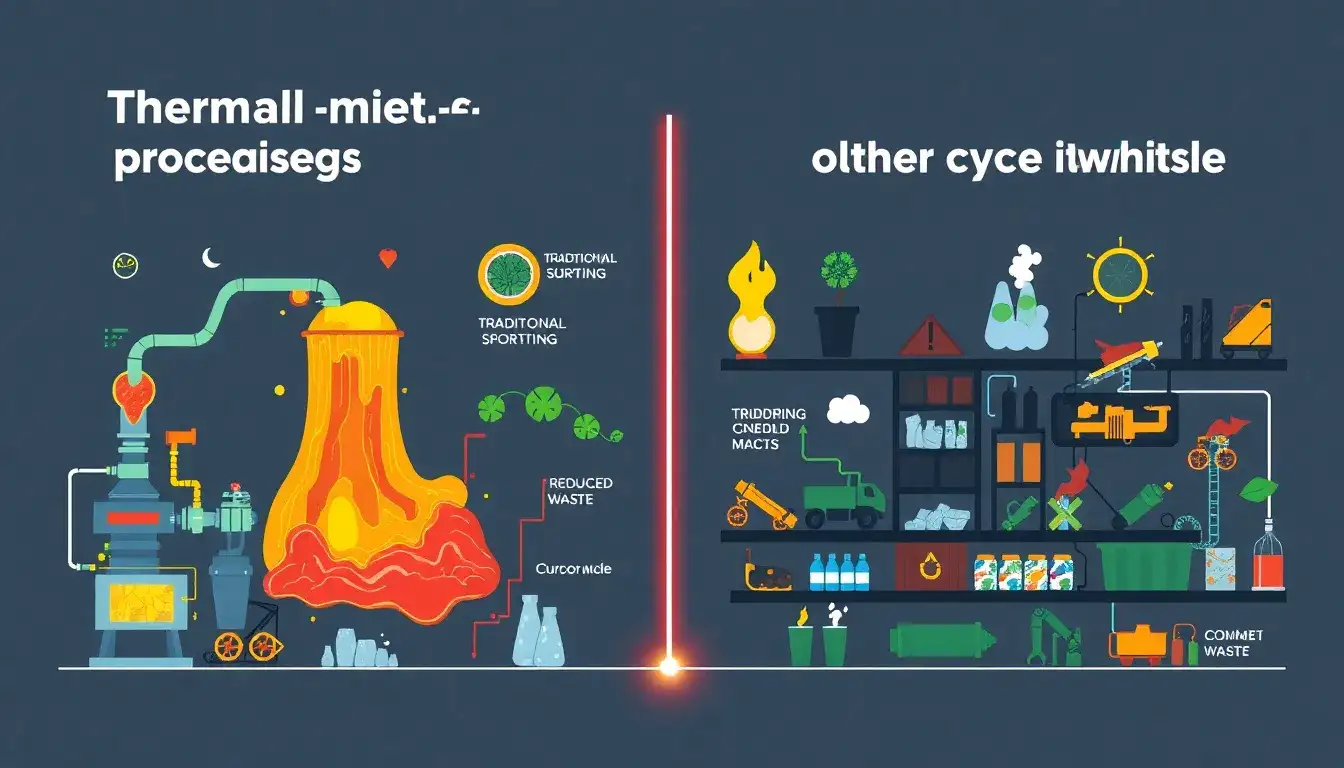
Thermo-mechanical treatment (TMT) as a recycling method involves the combined application of heat and mechanical action, often through processes like shredding, extrusion, or compounding. When compared to other recycling methods, such as purely mechanical recycling, chemical recycling, or composting, its characteristics and advantages are as follows:
Comparison of Thermo-Mechanical Treatment to Other Recycling Methods
1. Process Nature and Application
- Thermo-mechanical treatment typically involves physical modification of waste materials by applying heat and mechanical forces, such as extrusion or shredding, to reshape or repurpose materials, commonly thermoplastics and rubber. For example, in additive manufacturing plastics (like PLA and PP), thermo-mechanical recycling includes shredding, extrusion, and sometimes service-life simulation to reuse materials effectively.
- Other recycling methods include:
- Mechanical recycling, which generally involves physical processes like grinding and melting without chemical alteration.
- Chemical recycling, which breaks down polymers into monomers or other chemicals to be repolymerized.
- Composting, which is a biological process aimed at organic waste degradation into humus and is unsuitable for plastics or inorganics.
2. Material Suitability and Degradation
- Thermo-mechanical recycling is suitable especially for thermoplastics (e.g., PET, PP) because the materials soften upon heating and can be reformed mechanically. However, it has limitations such as polymer degradation due to thermal and hydrolytic effects, causing decreased mechanical properties and viscosity changes in recycled materials.
- Polymers like PET face hydrolysis during the thermo-mechanical process, which reduces recyclate quality but can be mitigated by improved machinery features such as vacuum degassing to remove moisture and contaminants.
- Bioplastics like PLA also degrade during thermo-mechanical treatment, showing reduced mechanical strength and changes in surface quality compared to virgin materials.
3. Effectiveness and Environmental Impact
- Thermo-mechanical treatment has the advantage of integrating multiple steps (service-life simulation, shredding, extrusion), which helps in recycling complex geometries and composites while maintaining reasonable material properties for reuse.
- Compared to incineration or landfilling, thermo-mechanical treatment reduces waste volume significantly and can be a more environmentally friendly option that prevents harmful emissions and landfill use.
- Waste-to-energy and metal recovery can be complementary to thermo-mechanical treatment in integrated waste management facilities but are different in focus and technology.
4. Economic and Operational Considerations
- Thermo-mechanical recycling methods, especially in industrial setups, can be cost-effective and sustainable if optimally run, with some setups being self-sustaining and requiring pre-sorting to ensure material purity.
- The method is less energy-intensive than chemical recycling but may yield lower-quality recycled materials compared to chemical methods, which fully restore polymer monomers.
- Improving thermo-mechanical recycling effectiveness often involves additional equipment to stabilize material properties and remove contaminants, increasing complexity and investment.
Summary Table: Thermo-Mechanical Treatment vs Other Recycling Methods
| Feature | Thermo-Mechanical Treatment | Mechanical Recycling | Chemical Recycling | Composting |
|---|---|---|---|---|
| Process | Heat + mechanical (extrusion, shredding) | Physical (grinding, melting) | Chemical breakdown into monomers | Biological decomposition |
| Suitable materials | Thermoplastics, rubber | Thermoplastics | Polymers (any type, but more complex) | Organic waste |
| Material degradation | Moderate (thermal, hydrolysis) | Low (mostly physical damage) | Low (restores monomers) | N/A |
| Product quality | Reduced vs virgin but usable | Reduced but often reprocessable | Near-virgin quality possible | Humus (not material reuse) |
| Environmental impact | Lower landfill and waste volume | Lower landfill and waste volume | Can be energy intensive | Reduces organic waste |
| Cost and complexity | Moderate, may require advanced equipment | Lower complexity | High complexity and cost | Low |
In conclusion, thermo-mechanical treatment offers a practical, relatively low-cost recycling route for thermoplastics and rubber, balancing technical feasibility and environmental benefits. It is less thorough than chemical recycling in restoring polymer quality but more versatile and less energy demanding, making it suitable for many industrial recycling applications. However, degradation of polymers and the need for pre-sorting and contaminant removal remain key challenges compared to other recycling methods.
Original article by NenPower, If reposted, please credit the source: https://nenpower.com/blog/how-does-thermo-mechanical-treatment-compare-to-other-recycling-methods/

