

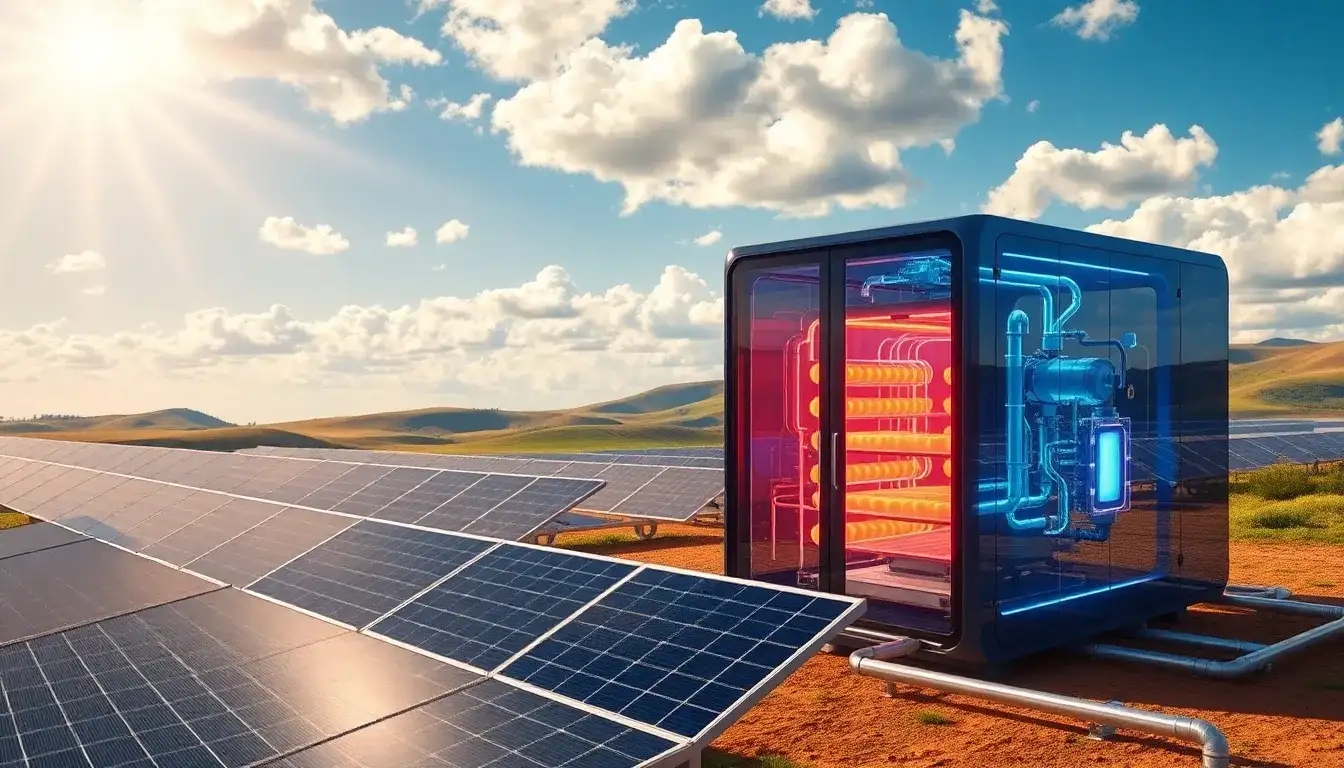
Thermal energy storage (TES) in solar systems works by capturing and storing heat collected from solar energy so it can be used later, typically to generate electricity or provide heating, even when the sun is not shining.
How Thermal Energy Storage Works in Solar Systems
1. Collection and Heating of Heat Transfer Fluid
- Solar thermal systems use a heat transfer fluid (HTF) such as molten salt, synthetic oil, or other liquids to collect heat from sunlight. This fluid circulates through solar collectors — either parabolic troughs or central receiver (tower) systems.
- In tower CSP plants, sunlight is concentrated via mirrors (heliostats) onto a receiver at the top of a tower, heating molten salt from about 260°C to roughly 565°C. In trough CSP systems, sunlight heats an HTF flowing through curved mirrors that concentrate solar rays on a pipe in a trough shape.
2. Thermal Storage Tanks
- The heated fluid flows into a high-temperature thermal storage tank where the thermal energy is stored.
- A two-tank direct storage system is common: the same fluid is stored at low temperature in one tank and high temperature in the other. Fluid cycles between these tanks as it picks up heat from the solar collectors and releases heat when needed.
- For example, molten salt is often used because it remains liquid at high temperatures and has good heat retention properties.
3. Using Stored Thermal Energy
- When electricity or heat is required, the hot storage fluid is passed through a heat exchanger.
- In the heat exchanger, the thermal energy transfers to water to produce steam.
- This steam drives turbines to generate electricity, analogous to conventional power plants fueled by coal or natural gas.
- After transferring its heat, the now cooler fluid returns to the low-temperature tank for reheating in the solar field.
4. Indirect Systems and Extra Heat Exchangers
- Some systems use an indirect approach with separate heat transfer and storage fluids, requiring an extra heat exchanger to transfer heat between them. This adds cost but can optimize fluid selection and performance.
5. Advanced Materials and Techniques
- Other TES methods use materials like zeolites or silica gels that adsorb and release heat through chemical or physical sorption processes.
- For instance, in adsorption TES, heat from solar collectors drives off moisture from zeolite beds during the day; at night or during sunless hours, re-adsorbing moisture releases heat for space heating.
- This type of storage is effective for low-grade heat and has advantages like indefinite energy storage when kept dry and lower insulation costs compared to high-temperature molten salt systems.
Summary
Thermal energy storage in solar systems works by:
- Using solar energy to heat a fluid (often molten salt or synthetic oil),
- Storing this heated fluid in insulated tanks to retain thermal energy,
- Later extracting the stored heat via heat exchangers to produce steam,
- Running turbines to generate electricity or using the heat for industrial or building needs,
- Employing materials and processes like adsorption to store heat chemically for longer durations or lower temperatures.
This approach enables solar power plants to deliver electricity on demand, improving reliability and allowing solar energy to be used even when sunlight is unavailable.
Original article by NenPower, If reposted, please credit the source: https://nenpower.com/blog/how-does-thermal-energy-storage-work-in-solar-systems/

