

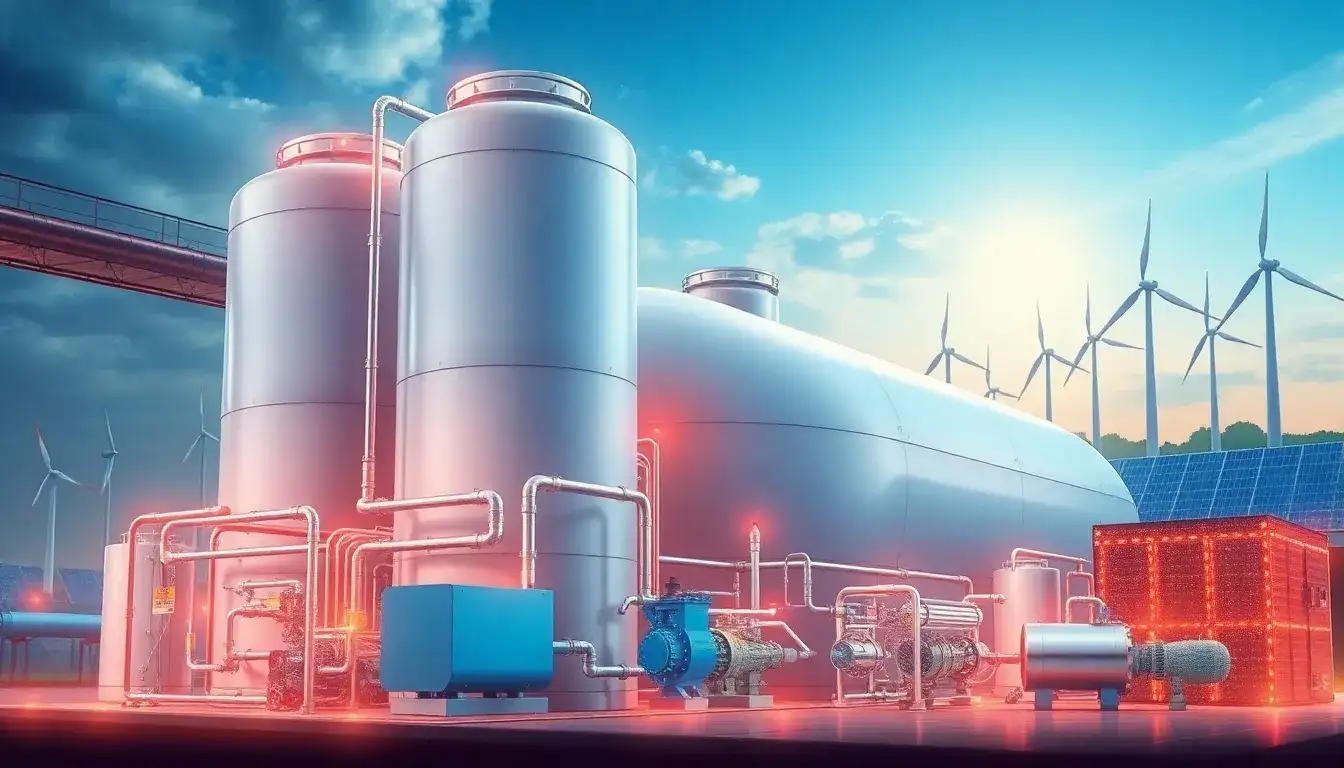
Thermal energy storage (TES) in adiabatic compressed air energy storage (A-CAES) systems works by capturing and storing the heat generated during the compression of air, and then reusing this stored heat during the expansion phase to improve overall system efficiency.
How Thermal Energy Storage Works in A-CAES
- Compression Phase: Electricity drives compressors that compress ambient air to high pressures (up to around 70-100 bar). This compression heats the air significantly, often exceeding 600 °C. Instead of letting this heat dissipate, the hot air passes through a heat exchanger that transfers the heat to a thermal energy storage medium.
- Thermal Energy Storage: The heat extracted from the compressed air is stored separately in a thermal energy storage system. TES can include materials such as concrete, stone, packed beds, hot oil (up to 300 °C), molten salts (up to 600 °C), or advanced phase change materials (PCMs) like xylitol and palmitic acid. These materials absorb the heat during compression and retain it efficiently due to good insulation and material properties.
- Storage of Compressed Air: Meanwhile, the cooled, compressed air is stored in underground caverns or other high-pressure reservoirs. This air is kept at high pressure but at a low temperature since its heat has been extracted and stored.
- Expansion Phase: When electricity is needed, the compressed air is released from storage and reheated by transferring the stored heat from the TES back to the air. This reheated air expands through turbines to generate electricity. This process recovers the heat that would otherwise be wasted, significantly improving the round-trip efficiency of the system.
Efficiency and Benefits
- By decoupling the compression and expansion heat flows, A-CAES systems avoid the efficiency losses seen in traditional CAES that release compression heat to the atmosphere.
- The theoretical efficiency of adiabatic CAES can approach 100% with perfect thermal insulation, but practical implementations achieve around 70% round-trip efficiency.
- Advanced TES materials such as phase change materials can store heat in smaller volumes and with more stable outlet temperatures, further optimizing system performance.
In summary, thermal energy storage in adiabatic CAES systems plays a critical role by capturing the compression heat, storing it in dedicated thermal reservoirs, and then returning it during air expansion to maximize energy recovery and system efficiency. This innovative heat management distinguishes A-CAES from traditional CAES and enables fossil-fuel-free, large-scale, and high-efficiency energy storage.
Original article by NenPower, If reposted, please credit the source: https://nenpower.com/blog/how-does-thermal-energy-storage-work-in-adiabatic-caes-systems/

