

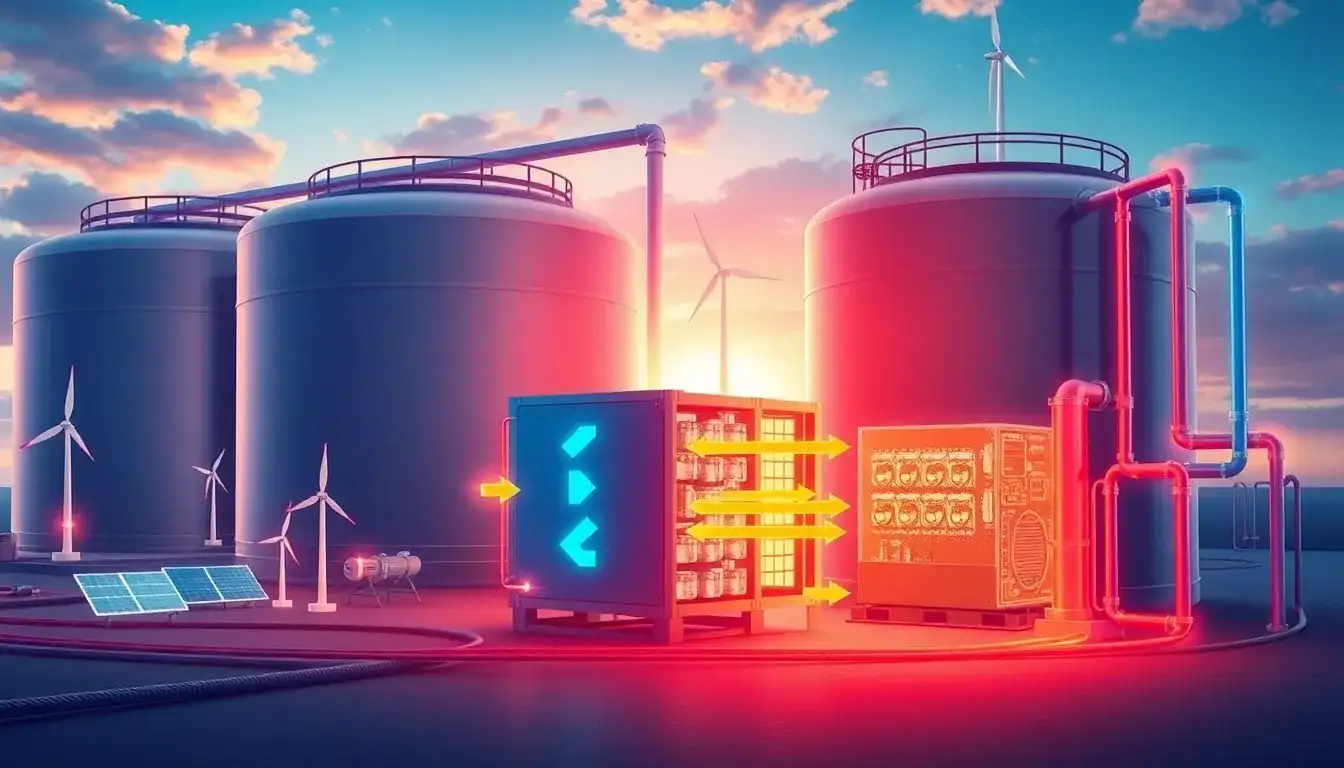
Compressed Air Energy Storage (CAES) systems improve efficiency through thermal energy storage (TES) by capturing and reusing heat generated during air compression, which would otherwise be lost in traditional diabatic systems.
Key mechanisms for efficiency improvement:
- Waste heat recovery: During compression, air heats up significantly. Adiabatic CAES stores this heat in materials like molten salt, concrete, or packed beds, then reintroduces it during expansion to avoid energy loss.
- Reduced fuel dependency: Traditional diabatic CAES discards compression heat and burns fossil fuels to reheat air during expansion, lowering efficiency to 40-54%. TES eliminates this need, achieving up to 70% round-trip efficiency in adiabatic systems.
- Thermal management: Advanced TES designs (e.g., high-temperature fluids at 600°C or insulated packed beds) minimize heat loss, enabling near-isothermal operation and reducing energy waste.
Experimental adiabatic systems demonstrate efficiencies exceeding 70%, while commercial diabatic plants like McIntosh achieve only 54% due to heat dissipation. TES thus bridges the efficiency gap between CAES and alternatives like lithium-ion batteries or pumped hydro.
Original article by NenPower, If reposted, please credit the source: https://nenpower.com/blog/how-does-thermal-energy-storage-improve-the-efficiency-of-caes-systems/

