

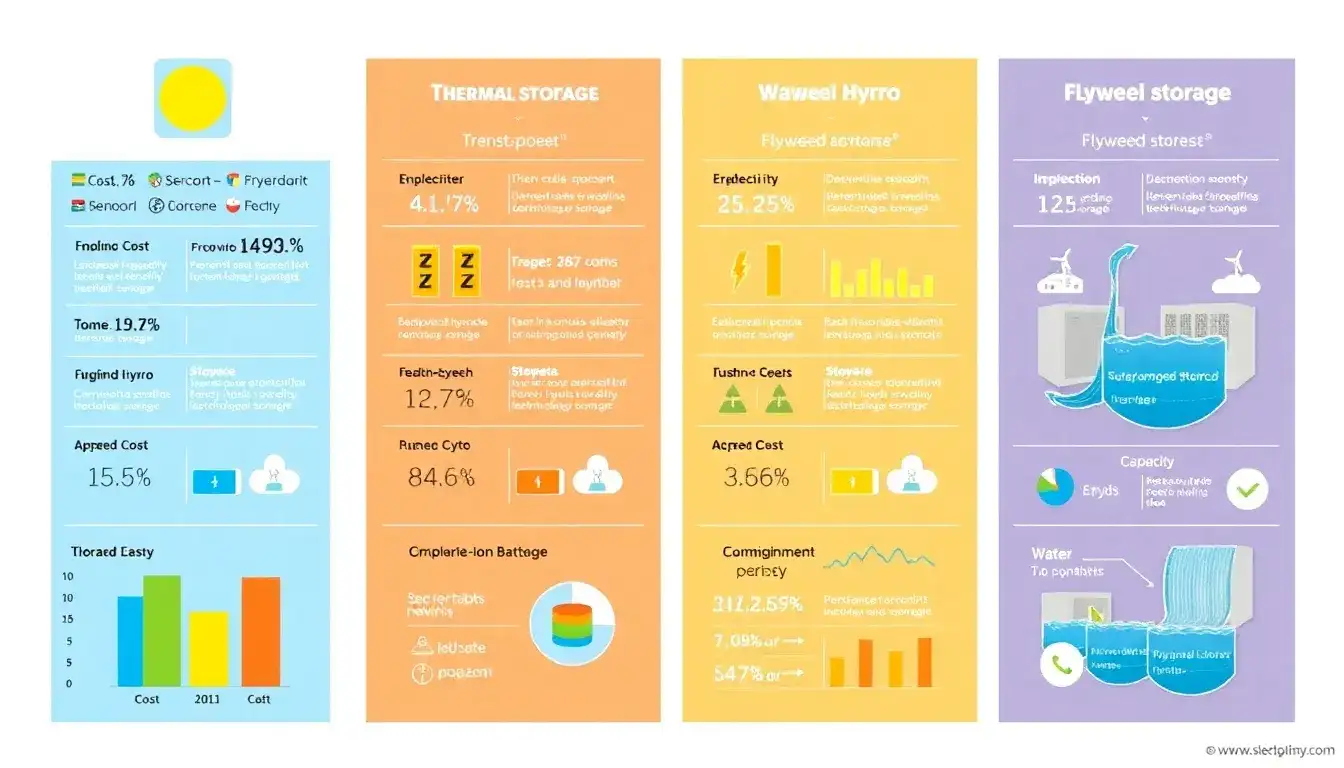
Thermal Energy Storage Comparison
Thermal energy storage (TES) systems are designed to store thermal energy, which can be used for heating purposes or converted back into electricity. When comparing TES with other forms of energy storage, it’s essential to consider both cost and efficiency.
Cost
- Thermal Energy Storage: The cost of thermal energy storage is relatively low when compared to certain battery technologies. For instance, the capacity cost for TES can range from 0.4 to 70 Euro/kWh depending on the storage medium used, such as water or molten salt. However, the cost per kWh of energy stored can vary depending on the system scale and application, with estimates suggesting around 13.5 cents/kWh for a molten salt system to achieve a 10% IRR with $350/kWh capex.
- Battery Storage: Lithium-ion batteries are more expensive, typically ranging from $308 to $419 per kWh. Other battery technologies, like vanadium redox flow batteries, have even higher costs.
- Mechanical Storage: Compressed air storage and pumped hydro storage offer different cost structures, typically higher than thermal but lower or competitive with some battery options.
Efficiency
- Thermal Energy Storage: TES systems generally have lower round-trip efficiency compared to electrical storage systems like batteries. However, innovations like the ThermalBattery™ from ENERGYNEST offer high efficiency above 98%, making them reliable for long-duration energy supply. The general efficiency of TES can be influenced by the type of thermal storage medium used and how well the system is insulated.
- Battery Storage: Lithium-ion batteries typically have a round-trip efficiency of around 90-95%.
- Mechanical Storage: Mechanical systems like pumped hydro and compressed air storage also have varying efficiencies, often around 70-90% for pumped hydro.
Key Points
- Scalability: Thermal energy storage can be highly scalable and flexible in terms of site selection compared to pumped hydro or compressed air storage.
- Materials and Environmental Impact: TES systems often use more environmentally friendly and recyclable materials than lithium-ion batteries, which can have environmental challenges due to mining and recycling issues.
Overall, thermal energy storage offers advantages in terms of cost and environmental friendliness, especially for applications requiring long-duration storage or integration with renewable energy systems. However, its efficiency and energy density may not match some battery technologies.
| Storage Type | Cost Range (per kWh) | Efficiency | Scalability and Flexibility |
|---|---|---|---|
| Thermal Storage | 0.4-70 Euro/kWh | Varies | High flexibility, scalable |
| Lithium-ion Battery | $308-419 | 90-95% | Limited space, high energy density |
| Pumped Hydro Storage | $106-200 | 70-90% | Geographically limited |
Original article by NenPower, If reposted, please credit the source: https://nenpower.com/blog/how-does-thermal-energy-storage-compare-to-other-forms-of-energy-storage-in-terms-of-cost-and-efficiency/

