

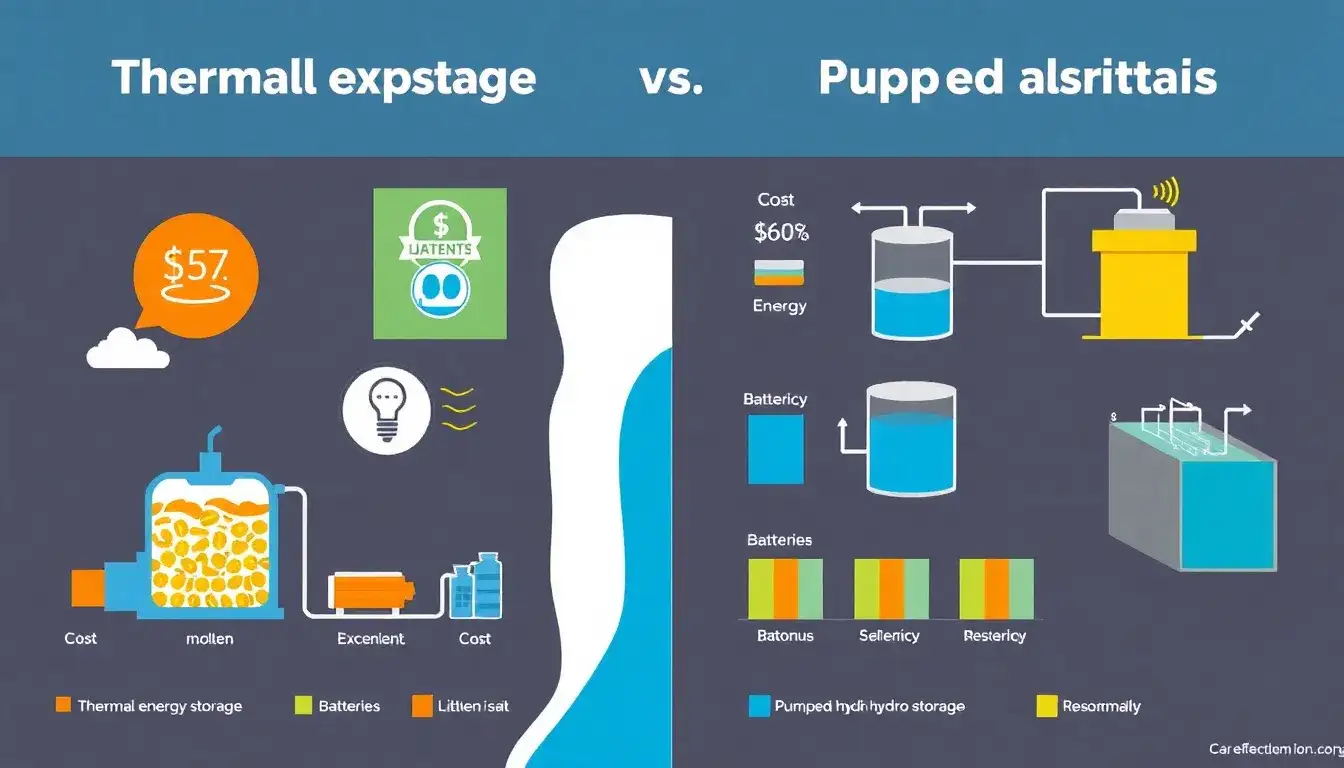
Thermal energy storage (TES) compares favorably to other energy storage technologies in terms of cost and efficiency, particularly for long-duration storage applications and industrial uses. Below is a detailed comparison based on recent data and analyses:
Cost Comparison
- Thermal Energy Storage Costs:
Thermal energy storage costs range around $232/kWh installed capex globally on average, making it one of the least expensive long-duration energy storage (LDES) technologies available today[2]. For molten salt TES systems used at utility scale, capital expenditure (capex) is estimated at about $350/kWh with an estimated levelized cost of storage (LCOS) around 13.5 c/kWh-th under a 10% internal rate of return scenario, with possibilities to reduce costs to 5-10 c/kWh-th with improvements and lower capital costs[1].
Thermal storage using materials like water, stone/rock, or molten salt can have capacity costs between 0.4 to 70 Euro/kWh depending on the medium, with water-based storage being the cheapest and molten salt somewhat higher but still competitive, especially for large-scale applications[5]. - Lithium-ion Batteries:
Lithium-ion batteries have higher capex costs, about $304/kWh for four-hour duration systems globally, which is higher than TES for longer durations[2]. Cost predictions for 2025 estimate lithium-ion battery capacity costs between $308-$419/kWh, significantly higher than many thermal storage options[5]. Lithium-ion batteries also require extensive safety and monitoring systems that increase overall operating costs[3]. -
Other Technologies:
Other LDES technologies such as compressed air storage and flow batteries have capex costs around or slightly above TES costs, e.g., compressed air at $293/kWh and flow batteries even higher[2]. Mechanical storage like pumped hydro and compressed air generally have lower energy densities and different siting constraints but can also be cost-effective at scale[5].
Efficiency Comparison
-
Thermal Energy Storage Efficiency:
ThermalBattery™ systems demonstrate round-trip efficiencies over 98%, which is very high for thermal storage[3]. Thermal systems generally experience low thermal losses (~1-2% per day) due to good insulation[1]. They can store and release heat continuously over periods ranging from hours to days, offering reliable supply especially for industrial process heat and renewable integration[3]. -
Lithium-ion Batteries Efficiency:
Lithium-ion batteries typically have electrical round-trip efficiencies around 85-95%, slightly lower than some advanced thermal storage systems but still high[3]. Their capacity degradation and limited cycle life can reduce effective efficiency over time. -
Other Technologies:
Compressed air energy storage and pumped hydro efficiencies vary widely, typically 70-85%. Flow batteries have efficiencies closer to lithium-ion but with larger footprint and cost concerns for long durations[2][5].
Other Considerations
-
Durability and Maintenance:
TES systems like ThermalBattery™ have longer service lives, minimal performance degradation, and are nearly maintenance-free compared to lithium-ion batteries which degrade over cycles and require fire safety measures[3]. Thermal storage is also based on abundant, recyclable materials, making it more sustainable and environmentally friendly[3]. -
Applications and Scalability:
TES is especially suited for industrial heat supply, grid-scale energy balancing, and renewable integration, providing flexibility in site location due to lower footprint constraints than pumped hydro or compressed air[1][4]. Lithium-ion batteries excel at short-duration, fast-response energy storage with high power density. -
Geographical and Market Differences:
TES and other LDES technologies benefit from economies of scale in markets like China where gigawatt-hour scale projects reduce costs substantially[2]. Outside China, costs are higher but still competitive for long-duration needs where lithium-ion costs rise due to materials and scale limitations.
Summary Table
| Aspect | Thermal Energy Storage | Lithium-ion Batteries | Other LDES (Compressed Air, Flow Batteries) |
|---|---|---|---|
| Capex Cost (global average) | ~$232/kWh (installed) | ~$304/kWh (4-hour duration) | ~$293/kWh (compressed air), higher for flow |
| Levelized Cost of Storage | ~5-13.5 c/kWh-th (thermal output) | Higher, varying by market | Comparable or higher depending on tech and scale |
| Round-trip Efficiency | >98% (ThermalBattery™), low heat loss | ~85-95% | ~70-85% (compressed air), ~85-90% (flow batteries) |
| Lifetime & Maintenance | Long service life, low maintenance | Shorter lifecycle, fire risk | Varies, often longer than Li-ion |
| Environmental Impact | Uses abundant, recyclable materials | High raw material demand | Depends on technology |
| Scalability & Siting | Flexible, modular, suitable for large scale | Moderate footprint, safety concerns | Large scale suitable but depends on geography |
In conclusion, thermal energy storage offers lower costs, higher efficiency, and longer durability than lithium-ion batteries and many other long-duration energy storage options, especially for applications requiring storage of heat or long discharge durations. It is particularly advantageous for industrial heat storage and grid-scale integration of renewables where thermal output is directly usable. Lithium-ion batteries, however, remain preferred for short-duration, high-power storage needs despite higher costs and environmental concerns[1][2][3][4][5].
Original article by NenPower, If reposted, please credit the source: https://nenpower.com/blog/how-does-thermal-energy-storage-compare-to-other-energy-storage-technologies-in-terms-of-cost-and-efficiency/

