

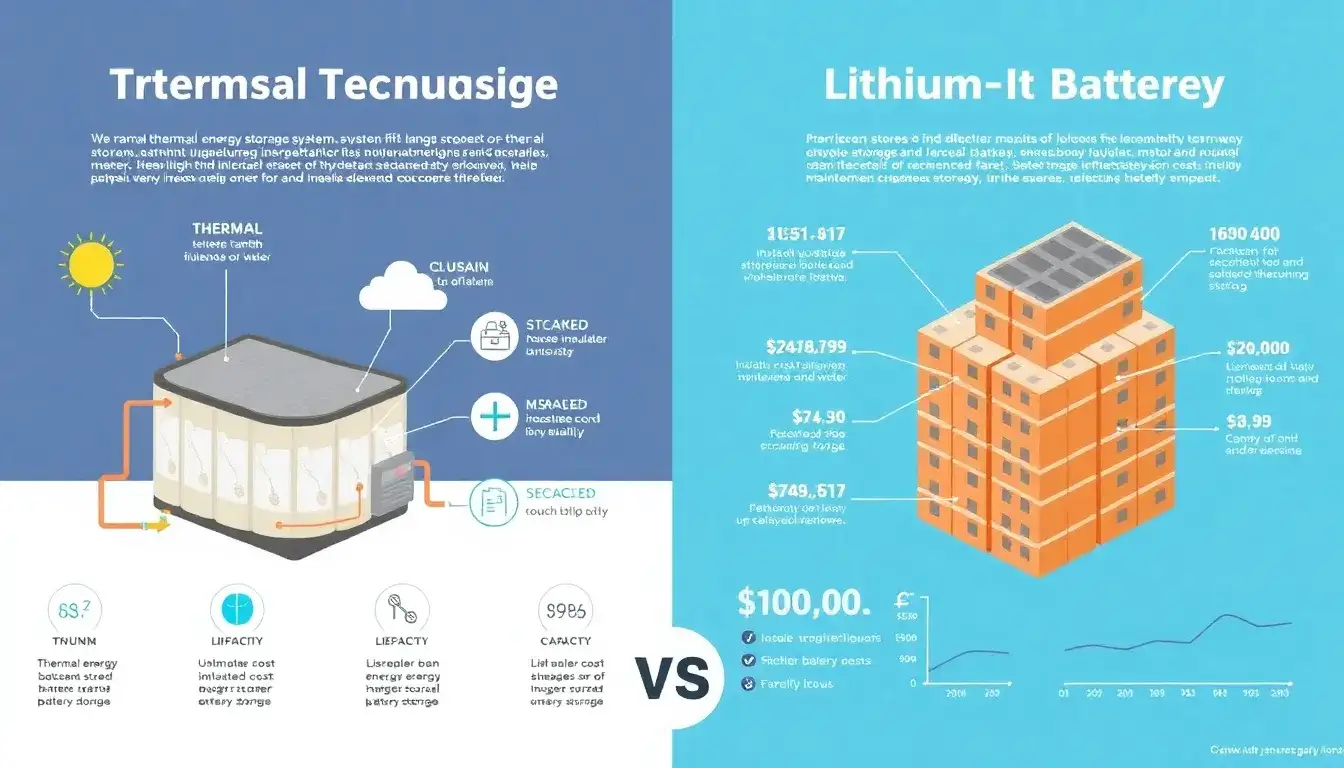
Cost Comparison
- Thermal Energy Storage Costs:
- TES costs, particularly for large-scale industrial or grid applications, are estimated around $2 per kWh of thermal energy storage capacity, based on particle-based systems using inexpensive materials such as silica sand and concrete containment.
- Levelized cost of storage (LCOS) for TES systems aiming at long-duration storage (10+ hours) can be below $0.10/kWh of electricity equivalent when integrated into power grids, which is competitive with other long-duration storage technologies.
- Some models show thermal storage costs near 13.5 cents per kWh-thermal for molten salt systems achieving a 10% internal rate of return, with potential reductions to 5-10 cents/kWh-th if capital expenditures are lowered.
- TES achieves very low operating costs due to inexpensive storage media, minimal degradation over time, and long service life.
- Lithium-Ion Battery Costs:
- Lithium-ion batteries have a much higher upfront capital cost per kWh compared to TES, often cited in the range of several hundred dollars per kWh installed capacity (varies widely but typically above $100/kWh for utility scale).
- Batteries provide high energy density and fast response but are typically economically suited for shorter duration storage (hours rather than days).
- Battery costs are declining but still significantly higher than TES for very large scale or long-duration energy storage needs.
Efficiency and Use Cases
- Thermal Energy Storage Efficiency:
- Thermal storage has round-trip efficiency typically lower than lithium-ion batteries; however, it can store heat at very high temperatures (up to 1300°C) and deliver well-suited high-temperature heat for industrial processes or electricity generation.
- TES is particularly cost-effective for applications requiring long-duration storage and high-temperature heat (e.g., industrial process heat), where battery storage is less practical.
- Lithium-Ion Battery Efficiency:
- Lithium-ion batteries have high round-trip efficiency (~85-95%) making them excellent for grid balancing, short-term storage, and fast response energy demands.
- Their energy density and rapid charge-discharge capability make them ideal for electric vehicles, consumer electronics, and frequency regulation services.
Scalability and Application Fit
- TES systems, like particle thermal storage using sand, can be scaled to very large sizes economically and are flexible in siting, including retrofitting existing thermal plants or industrial facilities.
- Batteries are better suited to smaller-scale, quick-response applications or where energy density and space are major constraints.
- TES can reduce energy costs in high-temperature industrial sectors by 30% or more by shifting heat availability to periods of low electricity prices and enabling renewable integration, offering large systemic cost savings.
Summary Table
| Feature | Thermal Energy Storage | Lithium-Ion Batteries |
|---|---|---|
| Capital Cost | ~$2/kWh-thermal (large scale particle TES); 5-13.5 c/kWh-th operating cost range | Several hundred $/kWh (varies widely) |
| Round-trip Efficiency | Moderate (~70-85%), depends on system design | High (~85-95%) |
| Energy Density | Low (bulk material storage) | High (compact electrochemical storage) |
| Best Use Cases | Long-duration, high-temperature industrial heat and grid storage | Short-duration, grid balancing, EVs |
| Scalability | Highly scalable, can utilize cheap materials and existing infrastructure | Limited by cost and space |
| Cost-effectiveness for Long-duration Storage | High cost-effectiveness, especially for industrial heat and renewable grid integration | Less cost-effective for durations >4-6 hours |
Conclusion
Thermal energy storage offers a more cost-effective solution than lithium-ion batteries for long-duration energy storage and high-temperature industrial heat applications. TES benefits from low material costs, scalability, and suitability for decarbonizing industrial heat sectors and stabilizing grids at large scales. In contrast, lithium-ion batteries remain more efficient and cost-effective for shorter-duration storage and applications requiring high energy density and fast responses. The cost advantage of TES becomes particularly clear when storage durations extend beyond several hours or when high-temperature heat is needed.
Thus, while lithium-ion batteries dominate short-term electricity storage markets, thermal energy storage is emerging as the cheaper and more practical choice for long-duration, industrial, and certain grid-scale energy storage needs.
Original article by NenPower, If reposted, please credit the source: https://nenpower.com/blog/how-does-thermal-energy-storage-compare-to-lithium-ion-batteries-in-terms-of-cost-effectiveness/

