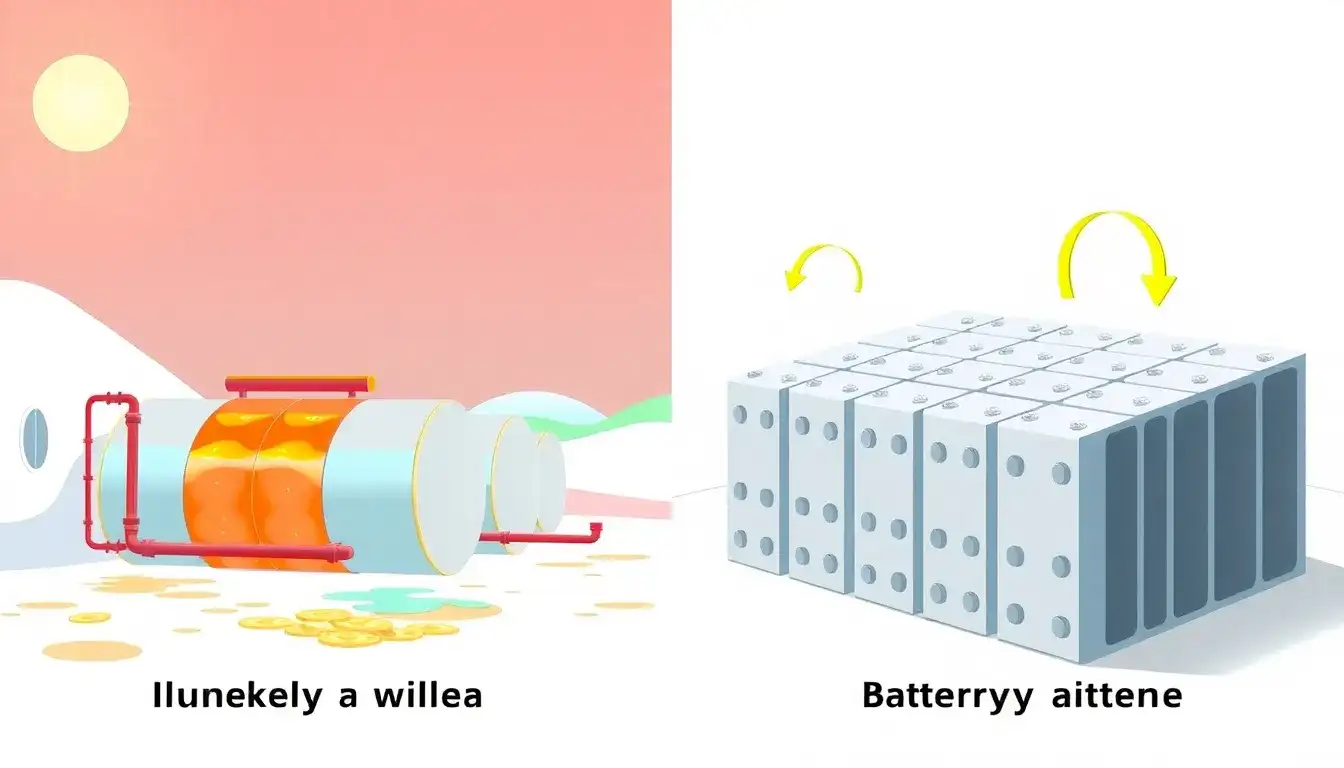
Thermal Energy Storage
Cost
- Initial Investment (CAPEX): Thermal energy storage systems are generally cheaper than lithium-ion batteries, especially for long-duration applications. For instance, thermal energy storage costs approximately $232/kWh, which is lower than lithium-ion batteries at $304/kWh for four-hour applications.
- Operating Costs (OPEX): Thermal storage systems require less complex technology and fewer resources (e.g., no lithium or cobalt), resulting in lower operating costs. They are often automatic and require less maintenance compared to lithium-ion batteries.
Efficiency
- Energy Efficiency: Thermal batteries can achieve high efficiency, often around 90% for molten salt systems and over 98% for systems like the ThermalBattery™.
- Storage and Release: Thermal batteries can store energy efficiently and hold it for extended periods, releasing it over several hours to days.
Battery Storage (Lithium-ion)
Cost
- Initial Investment (CAPEX): Lithium-ion batteries are generally more expensive than thermal energy storage, particularly for long-duration applications. However, costs are decreasing due to economies of scale, mainly driven by electric vehicle demand.
- Operating Costs (OPEX): Lithium-ion batteries require more complex technology and higher maintenance compared to thermal systems, which can increase operation costs.
Efficiency
- Energy Efficiency: Lithium-ion batteries offer high charging and discharging efficiency, often exceeding 90%. However, they are better suited for short to medium-duration storage rather than long-term energy storage.
- Storage and Release: They are ideal for applications requiring rapid charge/discharge cycles but can lose capacity over time and have a shorter lifespan compared to thermal batteries.
Comparison Summary
| Feature | Thermal Energy Storage | Battery Storage (Lithium-ion) |
|---|---|---|
| Initial Cost (CAPEX) | Cheaper for long-duration storage | More expensive, especially for long-duration applications |
| Operating Costs (OPEX) | Lower due to simplicity and less maintenance | Higher due to complexity and maintenance |
| Efficiency | High efficiency (around 90%-98%) | High efficiency but better for short-term use |
| Storage Duration | Suitable for long-duration storage | Best for short to medium-duration storage |
| Scalability | Highly scalable with modular designs | Scalable but often more complex |
In summary, thermal energy storage is advantageous for long-duration applications requiring heat storage, offering lower costs and higher efficiency for such specific needs. Meanwhile, lithium-ion batteries are highly efficient for electric power storage and mobile applications but can be more expensive and less efficient for long-term thermal energy management.
Original article by NenPower, If reposted, please credit the source: https://nenpower.com/blog/how-does-thermal-energy-storage-compare-to-battery-storage-in-terms-of-cost-and-efficiency/