

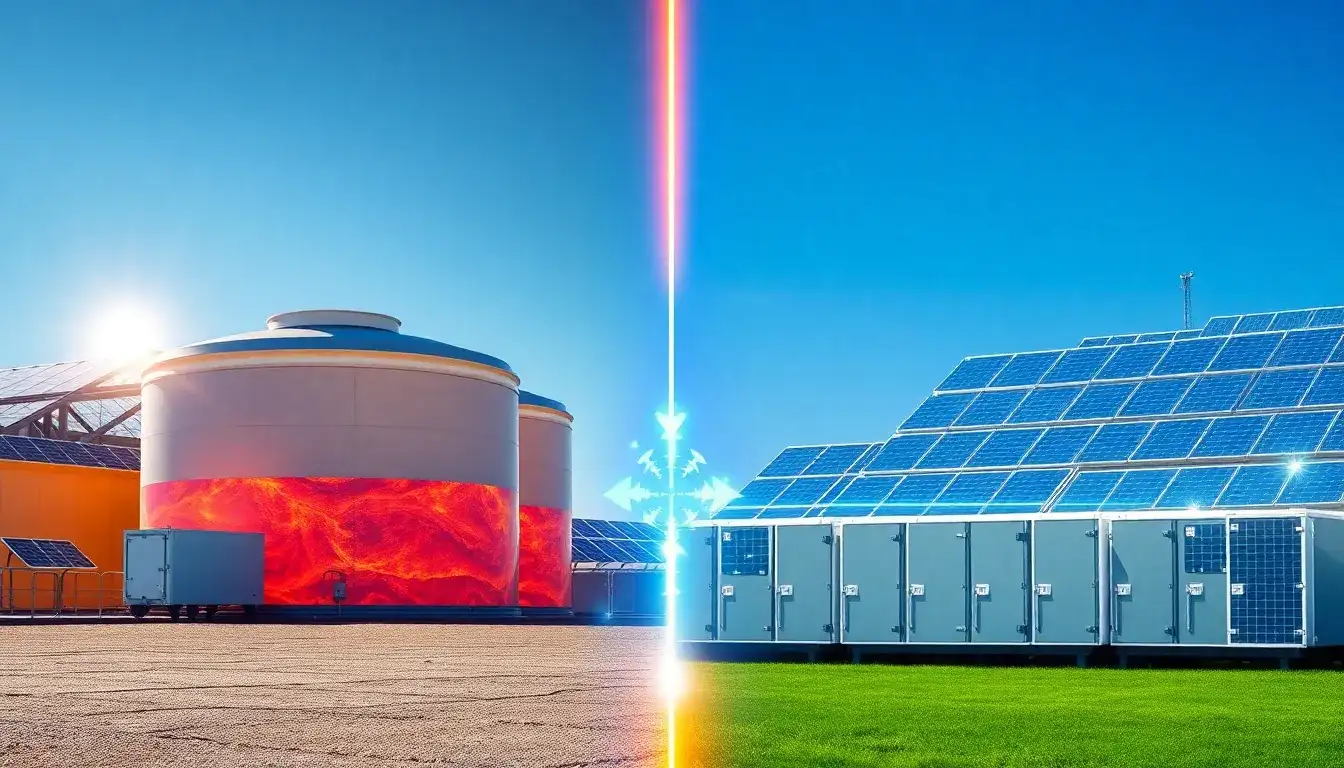
Thermal energy storage and lithium-ion battery storage serve different roles in solar energy systems, each excelling in specific applications:
Cost and Duration
Thermal storage is significantly cheaper for long-duration storage. Molten salt or concrete-based systems (e.g., ENERGYNEST’s ThermalBattery™) cost ~1/100th the price per MWh compared to lithium-ion batteries for multi-hour storage. By 2050, thermal storage is projected to provide 8-24 hour storage at $99–$100/MWh in Australia, while lithium-ion batteries remain ~40% more expensive for comparable durations.
Efficiency and Lifespan
Lithium-ion batteries achieve >90% round-trip efficiency and are ideal for short-duration applications (minutes to 4 hours). Thermal systems like the ThermalBattery™ reach >98% efficiency in heat transfer and can last decades with minimal performance degradation, unlike batteries that degrade over time.
Applications
- Batteries:
- Short-term grid stabilization (frequency regulation, cloud-induced solar fluctuations).
- Mobile/portable power (EVs, electronics).
- Thermal storage:
- Industrial process heat (24/7 steam supply for manufacturing).
- Utility-scale power generation via concentrated solar thermal (CSP) plants, delivering 10–24 hours of dispatchable electricity.
Environmental Impact
Thermal systems use low-cost, recyclable materials (e.g., concrete, molten salt), avoiding the resource-intensive mining and disposal challenges of lithium-ion batteries. CSP plants also provide synchronous grid services (inertia, voltage control) using traditional turbines, aiding coal-to-renewables transitions.
Comparison Table
| Feature | Thermal Storage | Lithium-Ion Batteries |
|---|---|---|
| Cost (long-duration) | ~$100/MWh (2050 projection) | ~$140–$150/MWh |
| Efficiency | 98% (thermal transfer) | 90–95% |
| Lifespan | Decades | 10–15 years |
| Best Use Case | Industrial heat, multi-hour grid storage | Short-term grid/EV storage |
| Scalability | Modular, space-efficient | Limited by material costs |
Thermal storage is emerging as the low-cost solution for overnight renewable energy shifts, particularly where heat demand exists (e.g., methanol production, mining). Batteries remain indispensable for rapid-response applications requiring high energy density.
Original article by NenPower, If reposted, please credit the source: https://nenpower.com/blog/how-does-thermal-energy-storage-compare-to-battery-storage-for-solar-energy/

